Fushi no Kami: Rebuilding Civilization Starts with a Village, Vol. 1

By Mizuumi Amakawa and Mai Okuma. Released in Japan as “Fushi no Kami: Henkyou kara Hajimeru Bunmei Saiseiki” by Overlap. Released in North America by J-Novel Club. Translated by Maurice Alesch.

I always enjoy it when I’m pleasantly surprised by a new license. The description of this did not seem promising – it read like “what about Ascendance of a Bookworm, only with a young boy?”. It also gets off to a bit of a slow start, though I will admit I was immediately taken in with the discussion of ancient writing types. As it goes along and picks up speed, though, this becomes excellent, with a young protagonist who has knowledge from a past life, manages to do wonderful things and save his village, and yet never feels overpowered at all. It helps that this lacks all the usual tropes of the genre – there are no dungeons, or guilds, and Ash has no magical powers or swords. Heck, even his knowledge from a former life isn’t all that helpful much of the time, as he’s not a botanist or chemist. But for this backwards village filled with exhausted farmers, he’s a breath of fresh air.
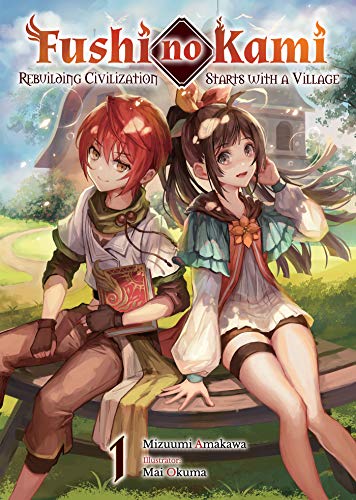
Ash has been reincarnated into this world, and retains his memories, but for the most part he’s spent the previous eight years pretending to be happy and content while being anything but. When we first meet him, he’s just had a major revelation, and bolts to the local church to beg to be able to read books – and also to be taught to read. It won’t be easy. The priest has been exiled and mostly given up. The village chief’s daughter dislikes those fake smiles of his. They’re all dirt poor. And there are mentions of demons out of the forest, though we never see one in this first volume. Fortunately, once he gets going, Ash proves absolutely impossible to stop, be it discovering aloe, learning about hunting and gathering, accidentally romancing the aforementioned chief’s daughter, and even fighting off a giant bear. But most of all: making life in the village better.

This book is not really slow enough to be a “slow life” title, but it has a bit of the same vibe. Ash may have memories of a previous life, but we never really hear all that much about it apart from a mention of nanotechnology in medical use… which is obviously not happening here. More to the point, with the exception of his romantic impulses, Ash feels like a kid more than a reincarnated adult (I’m looking at you, By the Grace of the Gods). The book is about 2/3 his POV, and the other third various people in his life, particularly Maika, who goes from the aloof chief’s daughter to being head over heels in love. (Ash sees her as a child, I think, which explains why he does not get the very obvious signs she is throwing at him.) All of the things Ash does improve life… somewhat. Things are a bit better. The highlight is the lack of deaths over the winter, a first for this remote village. It’s the sort of book that makes you smile.

It’s also not staying in the village – the ending indicates that Ash and Maika are going to the nearest city for the next volume, and I assume things will move onward and upward from there. In the meantime, this is recommended for fans of isekai who hate the usual RPG tropes that usually go with them.

Der Werwolf: The Annals of Veight, Vol. 9

By Hyougetsu and Nishi(E)da. Released in Japan by Earth Star Novels. Released in North America by J-Novel Club. Translated by Ningen.

While we’ve had a lot of fun watching Veight do a lot of really cool things while claiming to be just a humble vice-commander (and we get that here as well, to the point where he uses it as a tag line, Bruce Willis style), there has been a certain “harem manga” element to the title since it began. There were already a couple of his werewolf subordinates in love with him, we know that Eleora also fell for him, etc. That said, there’s really been no doubt since the series began that if Veight was going to finally clue in to romance, it would be Airia that is the choice. The main problem is that, due to her job and Veight having to save the nation so much, she’s gotten very little to do in the books. As a result, this book not only had to sell the romance finally starting but also remove the power imbalance between the two. In succeeds quite well, provided you don’t mind ridiculously overpowered hero and heroines. Which, hi, light novels?

As you can see by the cover, the book is not exactly concealing what it’s about this time. One of the fleeing senators from the north hid in a mine and then died with a hideously powerful magical artifact in his hands. Now Veight and the Southern Continent have to deal with a massive attack of undead skeletons. Unfortunately, the artifact is sentient, looking for its next occupant, and decides that Airia fits the bill. Can Veight figure out that she’s no longer who she seems to be in time to stop its plan? Does he actually want to stop the artifact’s plan? And will all of this finally manage to get it through his thick skull that he loves Airia and she loves him? (The last, trust me, will be the most difficult. Everyone breathes a huge sign of relief when Veight finally confesses.)

As you can guess from my synopsis, the romance here is not really a big surprise to anyone. There’s a ‘mindscape’ scene, a mutual confession, and a wedding. (We don’t see the wedding night – this series is as pure as its leads – but there is discussion on whether a werewolf can get a human pregnant.) The bigger surprise is the way that the artifact’s plot to bring a hero into this world forcibly is taken care of. Veight’s solution makes sense, but is also something only he could come up with. (Veight’s past does come up here, and he actually admits to Airia he’s a reincarnation from another world, but we still know next to nothing about it – by design, the author admits). It also allows Airia to take a much stronger role in the series… though I admit I’m doubtful that actually happens. I suspect we’ll still mostly be seeing Veight traveling.

So overall an excellent volume, with lots of awesome, lots of heartwarming, and a bit of fanservice (Airia’s large breasts feature heavily in much of the art). Fans who enjoy this series should find much to love. Now, the question is where it goes from here.

Slayers: The Sorcerers of Atlas

By Hajime Kanzaka and Rui Araizumi. Released in Japan by Fujimi Fantasia Bunko. Released in North America by J-Novel Club. Translated by Elizabeth Ellis.

These books came out in the early 1990s, but they got a recent re-release to prepare Japan for new volumes after a long break. As a result, the afterwords from the author that we see here are new. In this one, the author talks about the struggle to make Slayers into a series… as he points out, when you defeat the demon lord in book one, where do you go from there? The answer is that awkward second book, very similar to that awkward second album. Last time I pointed out the anime skipped it, but I’d forgotten that they did circle back round to its events in Slayers Next, a full season later. It’s not hard to see why they skipped it – there’s no regulars other than Lina and Gourry, there’s less humor and more horror than you’d expect from a series like Slayers, and the pacing also feels very odd, ambling along for 2/3 of the book before realizing that it actually has to come to a conclusion.

Lina and Gourry, on vacation in the city of Atlas, are doing the usual (Lina inciting bar fights by punching out creepers, Gourry snarking at her) when they’re hired by one of the local sorcerers to be his bodyguard. The head of the sorcerer’s guild has vanished, so there’s a bit of a power vacuum going on at the moment, and protection from the other side is needed. Lina is, frankly, not all that interested, but she gets more so when they’re attacked by two demons with masks. Fighting ensues… then, when Lina and Gourry go to investigate the competition, they find, buried at the bottom of an underground lake in a crystal prison, the missing head of the sorcerer’s guild. What follows is amazing to Lina and Gourry but not to the reader, who probably guessed what was going on about Page 40. The main surprise is when one of the characters involved DOESN’T die.

It has to be said, the most annoying aspect of this book is how it handles Lina. Gourry is supposed to be the big dumb muscle, though the anime exaggerates that to the poi not of parody. Lina, though, is supposed to be the one who gets what’s really going on. Unfortunately, here she’s got to be unable to make sense of the actual power struggle among the sorcerers in order for the plot to function, and you sort of slap your head a bit when she lets the cheerful obvious bad guy out of his prison and then walks away. She’s clueless. There’s also a lot more grotesque horror than I’d expect in a Slayers book here, with graphic descriptions of body mutations and diabolical experiments. And even then, the obvious payoff – the evil sorcerer is killed in a murder-suicide by his creation – doesn’t actually happen. (The anime fixed this.)

So yeah, overall a disappointment, although Lina’s narrative voice is still a lot of fun. That said, I know the series picks up again soon, and am definitely looking forward to more.