Past Life Countess, Present Life Otome Game NPC?!

By Sorahoshi and Yuki Kinami. Released in Japan as “Moto Hakushaku Reijou wa Otome Game ni Sansen Shimashita” on the Shōsetsuka ni Narō website. Released in North America by Cross Infinite World. Translated by Amber Tamosaitis.

First off, this book comes out of the gate with a killer premise. We’ve talked before about the idea of a “reverse isekai”, where a fantasy denizen dies and is reincarnated in modern Japan, but this is, I believe, the first time we’ve seen it in English. And Urara (formerly Annerosa Ortegamo) is not just in modern-day Japan… she’s in a Japan based on an otome game! She only hears about this when she meets Shizuku, a girl who, as it turns out, is the ‘poor girl reincarnated as the heroine of the otome game she loves’ that we HAVE seen before. Only Urara ends up charming the pants off of everyone, while Shizuku ends up being subjected to horrible comedy violence much of the time. What I just described is about the first fifteen pages of a 320-page book. The good thing about this book is it takes a multi-layered ‘reincarnation’ premise and makes us enjoy slowly meandering towards the ending.

The book is based straight off of a webnovel, rather than a webnovel that’s been picked up and edited by a publisher. This is the modus operandi for Cross Infinite World, and it tends to lead to books that are pleasantly long and stuffed with content, including things that would probably get cut down for length elsewhere. The benefit of this is that the character development feels less rushed and more natural, particularly with Shizuku, who starts the book as unlikeaqble as she possibly can be and slowly, over the course of the next two hundred or so pages, becomes Urara’s best friend. She doesn’t particularly change per se, but we get to know her past and her (somewhat warped) reasoning, and more to the point, she likes Urara, once she’s determined that Urara does not, in fact, have her eyes on one of the many male targets in this “otome game”, but is instead falling for… a woman?

Well, OK, no. The book gets this out of the way a fifth of the way through it, which probably was a wise move, as leaving the revelation that Chouko is a guy who dresses as a girl for family reasons for the ending would likely have angered yuri romance fans. Because wow, this reads like a yuri romance otherwise. The school they attend feels very Maria-sama Ga Miteru, though it’s co-ed, and if you can imagine a romance between Sachiko and Shimako you come closest to seeing how Chouko and Urara interact. The guys, unfortunately, do not come across as well, and I do admit that throughout most of the book I kept having to remind myself who was who, though eventually you learn to separate out Shinmyou (the jerk) and Shimozuru (the one who falls for Shizuku). There is also an epilogue set in Urara’s past life that left a very bad taste in my mouth, and I did not really like the implication at all. It added murder and mental torment to what was otherwise a nice, sweet romance novel.

But you can just stop before reading that. Most of this is the equivalent of a long, leisurely boat ride down the river that takes up the entire afternoon. It’s not all that concerned with anything but its heroine and her “perfect princess” manners causing everyone to turn her way. It’s a good read.

So I’m a Spider, So What?, Vol. 9

By Okina Baba and Tsukasa Kiryu. Released in Japan as “Kumo Desu ga, Nani ka?” by Kadokawa Books. Released in North America by Yen On. Translated by Jenny McKeon.

This is definitely a book that has most of its important content at the back, saving its biggest scene for the final chapter and epilogue. That’s not to say there isn’t a lot of other things going on here. White is learning good ways to regain more of her powers (get drunk); our ogre/oni is finally taken down and made somewhat sane again, and decides to just GO by Wrath now; our vampire has decided that she’s tired of being weaker than the rest of the group and decides to essentially bathe herself in evil to catch up, which works quite well – at least for this book; and probably most importantly, the demon lord arrives back in her domain and orders the war to recommence, despite the fact that the demons simply don’t have the manpower to win. She is not winning friends, though her extreme power means she’s certainly influencing people. Oh yes, and White goes to Japan. Of all the series to have a ‘return to Japan’ arc, this was not one I was expecting.

The entire series has sort of hammered this home, but this volume in particular wants you to realize how horrible most of the demon lord’s group is at communicating. Ariel is best of the lot, mostly as she has the Chatty Cathy part of Kumoko’s brain. The dissonance between White’s narrative voice and her actual outward expressions is well known to us, but here we see how it’s really causing problems, mostly as Sophia thinks that White is a lot more pissed off and angry than she actually is. Not that Sophia is any better, given her default mode seems to be ‘tantrum’. Really, this motley crew would get along with the cast of Overlord; they’re all basically broken evil people, and adding Wrath to the mix is unlikely to change any of that.

But yeah, the big part of the book is when White, who has realized how easy it is for her to teleport now, ends up going back to Japan. Fortunately, she arrives at the school in the middle of the night, and going home quickly finds D, who explains herself to White, who had figured out a lot of this already. I’m not sure the reader had; some of this was foreshadowed, but a lot of it was deliberately hidden from us, possibly to make the reveal that much bigger. The interesting thing here is White’s reaction to the fact that D not only manipulated her entire life, but did it for such a petty, vapid reason. White is justifiably furious… but also reacts the way a child would to their parent, feeling intense love just for the fact that D throws her a bone and says White can have “freedom”. It feels a lot like an abusive relationship, and I don’t think we’re supposed to love it, and it’s not helped by White’s hyperactive narration.

So I don’t know if this is a game changer (I doubt White will be acting any differently), but it’s certainly a startling revelation. In the meantime, we edge closer to war, meet some characters who I seem to recall getting killed off earlier in the series/later in the timeline, and are reminded once more that Potimas is the absolute worst. I’m still enjoying this, despite everyone being pretty terrible.

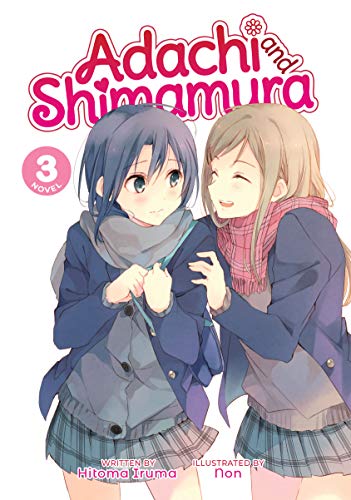
Adachi and Shimamura, Vol. 3

By Hitoma Iruma and Non. Released in Japan by Dengeki Bunko. Released in North America by Seven Seas. Translated by Molly Lee.

There was a wondrous moment about two-thirds of the way through this book which really made me sit up and take notice. No, Adachi did not actually work up the nerve to confess – heck, even Valentine’s chocolate proves to be almost too much for her to handle. No, Yashiro did not wave goodbye and go back to her own planet, though the author remains very good about keeping it up in the air as to whether she’s an alien of a chuuni. But for one, brief, shining moment, Shimamura was interesting. She met up with a friend from her old school, who seemed to want very much to rekindle their friendship, and Shimamura being who she is, “sure, OK, I guess” was the response. We see the two of them travel on the train together, go to the mall together… and it is the most painful, awkward thing you will ever see. It’s unclear what Shimamura actually gets from this consciously, but unconsciously I think the answer is clear: Adachi is not like other friends.

As noted above, we are right around Valentine’s Day. Adachi wants to exchange chocolates, which she communicates to Shimamura in the most awkward panicky way possible. Shimamura, who has come to the conclusion that Adachi is simply desperate for basic human contact due to her family situation, agrees with this. The two then have what amounts to normal pre-Valentine’s adventures, mostly separate, though they do meet up for video games at Hino’s place. Adachi thinks far too much about astrology, tries to make homemade chocolate and then backs off completely, and is essentially a complete mess. Shimamura runs into not one but TWO old friends from school, and realizes that she barely even remembers anything they did anymore. That said, she also gets the bulk of dealing with Yashiro. When the 14th finally comes, we get a clear winner, and it’s Shimamura.

It was suggested to me on Twitter that Shimamura might be suffering from depression. Certainly I’d argue she’s suffering from malaise, which influences most of her actions and makes her the passive narrator that drives me crazy. It’s a funny running gag that Adachi imagines Shimamura’s response to doing anything and it’s always the equivalent of “meh”. This pays off here in two ways. First, the scenes with Tarumi help to show off that Shimamura struggles as much as Adachi with basic human responses, in particular the idea of “what friendship is”. Tarumi wants to rekindle their relationship (and, the reader suspects, perhaps wants a bit more than that), but Shimamura just is not able to respond to that at all, and finds the whole thing uncomfortable. This is contrasted with the final scene, where Adachi coincidentally retraces the same route Shimamura took with her old friend… only now with Adachi, and she’s laughing and having a ball. She GETS the difference. It pays off with the message Shimamura paid for, which is, for her, a grand gesture. And Adachi… well, she gets a hug? Which she will remember for a long time to come.

This series, if I’m being honest, still tries my patience most of the time. But there were moments in this book when I could actually feel Shimamura attempting to make an effort, and that almost made it worth it. I suspect we won’t get Vol. 4 till the anime finishes, so enjoy this now, right before it starts.