I’m in Love with the Villainess, Vol. 1

By Inori and Hanagata. Released in Japan as “Watashi no Oshi wa Akuyaku Reijou” by GL Bunko. Released in North America by Seven Sas. Translated by Jenn Yamazaki. Adapted by Nibedita Sen.

I will admit, I knew very little about this series and was not really expecting much. It’s publisher, GL Bunko, seems to specialize in yuri light novels. This was a webnovel first, like so many others before it, and is another take on the popular “trapped in an otome game” genre, only this time instead of being cast as the villainess our protagonist gets to be the heroine. It does not really seem to concerned at first with setting up how she ends up in this world – she simply finds herself there in class, in front of her favorite character. It does not really bode well. And yet, she’s a very likeable character who’s fun to read. Then, as you go on, you realize that there really is a lot of thought being put into this, that a lot of the subtle (and not so subtle) hints pay off down the line, and by the last quarter of the book it’s become absolutely terrific.

Our heroine is Rae, who is the Maria Campbell of this series, a commoner who attends a school that, until recently, was reserved exclusively for nobles. However, now that magic has been discovered, commoners with abilities are being admitted. Rae is ALSO a former OL from Japan, overworked and unhappy, whose sole joy was playing the otome game Revolution… and analyzing it… and writing fanfiction about it. Particularly about the “villainess”, Claire. So when she finds herself now in the game’s world, as Rae, with the ability to interact with Claire every day… well, she could not be happier. She proceeds to insert herself into Claire’s life, first at school and then, as if that weren’t enough, as one of her maids. That said, the book is not simply happy go lucky shenanigans… remember the name of the otome game.

As I said, this book starts off pretty “same old, same old” to soften you up, though Rae’s general joie de vivre makes the narration run at a higher level. Claire is seemingly the standard “cartoon bully” you see in games like these, but we get to know more about her and see her more nuanced sides and grow to like her just as much (unlike Katarina Claes, Claire also has some depth in the game as well, it seems). There is also an honest discussion of sexuality, which uses the word lesbian, and also talks about the things that people tend to believe about them, which you almost never see in books like these. And then there’s the last quarter, where Rae declares that she’s not a political person and that her sole goal is to be with Claire, but politics is not something she can escape, and she does not hesitate to abuse her knowledge of the game to help save the girl she loves.

That love is still one-sided, at least by the end of this book, though Claire’s “I hate you” statements are getting weaker and weaker. More to the point, the book makes me absolutely ravenous to read the next two, despite the fact that the covers for the Japanese books are HUGE spoilers. I absolutely recommend it, even to those sick of otome game villainess stories.
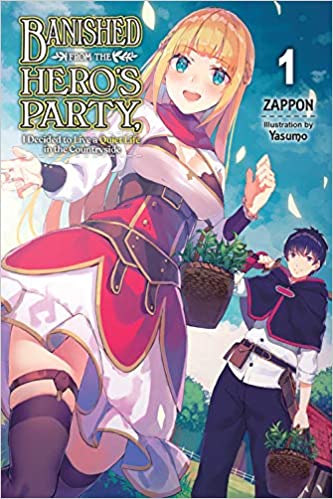
Banished from the Hero’s Party, I Decided to Live a Quiet Life in the Countryside, Vol. 1

By Zappon and Yasumo. Released in Japan as “Shin no Nakama ja Nai to Yuusha no Party wo Oidasaretanode, Henkyou de Slow Life Surukoto ni Shimashita” by Kadokawa Sneaker Bunko. Released in North America by Yen On. Translated by Dale DeLucia.

I probably should not have read this only a few weeks after Roll Over and Die, as the first thought that came to mind is that when the woman is leaving the party she’s branded, sold into slavery, and left for dead, but when it’s the guy he just moves to the country, opens a shop, and gets a girlfriend almost instantaneously. That said, the whole “you are a disgrace to the party, go!” plot is apparently also a big thing in Japanese webnovels now, though so far it’s been less “the party” and more “that one asshole guy in the party”. In any case, our hero starting up his apothecary and hooking up with his former ally is only part of the story here, as we also flash back to the party in action, get a few glimpses of life as the hero, and, perhaps most importantly, talk endlessly about the magical systems in place in this world.

This is not a “game world” per se, but the plot hinges on a common game element: Gideon, the banished guy, was born at Level 30, and is the very definition of “the strong guy who joins your party early in the game to help you level up”. Unfortunately, when the party grows strong enough, this type of character usually leaves, and Gideon doesn’t do that – mostly as the Hero is his little sister. So when one of the party with a hate on for Gideon and a crush on the hero tells him he’s useless now, Gideon quietly accepts it, leaves the party, changes his name to Red, moves to a backwater sleepy town, and opens an apothecary. Luckily he’s helped in this by Rit, an adventurer and princess whose kingdom the hero’s party saved earlier. Rit has had a not-so-secret crush on Red since that time, and essentially invites herself into his shop, his home, and his bedroom. Together the two grow closer and have a nice quiet life. But what of the hero?

I’ll start off with the negatives: Red/Gideon is not the most magnetic hero. He fits the stock “boring adventurer guy” a little too well, and it feels ridiculous that he’s just quietly listen and leave the party without, y’know, asking anyone else in the party about it. There’s also a heaping helping of explanations about “blessings”, which are essentially the powers that people have, as well as the weak points that come with them. (Gideon, for example, cannot go past the Level 30 he was born with.) It’s interesting in regards to the ongoing story, but also tends to go on a bit too much. On the bright side, Rit is genuinely likeable. We get a large number of flashbacks showing her being a giant tsundere towards Gideon and everyone else, but now that she’s grown up and accepted her feelings, she’s quite fun and cheerful, and their romance is very sweet. Most importantly, though, are the last few pages. We learned very little about the little sister hero throughout the book except that she had something of a brother complex and was relatively emotionless. Towards the end we see the emotionlessness is a result of the many, many blessings she has, and that it has not been good for her mental health. I am definitely hoping to see more of her later on.

Overall, this does a good job trying to balance the “slow life” that its audience likely bought it for with actually having a plot and future character development. I do hope it has Red become a little less of the stock light novel hero in future books, though. But I’ll be reading more.

Yona of the Dawn, Vol. 25

By Mizuho Kusanagi. Released in Japan as “Akatsuki no Yona” by Hakusensha, serialization ongoing in the magazine Hana to Yume. Released in North America by Viz Media. Translated by JN Productions, Adapted by Ysabet Reinhardt MacFarlane.

Yona of the Dawn fits into a lot of genres. First, obviously, there’s shoujo manga, and the tropes of a young woman surrounded by good-looking men. There’s trying to save the kingdom fantasy stuff, with a bit of revenge fantasy mixed in, although as we see in this volume, revenge doesn’t really play into it as much as disappointment. Lately we’ve had military fantasy, with the entire plot of the last few books being “can we stop the inevitable war?”. But the last couple of chapters of this volume also bring home another genre that this series falls under: Yona is walking around with a bunch of superheroes, each of whom are using their powers to protect her and help other people. They don’t wear capes, but it otherwise checks out, and really gets hammered home in the last few pages of this book, where Yona’s “can’t we talk this out” plea is met by a bunch of arrows… that fail to hit her. Which, good, because Yona of the Dead is not a genre I want to see.

Yona’s talk with Su-won goes about how you’d expect, though I was very pleased to see Riri step in to defend her and remind everyone around them what Yona has been doing the last few years. (I admit I’ve lost track of the timeline, how long as Yona been on the run now?) The main problem here are the religious fanatics, who, as with almost all religious fanatics in manga/anime, turn out to be power-hungry villains. Killing off Kouren’s allies one by one, their goal is war by any means necessary. Fortunately, though they’re still grievously injured, the dragon warriors are able to step in and help to drive them back, even at the cost of their remaining stamina. And, as always with this series, we see whether idealism like Yona’s or Tao’s – even Tao finds herself wavering after seeing what the priests have been doing – can hold up under pressure.

There are some wonderful scenes interspersed throughout this volume, but my favorite may be Kouren pointing out, as I did, that Yona is running around with a bunch of superheroes at her command – why isn’t she simply taking out Su-Won by brute strength? Yona responds that “they aren’t tools to satisfy my personal grudges”, which is a great moment (though it also amuses me, as I’m pretty sure by now all of them would be very happy to help Yona do exactly that). As for the encounter with Su-Won, once again it’s not quite as earth-shattering as their past would expect, but she does learn that his pragmatism and her idealism are still at loggerheads, and that reconciliation is not happening anytime soon. As I said earlier, Yona could easily slide into revenge fantasy, but Yona doesn’t hate Su-Won enough for that to work.

As for the next volume, well, Yona isn’t full of arrows, so that’s good. We’ll see if she can stop the war, though. In the meantime, this is a shoujo manga, but it’s also so many other things.