Act-Age, Vol. 1

By Tatsuya Matsuki and Shiro Usasaki. Released in Japan by Shueisha, serialization ongoing in the magazine Weekly Shonen Jump. Released in North America by Viz Media. Translated by Camellia Nieh.

In general, when you think of Weekly Shonen Jump, a certain type of series comes to mind. Lots of boys shouting at each other. Friendship/Training/Victory. Tons and tons of characters getting more and more powerful. Or you think of the goofy romantic comedies, usually involving a hapless guy and the bevy of girls who beat up/like him. But lately Jump has been going outside of its comfort areas quite a bit. And this new series (if you can call it new when it already has 112 chapters out in Japan) is certainly not the cliched Jump title. Indeed, the first thing a person might think, even after reading the first volume, is that someone put this on the wrong label and that it should be running in Betsuma instead. But no, this is pretty shonen. It’s just that instead of pirates, or volleyball, or superheroes, it’s acting that gets the Jump treatment. Best of all, the protagonist is a teenage girl, still a rarity in Jump titles.
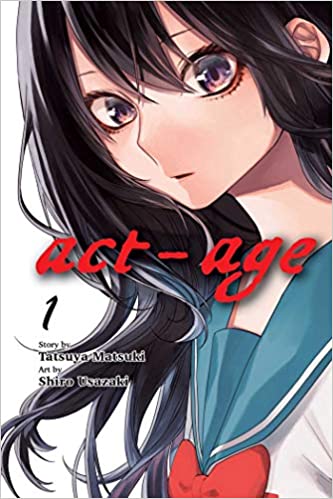
The start of this series makes it seem like it’s going to be darker and more depressing than it is. Kei Yonagi is raising her twin sister and brother by herself, trying to hold down jobs, go to school, and still have time to go to acting auditions, where so far she’s had no luck. Her emotions sometimes flow out of her when she thinks of her life, so she “resets” by recalling times when she was happy and smiling. That said, her method acting has not gone as unnoticed as she expected – the main reason she wasn’t cast is that the head of the agency refuses to let her act as it would be bad for her mental health. She’s opposed in this by a young hotshot director, who feels that Kei would be strong enough to get over the issues that method acting can bring about. More importantly, he just really wants to work with her. So begins Kei’s life lessons in how to act.

As someone who got a drama degree in college, let me be honest: I hate method acting. I would not say that it leads to mental stress the way that this manga does, but I feel that it should be used as one of many kinds of choices, not a be-all-and-end-all. Still, the manga does a pretty good job of portraying Kei’s burgeoning talent, as well as showing why she hasn’t gotten anywhere so far – she’s far too raw and has trouble with directions. What’s more, she draws the camera to her even when she’s playing an extra – which is bad. Fortunately she has director Kuroyama, who does some questionable stuff here (please do not kidnap girls off the street), but knows that Kei’s abilities can further both their careers. She’s arresting when she really tries. It’s that sort of thing that makes me want to read more.

This series struggles at times to keep its audience – Usasaki’s art in particular is highly variable throughout – But I really liked Kei’s character, and also her “character type” – stoic airheads are one of my favorite things. If you enjoy acting, or just like unusual Jump titles, this is definitely worth your time.

I Refuse to Be Your Enemy!, Vol. 2

By Kanata Satsuki and Mitsuya Fuji. Released in Japan as “Watashi wa Teki ni Narimasen!” by PASH! Books. Released in North America digitally by J-Novel Club. Translated by Tara Quinn.

In my review of the first volume I said that light novel fans would be disappointed but romance fans should be happy. This volume dials back the romance (though it’s still there), and I’d argue that it may be fans of RPGs who get the most out of the series, as it’s become a military fantasy novel, which Kiara’s choice to become a spellcaster having far more of an impact on the plot than whether she likes Reggie or Cain. (It’s Reggie, btw. Of course it’s Reggie.) The cliffhanger is resolved fairly quickly, but the overall situation is not, as the King and castle are still very much under attack. We also get a couple of good choices for ongoing villains in this book, and see quite a few people on both sides die, which impacts Kiara more than anyone would like. But most importantly, Kiara and Reggie show how incredibly similar they are to each other, and how that’s a VERY bad thing.

Last time I noted that Kiara’s life in Japan was far more vague than in most reincarnated isekai protagonists, and that’s still true, but we do see a bit more of it here, including some of her life in Japan as Chisato, when she was essentially pretty happy but also alone much of the time, having no siblings and two parents who were working much of the time. She’s determined to avoid the fate of everyone in the game, and we’re pretty sure what she’s managed to avoid turning into an evil spellcaster, at least, but saving Reggie is not as simple as stopping the soldiers from killing him that one time. This is a constant war, and Reggie is in constant danger. As is Kiara, much to Reggie’s chagrin – the woman he’s falling in love with is not one who would take kindly at all to him shutting her away to keep her safe, so he doesn’t, but boy does he hate that.

This series is a romance. And it ends with Vol. 6 in Japan. Not to spoil hideously, or anything, but the final volume has a wedding couple on the cover. That said, you might be surprised at that when you read this book, where you’re wondering if the series may actually kill Reggie off a third of the way through it, or kill off its heroine by the end of the series. It turns out that the thing that he and Kiara both share is a flagrant disregard for their own safety that verges on suicidal tendencies at times. In fact, in the dream we see Kiara have in the epilogue side-story, her reaction in the original world to being killed by Alan was essentially “oh, thank God”. In the second half of the book this turns almost comical, with both desperate to save each other at the cost of their own lives and then getting really upset when they do just that. They really are perfect for each other.

This is a smooth and easy read, with the translator change not really noticeable. If you’re here for the romance, I hope you like slow burn. If you like turn-based RPG strategy books, though, this is right up your street.

Wandering Witch: The Journey of Elaina, Vol. 2

By Jougi Shiraishi and Azure. Released in Japan as “Majo no Tabitabi” by GA Novels. Released in North America by Yen On. Translated by Nicole Wilder.

It did not escape my notice, when reading the first volume of Wandering Witch, that the best stories in it were the ones that focused on Elaina and her past rather than the ‘Elaina arrives at a strange town’ stories. Sadly, there is no more backstory here, just the wandering witch. Which should be fine. It’s why we picked up the series, after all. Look at the over! It’s the witch, smiling, drinking a cup of tea. This should be a relaxing, slow life series with a nice mix of humorous and serious stories. Unfortunately, I seem to have caught the author on a bad day. They admit as much in the afterword, where it’s noted how dark and tragic many of the stories in this book were. Indeed, one story was cut from the book for being too dark, which boggles my mind. Now, it’s possible that the next volume may try to counterbalance that. But that still leaves Wandering Witch with a problem: the people in this book are terrible.

Most of the stories here are short, with two or three longer ones that have a bit more emotional heft. Elaina goes to a country where prejudice against non-magic users runs rampant; stops a war between two villages; tracks down a runaway princess; starts a fashion trend; deals with a beast girl with a tragic past (the best story in the book, even if it was as much fun to read as a root canal); helps a man find his father’s inheritance; goes to a country where truth is magically enforced; has interaction with a bomb manufacturer; discovers her old teacher has written a book; goes to a country where laziness seems to be the norm; goes to a fake zombie town now infested by real zombies; tries to hide the truth from some happy-go-lucky hunters; and deals with a country where you had better love cats – or else.

As you can see, these sound exactly like the peaceful, slow life sort of stories you’d expect here. The trouble is the characterization. The people in these stories are bigots, shallow, greedy, slothful, and sometimes genuinely evil. Even the nicest stories deal with what might best be described as misguided fools. If Kino’s Journey has a running theme of ‘war is horrible’, Wandering Witch’s might be ‘people are awful’. Sometimes there’s karmic fate, but more often than not nothing really happens except Elaina leaves and goes to the next town. The very first story upset me in particular as Elaina sees that the non-magic using people in this town are being persecuted and literally called animals, but merely disapproves of this and leaves. She’s meant to be rather emotionally deadened, but it just ends up seeming incredibly callous. This also makes it harder with stories like the beast girl one, where Elaina is supposed to be genuinely moved and upset – it seems fake because of how we’ve seen her before. Also, her “that girl – it was me” narrative joke isn’t funny and makes her sound smug.

I’d heard that future volumes of this leaned on the yuri a bit, but I’m not sure how good it’s going to be. Saya, the girl from the first story of the first volume, shows up again and clearly has a massive crush on Elaina, but it’s unreciprocated. Moreover, one of the stories involves a romance between two women, but it ends up being treated like more of a punchline than anything else. More to the point, after this second volume, I simply don’t want to read anything more about this witch and her journeys. Which is fine. I’m sure if told that I was dropping her series, she’d simply shrug and move on to the next town filled with selfish, irritating people.