The Genius Prince’s Guide to Raising a Nation Out of Debt (Hey, How About Treason?), Vol. 3

By Toru Taba and Falmaro. Released in Japan as “Tensai Ouji no Akaji Kokka Saisei Jutsu ~Sou da, Baikoku Shiyou~” by GA Bunko. Released in North America by Yen On. Translated by Jessica Lange.

Calling your main character a “genius prince” can be a bit of a two-edged sword, as you need to have him continuing to be reasonable clever while not killing the audience’s disbelief. So far these books do a good job in holding to that balance. Sometime it leans straight up in Wein’s direction, such as when he describes having a book ghostwritten that will give bad advice to nobility and make it easier for him to eventually take them down. And sometimes it has Wein straight up flummoxed or panicking, which is just plain fun (as the illustrator of the book will tell you). And then there are the moment when you realize that Wein has a steel core that lives for one person alone, and threatening that person can cause things to get very dark very fast. All this comes together in this book, where Wein has to deal with possibly becoming one of a group of noble elites… all of whom seem to be extremely broken.
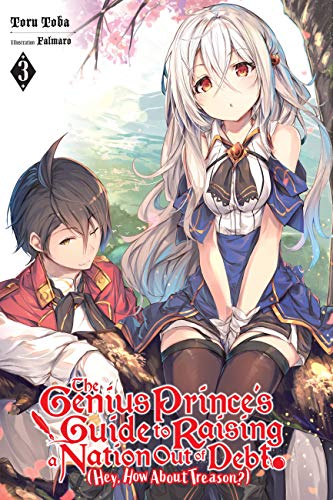
Wein and Ninym (who are on the cover again – these covers are very Strike the Blood in their choice of subjects) have just returned from touring the country in the middle of winter, but have to head right back out again when Win is invited to the country of Vavarin for a conference and also a religious festival. It smells like a trap. It is a trap, but that’s not going to stop Wein. That said, he also has to deal with the Remnant Army, the remains of Marden, which was torn apart in a previous book. After getting separated from his guard by bandits, he ends up taking in a representative from the army, Zeno, who is a) a girl dressed as a boy, and b) probably even more than that. (It’s not much of a surprise, trust me.) Zeno is filled with thoughts of revenge, but is also fascinated by Wein, who is doing his best to keep several balls in the air… and then trying to move as quickly as he can when all the balls drop.

There is one really terrific scene in this book, which I will try not to spoil much but involves a murder. These books can get a bit too intellectual for their own good at times, so it is good to remind us that Wein is a royal prince who can get away with a lot of things that other people cannot. It also reminds us that insulting Ninym is bad enough, but threatening to kill her means your life is forfeit. Speaking of Ninym, I wish she had more to do in these books – she gets some good scenes, but this is a series about Wein first and foremost. I wish there could be more balance in their relationship which is imbalanced by definition. I also enjoyed the rebellion by home by the traitorous general, which again did not surprise me in its twists and turns but was very satisfying narratively. As was the twist ending, showing how much Zeno really learned from Wein.

These are great books, especially if you like political intrigue. I’m anxious to read the next one.

Umineko: When They Cry, Vol. 21

Story by Ryukishi07; Art by Kei Natsumi. Released in Japan in three separate volumes as “Umineko no Naku Koro ni: Twilight of the Golden Witch” by Square Enix, serialized in the magazine Gangan Joker. Released in North America by Yen Press. Translated by Stephen Paul.

This is the final volume of Umineko: When They Cry, unless Yen licenses Tsubasa, which I suspect is about as likely as Hinamizawa Bus Stop. It’s a very good climax, essentially divided into two parts. the first is the “action finale”, showing off Ange and Battler doing battle with Erika and Bernkastel, with everyone getting a chance to kick some ass (even Krauss, in one of the funnier bits) and with Lambdadelta going above and beyond the call of duty, essentially sacrificing herself to save the siblings. Now, given we’re in the meta world, sacrificing yourself is not as permanent as it sounds, but it’s still quite heartfelt. From the sdtart, Lambda has been more interested in fun than Bernkastel, who just wants pain and suffering. (Of course, if the pain and suffering was fun, Lambda was all in.) We see another Higurashi flashback that reminds you of Lambda’s origins as Miyo Takano, though honestly there’s a lot of Satoko in her as well.

(It’s also my last chance to complain about Squeenix insisting on using “the first cover” every single omnibus, as it means we don’t get the awesome BeaBato final cover on the outside.)

The second half of the book is the aftermath, which faces up to the fact that most of the cast is dead, and that if Ange wants to have a future she’s going to have to “die” as well. Fortunately, if there’s one thing we’ve learned from Ryukishi07 it’s how words can be manipulated to mean multiple things. Ange erases her identity and lives on as a famous children’s author, who writes books essentially starring Maria and Sakutarou. (Well, mostly. This was based on a game, as you know, and the manga did include the game’s “bad end”, where Ange decides magic is a lie and kills everyone around her, earning praise from Erika. I appreciate the need for completeness, but it feels really out of place in the manga itself.) As a Higurashi fan, I must admit it’s very odd to see a nice, friendly Okonogi here. But then again he’s getting everything he wants. Certainly I’m sure he prefers dealing with Ange to dealing with Takano.

The other reveal is what we’d seen hints of this entire arc: Battler survived the tragedy as well. Well… sort of. One one last twist that combines the real life and the meta world, Touya (his new name) has a sort of amnesia – he recalls Battler’s life but doesn’t think of it as his own memories. This is why Ikuko’s books were so accurate. After a number of years (both are in middle age), Ange is finally invited to meet Touya and get the explanation, and Battler’s spirit is able to find peace (and separate itself from Touya). That said, the REAL ending of the book feels like the one with Battler and Beatrice, showing what really happened as they escape the mansion’s tragedy. Unfortunately, as we already know, this ends badly, as Beatrice/Sayo still can’t imagine Battler accepting her body and can’t forgive herself for coming up with a mass murder plan, even if she wasn’t the one doing the murders. It a gorgously bittersweet tragedy, that ends happily only provided you believe in magic.

So I think in the end Uminako manga readers will be very happy with this. Umineko visual novel fans may be slightly less happy, but this ended up being a story that needed to be told more tha a mystery that needed to be solved. Don’t be a goat. Enjoy Umineko.

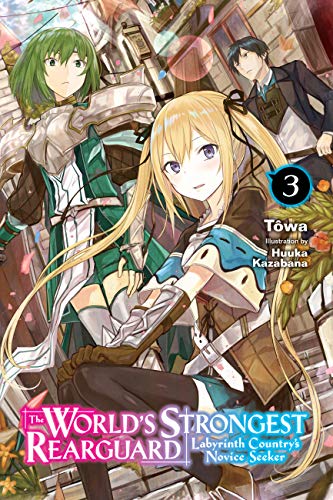
The World’s Strongest Rearguard: Labyrinth Country’s Novice Seeker, Vol. 3

By Tôwa and Huuka Kazabana. Released in Japan as “Sekai Saikyou no Kouei: Meikyuukoku no Shinjin Tansakusha” by Kadokawa Books. Released in North America by Yen On. Translated by Jordan Taylor.

Tempting as it might be to simply cut and paste my review of the second volume here, I will try to find new words to say about this series. For one thing, I think I’m going to have to come to terms with the fact that I enjoy it quite a bit, and not just because I’m hate-reading it. It’s still not a good series objectively, but subjectively it’s fine. It reminds me quite a bit of In Another World with My Smartphone, but so far has avoided all the traps that that work fell into, such as making its hero something of a relaxed sociopath. Arihito continues to attract women, and continues to be relatively oblivious to their overtures towards him. It’s a relatively huge light novel which takes place over a mere day and a half, and there’s still stats galore, including picking out new bonuses, etc. It should be dull as dirt and mildly offensive. Instead… it’s peaceful.

Arihito’s party (still unnamed, which is brought up but not dealt with here) arrive on Level 7, which has a lot more people on it but also a lot more people who have essentially stopped trying – it’s hard to go from 7 to 6. Well, hard unless you’re our heroes, who over the course of this book defeat two of the three named monsters you need to move up. They soon team up with a four-woman group called the Four Seasons (a name pun) who they saw being harassed/blackmailed by a group that are being set up to be antagonists but in this book are mostly just foreshadowing. The two parties team up and fight off giant moles and insects, then go to the next dungeon level and battle killer sheep. Once again, everyone does amazing things, and once again, everyone feels as if they need to “be the one protecting” everyone else. All this, plus a nice Chinese dinner and a bath/massage.

Reading this series is sort of like reading a game of Jenga, because it would take only one wrong move for the whole thing to come tumbling down. Arihito has to remain self-deprecating and mild-mannered because the alternative is a leering guy banging his (by the end of this book) eleven women who have fallen for him. Likewise, they’re all perfectly content to simply make the occasional overture (that he doesn’t get) and have a few bouts of self-hatred themselves. The battles are very well-written, to the point where I don’t even mind the inserted stats, which says a lot. I will admit that, in a book trying to remain so emotionally placid, sometimes it aims for a tearjerker and doesn’t quite get it – the scene with the demihuman and his late fiancee was not quite as sad as the author meant it to be. But for the most part, there aren’t really any sharp edges in this. It’s an isekai that a salaryman can happily read on the train home.

As noted, this volume does introduce a few plot points that are then left dangling – I expect the next book will take care of that. At least they didn’t move to Level 6 already. Still, this remains a book that’s easy to read.