The Beloved of Marielle Clarac

By Haruka Momo and Maro. Released in Japan as “Marielle Clarac no Saiai” by Ichijinsha Bunko Iris NEO. Released in North America by J-Novel Club. Translated by Philip Reuben.

I enjoyed the first Marielle Clarac series while noting a couple of flaws, and I’m pleased to say that this second book at least does a good job fixing one of them. (The “BL tease but no more” aspect is, I fear, not going away anytime soon.) But the mystery/thriller aspect of the book works even better than the first, keeping us guessing as to the motivations of the antagonist (who is not really a villain) and switching immediately to the thriller aspect the moment things are revealed. There’s also a good helping of elements of the first book I greatly enjoyed: Marielle and her tendency to see everything in terms of romantic ‘shipping’ tropes, who gets to simultaneously be very clever and good at reading people and also capable of the most shockingly dumb moves when trying to chase after a lead. She’s not quite an amateur detective, but it’s on the verge of that genre. And the relationship between her and her fiancee Simeon is fantastic.

It’s wintertime, so all the garden parties are inside. More importantly, the Crown Prince (Simeon’s best friend) is being forced to step up his attempts to find a bride now that Simeon and Marielle are engaged. Marielle recommends, in possibly the best scene in the book, the girl who had been bullying her in the past, because she’s clearly not concealing any hidden side and would stop doing it if her husband demanded it. The prince, however, falls for Michelle, a shy and withdrawn young woman who would rather be anywhere but at this party but who reluctantly opens up to the prince anyway. The Prince invites Simeon and Marielle to Michelle’s estate to basically be on his side, and they discover that the family seems to treat her with contempt, or at least treats her as a pawn rather than a daughter. What secrets does Michelle hold? And why is Lutin here and pretending (IS he pretending) to be an Earl?

Marielle and Simeon may have admitted their love to each other in the last book, but that doesn’t mean that they’re not still filled with doubts and misgivings. Marielle has a tendency to describe herself as plain and dull so often that it would come across as self-loathing if she weren’t so confident – it’s practicality turned inward and twisted, and I’m glad Simeon tries to get her to see that she can in fact be attractive. Marielle also has a tendency to get herself into trouble, and while I doubt that’s going away she does at least understand how much it’s panicki8ng him when she does this. The last third of the book has a number of excellent chase scenes, and shows that the author is just as good at action as they are at mystery and romance. As for Michelle’s secret, it’s relatively obvious (Marielle guesses it), but also not quite as obvious (Marielle is stunned), and is handled slightly better than I expected.

It’s suggested that the wedding might be in the next book, though given the subtitle for the third volume is The Temptation of Marielle Clarac that may not happen. But I’m definitely going to be reading more in any case. These are a fun addition to the J-Novel Heart line, and will interest any romance readers, even those not interested in Japanese light novels.
Bleach: Can’t Fear Your Own World, Vol. 1

By Ryohgo Narita and Tite Kubo. Released in Japan by Shueisha. Released in North America by Viz Media. Translated by Jan Cash.

There have been several Bleach novels released in Japan, but I believe this is the first one to be licensed for the West. Previous books either tended to be novelizations, tie-ins to games, or… well, no, I don’t know why they didn’t pick up We Do (Knot) Always Love You, except shipping reasons. This trilogy, though, is explicitly a direct sequel to the main manga, exploring aftermaths that Kubo couldn’t get to because they cancelled Bleach a bit earlier than expected. Moreover, it’s written by a known name to English-speaking readers: Ryohgo Narita, the creator of Baccano! and Durarara!!. Narita’s series are also known for their huge, hard to wrangle casts and slow-burn plots that end in explosions. Moreover, unlike Kubo, Narita actually knows how to pace. So it makes sense that this is the first novel we see of Bleach over here, and fortunately it’s a good choice, wrapping up several things while introducing a new villain to the piece. And boy howdy, Narita also knows how to write villains. This guy is smug scum who makes you long for Aizen.

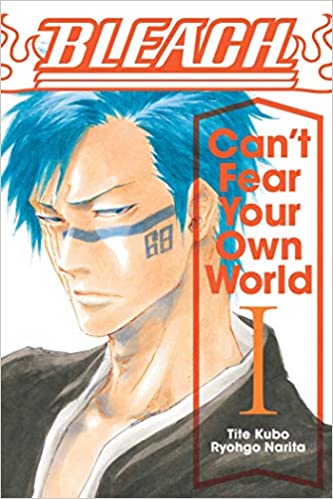
Aizen is in this book briefly, and he gets to be smug as well. That said, as the cover might suggest, the star of the book is Hisagi, who is in his capacity as roving reporter for the Soul Society’s newspaper. The newspaper, as you might imagine, was not being published during the last, oh, 30 volumes of Bleach, but it’s starting up again, and he’s trying to interview the participants in the Thousand Year War, figuring that it’s best to get opinions now while it’s fresh than years from now. Unfortunately, a new story inserts its way into the narrative: there’s a new head of one of the Four Great Noble Clans. He’s paying to have the newspaper talk all about him. Oh yes, he’s also a known murderer. Of his wife. Who was Tosen’s best friend. This is not a spoiler, he pretty much admits it. And he has a plan to install a new King in Soul Society. Fortunately, this plan MOSTLY does not involve Ichigo.

The “main” cast of Bleach are pretty much absent from this book, and you get the feeling that will be the case for the other two books as well. Narita seems to have two goals in this book. The first is to wrap up Bleach proper, as we see a lot of the aftermath of Hueco Mundo (including several people I was sure were dead who are, in fact, not dead) and the Sternritter (including several people I was sure were dead who are, in fact, not dead). If you dislike the fact that Jump tends not to kill off characters, this volume may annoy you. The other goal of this book seems to be saying “screw the class system”, and I’m behind that. We’ve seen before that Soul Society has a lot of skeletons in its closet, but here we really get a sense of what it means to be privileged. The villain is absolutely over the top, not in a laughing crazy way but in a smug snake way, and he reminded me not a little bit of another villain Narita has written in his series. I assume he and Hisagi will eventually confront each other.

In the end, I’d say this book succeeds in that it made me interested in Bleach again. I’ll definitely be getting the second in the series. And there’s no romance at all in it, so even shippers can buy it without fear. Maybe Kubo should hire out a writer and just plot his next work. Then again, that did not work very well for Naruto’s creator…

Kuma Kuma Kuma Bear, Vol. 2

By Kumanano and 029. Released in Japan by PASH! Books. Released in North America by Seven Seas. Translated by Jan Cash & Vincent Castaneda. Adapted by Will Holcomb.

There’s a lot less focus on bear in this second volume of Kuma Kuma Kuma Bear, mostly because Yuna herself has gotten used to it – at one point she casually names something with a bear motif, showing that unconsciously she’s accepted that’s what she is now. Instead the focus is on Yuna and her general attitude towards everything. Yuna is, in both her own internal narration and dialogue, a grumpy girl with minimal emotional range, and we see lots of that here. That said, the point of the books is to show that Yuna, underneath that, is a caring girl with a heart of gold. Here she helps a nearby orphanage, employs Fina’s mother so that she doesn’t have to return to adventuring, helps save a village from a giant snake, and protects a newbie group of adventurers from a giant wolf. All in a day’s work for our overpowered heroine, who has a few moments here where she has to break a sweat and not simply overpower everything in her path… but only a few.

As with the first book, if the idea of OP heroes irritates you in any way, steer clear. Here not only does Yuna do awesome power moves to defeat strong monsters, including having an army of tiny bears made of fire march down the gullet of an enemy, she’s also learning cure and heal, so that she can be an all-purpose team all on her own, and also save Fina’s mom from her tragic ending. Other than that, though, Yuna doesn’t really have very many motivations in this book. The ending of the book indicates she’s going to the capital city of this world, and that might be a good idea, because she’s a bit unmotivated. We see her looking at several quests and rejecting them all as she doesn’t feel like doing them. It’s hard when you’re stuck in a rut only a few weeks after you arrive in your “trapped in a game world” world.

One interesting thing (in both good and bad ways) that was done here is the local lord of the Town, who Yuna meets in this volume. He’s a nice guy with an adorable daughter, but Yuna, having read far too many light novels in her old life in Japan, immediately thinks he’s going to be cruel and arrogant, with a snide, privileged son. This turns out not to be true… however, the lord *is* negligent, as we see when Yuna discovers kids begging on the street and a run-down orphanage losing its funding. Yuna is understandably furious, even as she fixes the problem all on her own (because of course she does). That said, it turns out the reason for all this is an evil aide and his evil family. The aide is REALLY evil – as in “kidnapping young girls, raping and killing them” evil. It’s tonally awful in a book that is supposed to be “cute girl in bear suit is awesome”, and I didn’t enjoy it, mostly as the lord, who was negligent in not noticing this, is very quickly forgiven. (The first book also had that mindboggling “so I paid my parents off till they abandoned me” moment, and it was just as jarring.)

Putting that aside, though, the book delivers what its readers want, though I wish Yuna’s stoic emotionlessness didn’t sometimes carry over to the actual prose. It will be interesting to see what a larger city does for our favorite bear.