In Another World with My Smartphone, Vol. 19

By Patora Fuyuhara and Eiji Usatsuka. Released in Japan as “Isekai wa Smartphone to Tomo ni” by HJ Novels. Released in North America by J-Novel Club. Translated by Andrew Hodgson.

It’s never a good sign when people keep asking why you’re still reading that series as you tweet about it, but that’s what’s been happening for me with this Smartphone, which seems to have worn out its welcome for everyone but the most hardcore of fans. It’s not a bad question, why do I read it? Especially given the beginning of the book, a reprehensible pile of crap that involves getting a unicorn horn, slutshaming the entire female cast while ALSO having them insist they’re all virgins, and finally ending with a “ha ha, he was gangraped by men and now he’s gay” joke. I recommend just skipping the whole chapter. After this, thankfully, it does improve, and indeed it feels like the author may have been told to wrap this up soon, as we’re resolving one of the remaining storylines, as everyone in the world, including Touya and his fiancees, battle the wicked god and the wicked Phrase that has allied with it.

The fiancees are getting a bit impatient, wanting to actually get married, but Touya has decided not to do that till the whole “evil from another world coming and killing people and destroying their souls” thing is dealt with. The first half of the book involves preparations for this, including the aforementioned horrible scene. They slowly purify the world with the help of a “puretree” (no worries, fans, this tree is a virgin too) and, unexpectedly, help from Luna Trieste, the Himiko Toga of Smartphone, who thankfully gets locked away for the rest of the book. The second half of the book is the battle against the Mutant Phrases, evil normal Phrases, the evil NEET god, and Yula, the Phrase who set this ball rolling in the first place. Even more unfortunately, Touya gets sealed off in a pocket dimension away from the battle. Can our heroes win without their OP husband-to-be?

Credit where credit is due, the plan that Touya has to counteract this sort of attack is very clever indeed, and I was impressed. It also helps that he tells Yula about the plan with a line that is so cheesy you cannot help but laugh out loud. I like this series when it’s being big dumb. That said, surrounding it is a lot of the same old same old. There are mecha battles, there are guns being fired, there are near misses… and, in the end, Touya does actually save the day. I mean, it’s his series. Aside from the battles, which do take up a good 2/3 of the book, we get Touya becoming more comfortable with being a god (which is why his initial attacks didn’t work well – he was too attached to humanity) and getting more comfortable with actual love and affection (he’s snuggling his fiancees without even turning red!).

So in the end, this is another volume of In Another World with My Smartphone. It has crappy and offensive rape jokes, but on the bright side, Touya doesn’t commit genocide here. If you’re reading it, keep going, you know what you’re getting. If you haven’t read the series but you’re thinking of reading it, Christ, no.
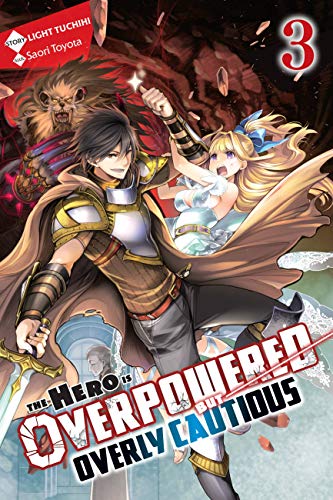
The Hero Is Overpowered But Overly Cautious, Vol. 3

By Light Tuchihi and Saori Toyota. Released in Japan as “Kono Yuusha Ga Ore TUEEE Kuse Ni Shinchou Sugiru” by Kadokawa Books. Released in North America by Yen On. Translated by Matt Rutsohn.

Though they share few similarities except for being comedies, I was reminded quite a bit of My Next Life As a Villainess while reading this 3rd volume of a series that was clearly designed to be two volumes long. Bakarina struggled for several volumes to try to find a way forward, and this volume of Cautious Hero does the same. That said, Cautious Hero has a lot more to walk back; at the end of the second volume Rista has been told who she is, and who Seiya is, and their destiny. Even better, when Seiya is called forth as a hero once more at the start of this book, he remembers what happened, and seems to actually return Rista’s feelings! Sure, they have to save the world, but he’s powerful, she’s a goddess, they’re in love, it’s great, right? Wrong. No one is reading the series for that. And so, sure enough, by the middle of the book, love has been trodden on and Seiya is using Rista as a comedic punching bag again. Know what your audience wants.

Those who read the first two books, or saw the anime (popular enough to get the two leads a cameo in Isekai Quartet’s second season) will be surprised at the cover art, showing a grinning, not-at-all-cautious Seiya charging forward. It’s the start of a long line of bad things happening to Rista. An enemy hits Seiya with an amnesia stat, meaning he’s back to his old reckless personality… and his love for Rista has gone down. Then, after more plot stuff happens, he loses the amnesia and is back to being Seiya… but thinks of Rista as an annoying weed. Yes, we’re back to baseline there. Honestly, it’s probably for the best, as this world is, as promised, much worse than the previous one. Humanity is not only enslaved but eaten, and the beastmen rule supreme. Seiya has to rescue the slaves in the old town they used to be fron, then he has to infiltrate the palace guard and take on the lion-headed big bad, Grandleon.

Does the book succeed at walking everything back? Partly, I’d say. Some of Seiya’s treatment of Rista, while horrible, does cross the line into funny, particularly his use of her as a periscope. The reader is, I think, meant to infer that his feelings for her are not rock bottom but that he’s faking that stat… but if so, he’s really good at it – even the old Queen at the end takes back her “he loves you deep down” speech after he’s appalling once more. Where the book does succeed, as always, is with Rista, who does not remember her life as Tiana, but that doesn’t stop it emotionally affecting her, particularly when she finds Tiana’s mother held prisoner and being tortured. Rista’s frustration and resolve waver constantly throughout the book, but at the end, her honest exhortation to Seiya actually gets through to him and makes him do the right thing. It was nice to see.

Of course the world’s not saved yet, and even stronger bad guys are on the way. Fans of this series had better be prepared for more of what the anime did best – comedy slapstick violence. That said, there’s enough character development in Rista to make this a series still well worth reading.

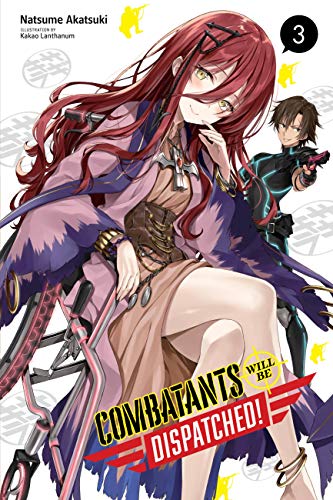
Combatants Will Be Dispatched!, Vol. 3

By Natsume Akimoto and Kakao Lanthanum. Released in Japan as “Sentouin, Hakenshimasu!” by Kadokawa Sneaker Bunko. Released in North America by Yen On. Translated by Noboru Akimoto.

It can be hard reviewing these books because, much as I’m still finding them funny, there’s not as much to say about them that I haven’t said in my previous two reviews. The characters were reused and combined into the characters we love from KonoSuba – Snow is the most obvious, but in this book it really becomes apparent that if Wiz was a lot more pathetic she’d be Grimm from this series. The author is making a slight effort to try to give the characters depth – mostly with Grimm here, but a bit with Six as well. But it can be hard when you also have to fulfill a certain quota of over the top humor. Combatants is slave to its joke plot and characters, in a way that the author hasn’t quite figured out how to escape. They will in KonoSuba, but this isn’t that. So we’re left with the jokes. Which are excellent… provided you have sympathy for no one and don’t mind things getting quite crass.

Our heroes… sorry, our villains are busy trying to build an enemy base from which they can fulfill their plans to take over this world. Sadly, the bases keep blowing up. Not only that, the very world itself seems out to get them, as they’re attacked by monsters, sandstorms, and can’t even burn down the forest without it coming back to take revenge. In amongst this chaos, the kingdom is having its annual Undead Festival, where the souls of those departed are… put into stuffed animals via Grimm, and wander around helping loved ones to move on. Trust me when I say this is played for laughs, not heartstrings. Unfortunately, some of the undead don’t seem to be peacefully mingling. And a former enemy, killed by Six, may be taking advantage of the Festival to stage a comeback. Can our heroes be horrible enough to win this time? Oh, no sweat.

Grimm is the heroine of this volume, though as with Alice before her, that doesn’t mean she gets all the focus. She does get an attempt at actual depth, though, as we see how dedicated she is to her archbishop job, and she truly does want to help the undead to move on (sadly, this usually also involves sending HERSELF to the next life as well). Six even notes if she were the nice helpful archbishop rather than the desperate man-hungry woman, she’d have a husband by now. As for Six, well, he’s terrible as always, but he manages to be topped by another agent here, Ten, whose own tendencies towards gross and petty evil are far worse than what Six has been doing, and lead to the biggest “oh my God” moment in the book, involving doing something in the Princess’ room. Snow is also entertaining, though as the series goes on she’s shifted from “mostly Darkness with a bit of Aqua” to “Mostly Aqua with a bit of Darkness”. And Rose deciding “Screw it, I’m gonna be a pet dog for this book” is fantastic.

So again, this book is not recommended to anyone who wants warm fuzzies. But if you like your humor along the Beavis and Butthead end of the spectrum, Six and friends are here to entertain you.