Me, a Genius? I Was Reborn into Another World and I Think They’ve Got the Wrong Idea!, Vol. 3

By Nyun and Sakana. Released in Japan as “Isekai ni Tensei Shitandakedo Ore, Tensai tte Kanchigai Saretenai?” by Overlap, Inc. Released in North America digitally by J-Novel Club. Translated by Shaun Cook.

Of all the places for Me, a Genius? to go in its third volume, I was not expecting it to go here. Note that I’m not talking about it suddenly becoming a tense techno-thriller a la Tom Clancy – given the fact that we spent much of the second volume in a cod-fantasy world, I barely raised an eyebrow to see that we’re suddenly back in Kouki’s home world and taking on Russians and international terrorist organizations. No, the main thing I wasn’t expecting was that Me, a Genius has gotten rid of the humor. You might argue that it’s trying to be funny and the jokes just aren’t landing, but I’m not sure that’s quite it. We do see one or two “lol!” situations in the book that aren’t funny (Baldy is a lolicon! Hilarity ensues!), but for the most part this seriously looks like it still has its bonkers premise, but is trying to deal with it realistically. Which is… weird.

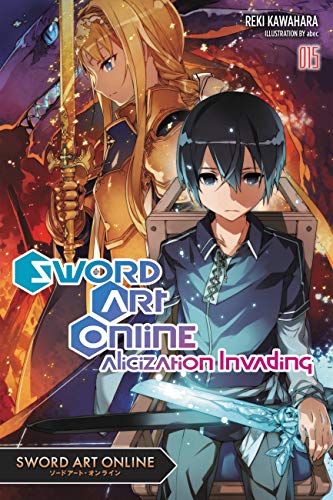
Yes, that’s Alice on the cover again, despite appearing in the book even less than she does in the 2nd volume. This is especially frustrating given how much of the reason for all this is supposed to be The Alice Project and her illegal genetic creation. But given that’s just an excuse to have cool action and espionage sequences, I shouldn’t really be surprised. Honestly, everyone in this series aside from Kouki and his mother are superfluous to requirements. We do get a very interesting development, though, in that the head of the terrorist organization (who is basically an evil version of Kouki’s mother) has been researching reincarnation, and Kouki is forced to admit that yes, he was reincarnated with his memories. This being Me, a Genius, everyone misunderstands the nature of the reincarnation and things he’s trapped in a Higurashi loop, but I was still surprised, and it gave a brief shade of depth to people (which went away about a page later).

The book should be filled with taut action sequences, this being a pastiche of a techno-thriller, but they’re actually pretty absent – we just see people talking around them or the immediate aftermath. The book also ends with a lot unfinished, which is a shame as there’s no sign of a fourth book coming anytime soon – apparently the writer has hit a block, and so this is all we’re going to get. And to be fair, there may be only so far that you can take this premise. Trying to do a serious version of Me, a Genius? was intriguing for one volume, but let’s face it, if I’m going to be reading a serious light novel about someone reincarnated into another world who’s caught in a worldwide power game and has people constantly misunderstand what they’re thinking, I’m going to be reading The Saga of Tanya the Evil, not this. This is an interesting third volume, but it wasn’t all that funny, and I’m starting to ask how many tricks this pony has.

Hakumei & Mikochi: Tiny Little Life in the Woods, Vol. 1

By Takuto Kashiki. Released in Japan by Enterbrain, serialization ongoing in the magazine Harta. Released in North America by Yen Press Translated by Taylor Engel.

This was really cute and fun. I mean, I knew going in that it was going to be – that’s the premise. It’s one of those slice-of-life series starring two girls, only in this case the life is fantasy life and they’re four inches tall. But all of the things I was expecting the series to do were done well, and I enjoyed all the characters. The premise is that Hakumei (the extroverted redhead) and Mikochi (the introverted black-haired one) live together in a tree in the middle of the forest, and we follow then as they do things like go shopping, do their jobs, hang out at a bar, and hitch rides on giant birds who also happen to be old forgotten childhood pets. This isn’t aa laugh riot, and not much of anything happens. And despite the fact that the two of them live together, there’s no real yuri subtext either. It just puts a smile on your face.

I think one of the big reasons I liked this so much is that it feels like a slice-of-life with grownups, as opposed to impulsive teenage girls. Hakumei and Mikochi are like Ritsu and Mio when they both grow up, sort of. Hakumei is impulsive and loud, but not obnoxiously so, and she’s likeable and endearing. Mikochi can be fretting and stressing as well, but it too never gets to the point where it’s too much. Despite being tiny creatures, they’re both functional adults. Hakumei works for a weasel as a repair person, and we see she takes her job quite seriously, which is not somethng you’d expect given her stereotype. Mikochi makes preserves and household stuff, and she ends up having more issues with the local tsundere songstress than with Hakumei. The cast is minimal – besides said tsundere songstress and Hakumei’s boss, the only other fellow we meet is a mad scientist sort who means well, but comes off as… well, a mad scientist.

You’re never quite sure if you’re going to be getting fantasy or regular old slice-of-life. Scenes like Hakumei and Mokochi on the sunset kite (which is the first chapter, and has some gorgeous art to show off) or dealing with the lake’s skeletal denizens are definitely fantasy, but other plotlines like Mikochi losing their wallet while out shopping or hanging out at a pub playing games in a blizzard barely need fantasy context at all. And throughout the entire volume there’s a warm feeling of peace while reading it. It’s like a nice hot soup. We do meet our two heroines when they’re already in their house, and I’d like to see how they met, but that’s why this series is six-plus volumes. There are lots of places you can go from here. I’m definitely content to follow the author, as long as I keep seeing these two tiny women going about their tiny lives with aplomb.

Didn’t I Say to Make My Abilities Average in the Next Life?!, Vol. 3

By FUNA and Itsuki Akata. Released in Japan as “Watashi, Nouryoku wa Heikinchi de tte Itta yo ne!” by Earth Star Entertainment. Released in North America by Seven Seas. Translated by Diana Taylor. Adapted by Maggie Cooper.

I don’t think I’ve read a series that’s as consistently funny as Make My Abilities Average. The author simply knows how to write humor and write it well (she also apparently makes a lot of tortured puns and wordplay jokes, which the translators make a valiant effort at adapting). The book starts off relatively sedately, but the entire battle with the Wyvern in the final third is comedy cold from beginning to end. You would think that “Mile suggests something incredibly off the wall” would get old fast, but she’s simply a walking font of ridiculous, and it helps greatly that she has three types of tsukkomis traveling with her. There is the occasional moment of seriousness, mostly involving the background for Pauline’s family, but for the most part Make My Abilities Average knows what the audience wants: laughs.

Mavis and Pauline share the third cover, which is appropriate as their backstories come back to haunt them at the same time. Pauline’s is more serious, involving the murder of her father and loss of her family business. Mavis’ family is still intact, but she is the only daughter of a Count, and as such they would rather she not be training to be the best knight she can be and get back to being a marriage prospect. And so the Crimson Vow heads off (unofficially this time) to deal with the problems and ensure that they can carry on as before. There’s some lampshading of obvious tropes here, which is where the humor is really mined. Mile shows up as Mavis’ teacher, Evening Gown Mask (yes, really) in order to take on the Count in swordfighting. Her disguise is… an eye mask. That’s it. Despite this, and without the use of magic, Mavis’ entire family fails to recognize that it’s Mile.

Then there’s the Wyvern fight, which ends up being a series of toppers. I had assumed that the high point would be the scene that is illustrated (quite well, I might add), but no, it gets better. And then gets better again. The absolute highlight may be the mastermind explaining his plans to (and for) Mile, which involves plans so deeply silly that Mile is forced to play the tsukkomi herself. I’m trying not to spoil because it was simply that funny to me. This isn’t a perfect book – as with a lot of light novels that need to pad out the word count, one of the short stories falls amazingly short, as we see Adele (yes, it’s a flashback to school #1) going on a date with a classmate, where the humor involves a) said classmate being a “nice guy” with extra quote marks, and b) the class rep being a wacky comedy lesbian. I hate wacky comedy lesbians. On the bright side, this does suggest that the series is determined not to have romance invade its fun. which is fine by me.

Last time I mentioned that the lack of a “main plot” was also a flaw, and you can say the same thing about this book – it still feels more like a short story collection that happens to be sequential. That said, the author seems to realize this, and is implying she will add more plot in the next book. In the meantime, if you want a laugh, or want to see a great all-girl fighting team, I highly recommend this series.