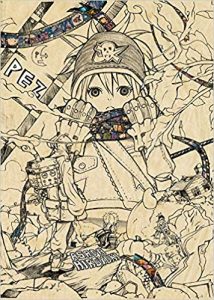
The Asterisk War: Festival Symphony

By Yuu Miyazaki and okiura. Released in Japan by Media Factory. Released in North America by Yen On. Translated by Haydn Trowell.

The author admits in the afterword that this was supposed to end with the start of the next school battle, but that things got out of hand. As such, we have another volume that is theoretically marking time and having fun before the next round of fights. In reality, of course, what we get here is more insight into the six other schools, with attention paid to almost all of them. We finally find out what Claudia’s wish is, and why the entire world seems to want to stop her. And Ayato gets another girl falling in love with him, and like the others, she’s intensely likeable. The drawbacks of the series remain the same – every plot twist is quite predictable, and the characters sometimes seem to be types rather than real people. But as a book that puts the “light” in light novel, it’s fun.

The majority of the book, as the title might suggest, is taken up with the Culture Festival that all six schools are giving. Ayato has agreed to take Sylvia on a date around the schools, something which the other girls in his orbit are all very well aware of. I liked the differing approaches to dealing with their jealousy – Julis hides from the entire festival and works on training, Saya does a bunch of events where she can just destroy everything, etc. Ayato, meanwhile, being terminally clueless about romance, has no idea why any of this is going on, which can sometimes be a problem, as he and Sylvia put on disguises but he keeps breaking their cover. The date itself also serves as an excuse to talk a bit more about the different schools and the types of students they attract, and we also meet some new recurring cast members, both comedic (the idol group that’s trying to top Sylvia) and serious (Jie Long’s new powerhouses, though Hufeng’s “long suffering” attitude is sometimes funny).

We’re gearing up for the next tournament, the Gryps, which depends on teamwork. As such, Claudia discusses her weapon and what the drawbacks to it are, and also shares why she wants to win: she wants to talk to a supposed criminal that’s been imprisoned. Ayato and Sylvia, meanwhile, may not be at the same school, but their desires also hinge on the book’s later plotline, with Ayato being offered a way to wake his sister up that involves a “deal with the devil” sort of bargain, and Sylvia finding out that her old teacher is not who she once was. Sylvia seems to have a large amount of “I don’t want to burden others with my own problems” to her, which I’m sure will get her in danger sooner rather than later.

The Asterisk War is never going to be among the best light novels out there, but it’s always readable and fun, and I’d argue it’s perhaps the most “typical” example of the genre.

Otorimonogatari: Decoy Tale

By NISIOISIN and VOFAN. Released in Japan by Kodansha. Released in North America by Vertical, Inc. Translated by Ko Ransom.

This was one I was always going to be very interested in. Long-time readers of this blog will know that “Sean loves to defend hated characters” is a thing I do, especially when the characters are young women and the haters are mostly men. And while I’d argue that the most recent Monogatari anime has meant that Nadeko Sengoku isn’t hated anymore, I think there’s still a lot of ambivalence about how to react to her in the fandom. Now, having read the book that features her, I can see why that’s the case; Nisioisin is trying to lead you that way himself. There are a LOT of elements in this book designed to set the reader up to viciously turn on Nadeko. Rumor has it that the story idea came to Nisioisin after Kana Hanazawa, the voice actress who played her in the first Bakemonogatari series, said she’d like to play a Nadeko who’s turned evil. And that’s what we get here, even though I can’t help but see it as a stressed introvert at the end of her rope finally snapping.

Even Nadeko’s narrative voice is leading the reader to think “OMG, FAKE CUTE!”. She thinks of herself in third person, and speaks that way as well, which is common for children in Japan, as well as “girls who are trying to be cute”. She also has a tendency to quote and misspell certain words, which I’m not sure about – is it something to do with katakana? I’d like translation notes on that, but again, I think it’s meant to be seen as an affectation. Most notably, though, when she uses the personal pronoun ‘I’ it’s in lower case, showing off the fact that Nadeko debases herself to a large degree. That said, for all the narrative tricks, Nadeko is basically going through the ever-popular “middle school syndrome” to a large degree, and most of her personality problems that aren’t “is a terminally shy girl” are based around that. It’s telling that she gets called out big time by Tsukihi, who one can argue is the extroverted version of Nadeko, but also owns that and doesn’t try to deny it.

There are a lot of great set pieces in this book. Tsukihi’s teardown of Nadeko, which is not so much about Nadeko’s fake cuteness – Tsukihi even praises that – so much as Nadeko’s desire to not try to move forward or have a goal. (There’s some light subtext here, not helped by Nadeko wondering if she actually fell in love with Tsukihi rather than Araragi.) And then there’s Nadeko finally losing it when her asshole teacher asks if she’s managed to fix their classes’ problem, as she starts screaming, swearing, and kicking in doors in one epic tantrum that is, frankly, awesome. Unfortunately, things go south after that. For all that the “villain” of this piece points out that he’s imaginary and this is all Nadeko’s delusion, we can finally start to see a sort of arc villain: Ogi Oshino seems to actively be pushing against Araragi, and it’s concerning, especially as this book ends unresolved – Nadeko is now a Missing Person, and the god that took her place is holed up at the shrine fantasizing about blockbuster action-filled finales that, I hate to break it to her, are not going to take place.

Next time, after Hanamonogatari leapt forward nine months, and Otorimonogatari about 2-3, we finally go back to August to resolve a few plot points there. In the meantime, enjoy Nadeko Medusa, but try not to think of evil scorned Nadeko as her “real” personality any more than cutesy Nadeko was. If we see a “real” Nadeko in this story, I think it comes from a repeated line of dialogue: “It’s just… tiring.”

Silver Spoon, Vol. 4

By Hiromu Arakawa. Released in Japan as “Gin no Saji” by Shogakukan, serialization ongoing in the magazine Weekly Shonen Sunday. Released in North America by Yen Press. Translated by Amanda Haley.

Through the beginning of Silver Spoon, we’ve seen Hachiken interact with the other agricultural college students, and gradually learn wheat they do and how tough a job it is. He has a reputation, as is stated in this book, for being “stupidly honest”, but doesn’t quite have the life skills that are needed yet to wear that well – he just comes across as stressed most of the time. Still, he is slowly making an impact, and we see that the graduating third years know that he can use those skills if given the chance when they choose him to be vice-president. What’s more, his own ideas are starting to influence the others – we get the resolution of the “pig meat” arc here, and it shows off the way that he forces others to think of new ways to try things and new options to explore, as well as proving Hachiken is never going to become stoic about the slaughter of animals.

Of course, while Hachiken is the main character, there are others to think of. And not everyone wears their heart on their sleeve the way he does. We already know that Mikage is coping with needed to take over her family’s farm even when she’d rather be working with horses, and now it looks as if Komaba is having issues as well. Since they’re both farm kids who grew up together, it’s natural they’d confide in each other. Since they’re both very good at pretending everything is fine in front of other people, it’s natural they’re both unwilling to confide in Hachiken. Still, they both need social skills development, as the blunt “it’s nothing to do with you” they give him over and over pretty much eats into his heart. Unlike Hachiken, who is still a bit lovestruck, I don’t think that this means Mikage and Komaba are dating, I think it just means they’re not good at showing weakness. Which is why, in the end, Mikage ISN’T picked to vice-president of the club.

There are a lot of things going on in this series, and it seems planned out in advance quite well. The chapters do a good job alternating between character drama that advances the plot, learning about farming and agriculture, and goofy fun comedy. The goofy comedy this time around involves all the guys escaping so they can go to “Area 51” to see the amazing spectacle that only comes there at night. Yes, that’s right, it’s… not UFOs. It is, of course, something that would excite everyone except Hachiken (and Tamako, for an extra added punchline). At this point, Silver Spoon seems like a series brimming with its author’s self-confidence. Next time around it looks as if we’re getting the Ag School equivalent of a Culture Festival. Let’s hope Hachiken remembers to have fun. (Who am I kidding, he’ll be a wreck.) Every volume of this is a joy.