My Solo Exchange Diary, Vol. 1

By Nagata Kabi. Released in Japan as “Hitori Koukan Nikki” by Shogakukan, serialized in Big Comic Special. Released in North America by Seven Seas. Translated by Jocelyne Allen. Adapted by Lianne Sentar.

When we last left Nagata Kabi, she had been telling us about the experiences of her depression and the exploration of her sexuality, and how she ended up using the (sometimes very painful and raw) experiences to create a manga volume. Well, the manga was a hit. Possibly a bigger hit than the author was expecting. Now she’s being asked to do an ongoing series with a larger publisher, and being influenced by her followers on Twitter, and trying to move out of her family home. Oh yes, and still dealing with the depression and sexuality, neither of which has been made any easier by her sudden success. If My Lesbian Experience with Loneliness ended on a hopeful note, this second volume shows us that there are no easy, magical outs, and that sometimes you know exactly what needs to be done and yet can’t quite do it.

This volume focuses more on interpersonal relationships. Nagata, like most people, craves contact with others, but that’s easier said than done, and even when she gets what she wants she’s not sure how to act or react, and her emotions aren’t the ones she should be having. This extends to her family as well. She’s able to understand her mother better and realize that she is also going through many of the same things, but that does not necessarily extend towards being able to help her – Nagata wants to help herself first. Which means moving out, though she finds that’s not something to be done at the spur of the moment. And at the end of the book, she even manages to go out on a date with another girl, but this too is hampered by her depression and self-esteem, as she realizes she’s only focusing on herself and not the other person.

Again, I’ve never dealt with serious depression, but nevertheless a lot of Nagata’s monologues and advice to herself struck a chord with me. Her chapter on self-esteem and how to measure yourself against others was particularly good, and the tension and anxiety that went with “how do I tell my parents about my manga?” leapt off the page. (We do also, by the way, revisit the escort agency that Nagata went to the first time, and it’s possibly the most helpful thing to happen to her in the book – even though it’s just hugging, the physical affection alone lets her take a conceptual leap forward in terms of what she wants.) There’s a reason that Nagata’s stories got so popular, which is that she is very good at being able to take her life, her worries and anxieties, and get it down onto the page in a way that a reader will identify with it and root for her. And you want to root for her, want to see her do better, even as you read on and see everything that is pulling against that.

Essentially, if you read My Lesbian Experience with Loneliness and got something out of it, you’ll definitely want to pick this up, and I’ll be getting the next volume to see how Nagata is doing.

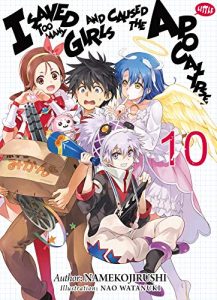
I Saved Too Many Girls and Caused the Apocalypse, Vol. 8

By Namekojirushi and Nao Watanuki. Released in Japan as “Ore ga Heroine o Tasukesugite Sekai ga Little Mokushiroku!?” by Hobby Japan. Released in North America digitally by J-Novel Club. Translated by Mana Z.

We conclude Little Apocalypse’s first two-parter here, and though things end as one might have expected, the purpose of the journey has changed. Little Apocalypse has always waffled back and forth between whether it’s a parody or not, and it’s true that the next volume may make me eat my words, but for the moment it’s taking itself seriously. What we see here is what we’ve seen in previous books. Rekka uses various powers that he has available to him via the girls around him to solve his problem. (It’s much like Rokujouma in that regard.) But there’s little joking around here, the villains are seen to inflict horrible consequences, and the solution, as R notes, may actually make things worse. In fact, that’s how you know things are super serious – R is actually dispensing advice and trying to help, at least as much as she’s allowed to.

Speaking of R, we get to hear more about her actual mission than we have since the first volume. It’s clear that she’s not allowed to help Rekka figure out which girl he likes, or even clue him in that the girls like him. She’s only allowed to help him in his missions to save the girls’ stories. As we’ve seen, this can be very frustrating to her, as Rekka is deeply clueless about the feelings that the others have for him. That may change soon, though I somehow doubt it – he seems to think that Harissa’s gambit at the end of the book here might be accidental, whereas I’m pretty sure she, and R, knows exactly what she’s doing. Unlike Rokujouma, where you can pretty much tell near the halfway point of the series that they’re headed for some sort of polygamous ending, and everyone’s mostly confessed, here you’re continually reminded that the girls really are in constant rivalry with each other, and something else is probably needed to make sure we don’t end with an even bigger apocalypse.

All right, let’s talk about the time travel. I mentioned in my review of the seventh volume that even though I suspected that Sophia was somehow going to be saved, that didn’t make the matter of Lyun’s grief and rage any less important to Rekka. We get to see that even more with the massacre of the psychic gang, which hammers home once more how difficult the “job” that Rekka has is, and how easy it can be to get an unhappy ending. Fortunately, this is not Grimgar or something similar, and I was happy to take the time-travel out, even if it did involve Rekka disturbingly having to leap off a building to trigger it. But even with the time travel there’s still a lot of tension here – I’d mentioned that there was little humor in this book, and it’s true. Little Apocalypse has gotten serious, and thankfully in a good way.

Now, I’m not sure this will last. We’re exactly halfway though the series now, and I think the next volume may be far more comedic to make up for the serious bits here. But as long as it keeps up the small but noticeable character development we see here, and moves us closer to Rekka getting a clue and making a decision, then Little Apocalypse is still worth your time.

Captain Harlock: The Classic Collection, Vol. 1

By Leiji Matsumoto. Released in Japan as “Uchuu Kaizoku Captain Harlock” by Akita Shoten, serialized in the magazine Play Comic. Released in North America by Seven Seas. Translated by Zack Davisson.

I had reviewed the first volume of the modern-day remake of this series, Dimensonal Voyage, and I worried that reading the original afterwards might be a bit of a letdown if they covered the same ground. No need to worry there. The more recent series seems to be far more concerned about the planet Earth and what’s happening back there, whereas the original Captain Harlock can’t wait to head out into the depths of space. Which makes sense, because as with the other classic Matsumoto series we’ve seen, Queen Emeraldas, the author is less interested in creating a manga story than in creating a manga mood. Harlock is a Wagnerian opera, complete with the repetitive, sonorous narration that makes the whole series sound like a collection of leitmotifs. As such, there is a general theme of “war against the eerily beautiful and yet eeeeeeevil women’, but for the most part you are here for the spectacle. And what good spectacle it is.

To an extent, the story of Harlock is actually the story of Tadashi Daiba, a young boy whose scientist father is gratuitously killed off to jumpstart the plot. Earth is currently under the rule of a useless, narcissistic leader (so nothing at all like our current timeline), and Tadashi is longing to get revenge on the beautiful women “who burn like paper” that killed his father. Enter Harlock, who arrives with his crew and backstory already in place – albeit the backstory is teased out to us bit by bit, and the only time we see Emeraldas she’s an evil doppelganger. Instead we have Harlock’s eccentric crew, which are composed entirely of Matsumoto’s two basic types: short, squat men and gorgeous long-haired blondes. With Tadashi now on the crew, they head out into space to try to find out the secret of the Mazon, and see if they can discover a reason for their war against the Earth… or if it’s just pre-destined after all.

As with a lot of manga from this time period, readers should be prepared for a lot of silly comedy interspersed with Harlock’s stoic nobility. His first mate Yattaran is the primary source of this, caring about putting together models of battleships and nothing else, to the point where the running gag starts to get tiresome, but thankfully not past that point. There’s also an alcoholic doctor, which might seem a bit familiar to fans of Space Battleship Yamato. As for his two female crew members, sadly they’re just as serious-minded as Harlock, though at least Yuki gets in the occasional snarky line. As for Mimay, it’s rare to meet a character who screams “I am going to die tragically somewhere in the next volume” more than she does, and every single line she says just underlines that point.

The plot is slight, and the art is very 1970s. That said, this is the sort of manga that’s not meant to be read so much as sipped. If you keep that in mind, Harlock turns into an excellent purchase, showing off a creator at the height of his powers.