JoJo’s Bizarre Adventure: Stardust Crusaders, Vol. 2

By Hirohiko Araki. Released in Japan as “Jojo no Kimyou na Bouken” by Shueisha, serialized in the magazine Weekly Shonen Jump. Released in North America by Viz. Translated by Evan Galloway, original translation and adaptation by Alexis Kirsch and Fred Burke.

I had worried with the last volume if I wasn’t going to like Jotaro as much as his predecessors, and indeed that still seems to be the case, though I’ve somewhat come to terms with it. Things are still “we must do as many cool things as possible”, but there’s a notable element of humanity missing from this new series, instead relying on set piece after set piece and slowly moving the story around the globe, presumably ending up confronting Dio, though he barely shows up here. I also noticed the first major “we have to change this or the band will sue us” adaptation fix, as Soul Survivor (a Santana reference, so clearly the translators did an excellent job there) replacing the Japanese Devo. (Couldn’t they just say Deevo or Divo or something? They did with Kars, after all.)

It’s always worrying when I’m discussing translation choices in the first paragraph of a review. JoJo’s is one of those series I decided to write full reviews for every volume, but that was much easier in the days of Jonathan’s histrionics and Joseph’s amusing banter. The trouble with Stardust Crusaders is that while it’s not exactly bad, there’s nothing to really grasp and think deeply about. It’s all surface. Now, to be fair, Araki does surface very well. There are some striking fights here, and some of the gory deaths are both horrifying and somewhat amusing, in the best JoJo’s tradition. But even when a major plot point does appear, such as Kakyoin supposedly still being under the influence of Dio, it ends up being a bit too confusing for its own good, as it turns out that the Kakyoin that’s betraying them is actually a spy. (Also, is he named Rubber Soul or Yellow Temperance? Was the name adapted out as well?)

We also pick up a bratty little kid along the way, which I don’t really have too much of an objection to – bratty kids hanging out with heroes is very much a shonen manga trope. I was rather annoyed when she randomly decided to take a shower in the face of ever-present danger, which seems to have been solely to have her be named when faced with such danger. She looks to be about 11 years old, so this was especially annoying. We don’t need that kind of fanservice. I’m not sure how long into the series she’ll last – she doesn’t even have a name to date – but she certainly seems to have taken a shine to Jotaro. As for everyone else, they pose, they shout, and I can’t even remember most of their names.

After spending its first two volumes influencing the majority of modern Jump manga, Stardust Crusaders seems to be coasting, confident that it’s popular enough not to worry about getting cancelled, and relying on violence, set pieces, and attempting to look cool. I miss the earlier style.

Konosuba: God’s Blessing on This Wonderful World!: Oh My Useless Goddess!

By Natsume Akatsuki and Kurone Mishima. Released in Japan as “Kono Subarashii Sekai ni Shukufuku o!: Aa, Damegami-sama” by Kadokawa Sneaker Bunko. Released in North America by Yen On. Translated by Kevin Steinbach.

In the current light novel boom that North America has been experiencing, there have been many novels that fall under the broad category of ‘funny’. They either take a relatively serious plot and give it a funny touch (The Devil Is a Part-timer!), expand on a completely ludicrous situation (Psycome), or are an outright parody (I Saved Too Many Girls And Caused the Apocalypse). KonoSuba’s first volume is most like the latter of these options, but I have to say as I was reading it that I can’t think of a single series, even Little Apocalypse, that was as dedicated to wringing as many laughs out of everything as KonoSuba is. Never mind plot complications or depth of characterization. This series is damned funny, and that’s why you should read it.

The archetype being parodied will be most familiar to readers of the manga Mushoku Tensei. A young man who is something of a loser dies performing one noble act, and is given an option to reincarnate in a fantasy world so he can be a hero. Except here, Kazuma’s death turns out to be so pathetic that even the doctors who tried to save him and his own parents laughed when they heard about it, and the young goddess who wants to send him to a fantasy world seems to be doing it so that she can fill her quota more than anything else. She’s so annoying, in fact, that Kazuma, rather than wishing for a fantastic sword or unbeatable magic powers to go along with him into this world, wishes for… the goddess herself. Fans of Oh My Goddess will be especially amused, showing that the subtitle of the first volume isn’t just for show. Kazuma and Aqua could not be more different than Keiichi and Belldandy, though, and when they both arrive in Generic Fantasy world X, he finds this goddess to be a lot less help than he’d hoped.

Everything that follows amps up the comedy, as it should be. Kazuma, because he didn’t pick an insane superweapon but a useless goddess, as average stats and minimal weapons to defeat a giant demon king. He has luck… but that merely seems to allow him to use thief abilities to steal girl’s panties. (Yeah, sorry about that, it’s still written for guys.) We meet Megumin, a teenage overdramatic girl who likes explosions and not much else. We meet Darkness, a knight with elite defensive powers who can’t hit the side of a barn door with her sword, and who seems to get off on just about anything. Together, these four take on giant frogs (which I won’t spoil), supposedly evil lichs (another great scene), and in the end a demon general who is a dullahan (were these always in anime even before Celty, or is their resurgence all Ryohgo Narita’s fault?). And what’s more, they win!

It’s tricky to review this, because I don’t want to give away the best gags. I will note that, while I’m sure this will change, I was pleasantly surprised at the utter lack of romance in this first book. Kazuma and Aqua act like bratty siblings, Megumin is too young for him, and while Darkness is basically what he finds attractive, her masochism creeps him out. That plus his tendency to yell at everyone and everything makes this party dynamic more family than harem, and I appreciated that. But when all is said and done, you read this book because it will make you laugh. Even if you aren’t familiar with the tropes of isekai and reincarnation novels, you’ll still like this.

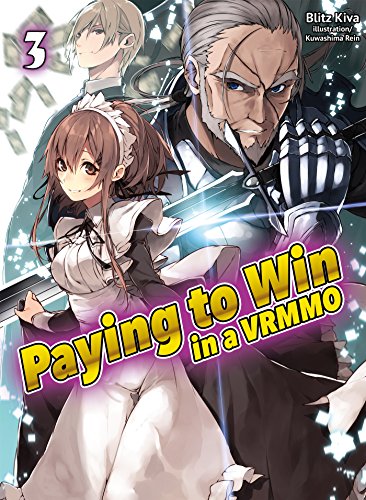
Paying to Win in a VRMMO, Vol. 1

By Blitz Kiva and Kuwashima rein. Released in Japan as “VRMMO wo Kane no Chikara de Musou suru” by Hobby Japan. Released in North America digitally by J-Novel Club. Translated by Elizabeth Ellis.

You would think after reading all of the light novels currently out in North America about games, either with people trapped in them, transported to them, or having worlds based on them, that I would be used to things by now, but Paying to Win in a VRMMO reminds me once again: I’m not really a gamer. I get the aggressiveness of microtransactions due to playing Candy Crush Saga, but that’s as far as it goes. And while it’s refreshing to actually see a book where people play a game they can actually log out of at the end of the day, it also means that more than the usual amount of prose was expended in regards to items, levels, attack names and types, and the like. Don’t get me wrong, the fights were exciting, especially the final one, it’s just hard for me to get into it as much when I’m seeing “he swiped his inventory to grab another sword”. But I suppose that’s VR for you.

Our hero is the man on the right, Ichiro, a young obscenely rich man who is also a genius, having graduated Harvard at age 13 (which is the usual requirement for fictional geniuses). Sadly, the fact that he can easily do anything has led him to be bored by almost everything. Then his second cousin Asuha asks for his help with a problem she has, one that needs to be solved by playing the popular VRMMO “Narrow Fantasy Online”. Ichiro has no reason to refuse, so agrees, pays an obscene amount of money to get an arcade version of the game put into his highrise penthouse, pays an obscene amount of money to get the cool character traits he wants, and pays an obscene amount of money to level up to obscene levels. He does all this rather coolly and stoicly, with the occasional bemused grin. Luckily, he finds something in the game that, for the first time perhaps ever, really challenges him. That someone… is Kirito.

Pardon me, my apologies. That someone… is Kirihito, one of many gamers who base their stats and appearance on “a certain famous light novel hero”. The main reason to get this book is probably for the almost-litigious-but-not-quite parodies of Sword Art Online, which keep coming fast and furious – the idea that most newbies play as Kirihito (this book’s version of WcDonald’s), the high-level Kirihitos who team up and become a sentai team, complete with pose (the illustration alone is worth the price of the book), all the way to “King Kirihito”, who may not like that nickname, but is the only other person in this game who can challenge Ichiro, and is also the source of the problem that Asuha would like to solve. (Also, if you’re going to be broadly satirizing SAO that much, perhaps choose a name other than “Asuha”, maybe?)

To be honest, while I enjoyed the book somewhat, I found the characters wanting. Kirihito’s real-life self was probably the most interesting, and I approve of the author leaving it up to the reader to choose their gender. Ichiro unfortunately grates a little too much with his “I earned this money myself, so can use it to solve all life’s problems and none can complain” ways, which get called out a bit in-book, but are mostly shrugged off. Asuha is very passive throughout the book, which is very frustrating given that one of the major cores of the book is getting her to stop being so passive – I didn’t really feel the satisfaction I was supposed to. And the otaku maid just wasn’t over the top enough for me to find amusing. The writing is good, and the jokes are excellent, but Paying to Win needs some better character development stat.