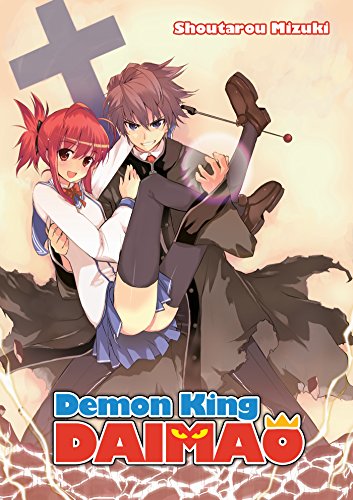
Demon King Daimaou, Vol. 1

By Shoutaro Mizuki and Souichi Itou. Released in Japan as “Ichiban Ushiro no Daimaou” by Hobby Japan. Released in North America digitally by J-Novel Club. Translated by David Musto.

While I would not go so far as to say that it was terrible, or that I won’t get more (I am curious to see what happens next), there’s no getting around the fact that Demon King Daimaou is a deeply flawed book. It knows what it wants to do, but sometimes skips necessary steps to get there. Its setting is bog standard, and most of its characters hew to the cliched stereotype. In fact, when this fairly old light novel series was made into an anime several years back, fans called the heroines by their hair color rather than their name. That’s harder to do with a textual book, even with illustrations, so I will try to use actual names – I apologize if this makes things confusing. The most interesting part of the book is the hero, but that’s not always to its benefit either.

Our hero is Akuto, seen here on the cover showing more expressiveness than he does in the entirety of this book. He’s a young orphan who arrives at Constant Magical Academy in order to start a path towards changing the world by becoming a high priest. Unfortunately, like the Sorting Hat in Harry Potter only much worse, there’s a machine at the school that lays out your perfect career path for all students. And Akuto’s is Demon King, which disturbs almost everyone since the last Demon King was defeated at that very school years ago. Of course, Akuto doesn’t believe in fate, and a simple explanation to his fellow students should do the trick. Unfortunately, while he may be overly serious, studious, and have seemingly noble intentions, he cannot help but stick his foot in his mouth every time he speaks – partly as he genuinely isn’t paying attention to how his words come across till after he’s said them, and partly because, well, he really would make a pretty nifty demon king.

Akuto is interesting as a hero mostly as he’s not really the hot-headed, fiery type or the “harem protagonist” type – the book runs on his total inability to say the right thing in any given situation, but skewed just enough so it doesn’t seem familiar. The same can’t be said of the heroines. Keena, the girl on the cover, is meant to be the ‘airhead’ sort, but also has a mysterious past, and spends a lot of the book away from events. Junko is our standard Akane Tendo heroine, who likes Akuto at first before he’s chosen by the machine to be demon king, but afterwards alternates between humiliated rage at being played for a fool and growing feelings of love (that frankly grow far too fast given their interaction). The best of the girls so far is Korone, an android bodyguard with a stonefaced expression and a tendency to tease the bejabbers out of Akuto – she was my favorite part of the book.

I should also mention the ending, which features another girl, who is secretly evil, getting her comeuppance at the end in what is meant to be a humorous way. Sadly, this involves her getting gangraped by her other female classmates, who are under the influence of a drug. It’s implied and offscreen, but I don’t care. It’s ugly and awful. It helps to make this first volume something of a hot mess, and while I’m not abandoning it just yet, it’s on thin ice. I’d recommend it to those who enjoyed the anime only.

The Combat Baker and Automaton Waitress, Vol. 1

By SOW and Zaza. Released in Japan by HJ Bunko. Released in North America by Bookwalker. Translated by David Musto.

I wasn’t quite sure what to expect from this series, the first to be licensed by Bookwalker directly from Japan. I had seen it on HJ’s site a while back, and thought it might make a good license at the time due to one specific reason: it didn’t appear to be an isekai, which light novel licenses were currently drowning in. (Still are, to be fair.) I wondered if it would end up being something of a foodie book, focusing on the making of the bread and daily life of the bakery. In fact, it’s nothing remotely like that. But that’s OK, because I genuinely enjoyed what we get, which is a darker story about a country recovering from a vicious war that spanned the continent, the scars it left behind, and one of its veterans trying to repent for his sins with delicious bread.

The baker is Lud, a former soldier who was responsible for much of the devastation and death, and also happened to be on the winning side. He was never happy with it, though, starting off as a child soldier, and his biggest regret is being unable to save the bakery he had stayed in for a spying mission at one point. After the war, he settles into one of the neighboring countries and decides to open his own bakery. There are a few problems with this. 1) He has a face like a hardened combat veteran, and has trouble making his smile not seem like a threat. 2) The town in question is avoiding him and no one will buy his bread. His only friends are Jacob, a young man who stops by on occasion to buy some bread and snark at him, and Marlene, who is the nun in charge of the orphaned kids. Things are looking pretty bad, that is until he hires a young, highly enthusiastic, and extremely odd waitress named Sven.

Sven’s true identity is not unknown to the reader, as it’s the first scene we see in the book, but it is unknown to Lud, who finds her a good employee and friend, but doesn’t connect the dots to his former life till the very end. Sven herself has a very easily triggered jealous and possessive side, but given who she is and her newfound state, this is actually a bit more acceptable than most clingy jealous girls. The large majority of the book is dedicated to the fact that the war may technically be over, but there are still aftershocks spreading through this continent that is clearly meant to be Europe, only not. Neighboring countries that sound suspiciously like Russia are sending in terrorists as moles, or using old men with a chip on their shoulders to repair tanks, or searching for evidence of the old, world-conquering civilization that used to exist a thousand years ago. The book does a very good job keeping the reader’s interest through this, and it reads more like a thriller than a wacky romantic light novel.

Translation was good, on the whole – there were a few times I saw Lud’s name as Luke, but apparently Bookwalker are already fixing that (the benefits of being a digital publisher). As for the heroine being named Sven, well, that’s the Japanese author’s fault – if you can accept Jacuzzi Splot, you can accept this. I will note that I think the book’s formatting works better on a larger tablet than it does on a phone, so Bookwalker readers may want to try reading it that way. On the whole, though, a very good debut, and I look forward to seeing more of the series, which is 6 volumes in Japan.

Land of the Lustrous, Vol. 1

By Haruko Ichikawa. Released in Japan as “Houseki no Kuni” by Kodansha, serialization ongoing in the magazine Afternoon. Released in North America by Kodansha Comics. Translated by Alethea Nibley & Athena Nibley.

This was a trip. I wasn’t sure what to expect going in, as I didn’t know much about it beyond “fighting gems” and that it’s been nominated for awards. Indeed, Kodansha even says it’s for fans of Steven Universe, presumably because, well, gems. I can see some similarities, but really, this manga is its own thing, and calling Phos and Steven similar lead characters seems a bit insulting to Steven. As for the plot, I honestly found it to be somewhat confusing much of the time, not really a surprise when it’s the first volume. But there are a few very good reasons to read this. The first is that the author is very good at depicting tension and frustration between two different characters, as our lead goes around and annoys everyone into submission. Secondly, the art is really nice, and conveys a sense of wonder and a sense of horror depending on where you are in the story.

The basic premise is that gem people are fighting against Moon creatures. They seem to fight based on the hardness of their base gem – the harder the better. Our lead gem is Phosphophyllite, who is most assuredly NOT on of the hardest gems – indeed, they’re known for being rather fragile and brittle. Phos is also a bit of a ditz, whiny, selfish, and lazy, which makes it very diffifuclt to find them a job. Fortunately, the sensei who’s in charge of the gems has come up with something: Phos will compose a natural history of their world. This seems, on the face of it, a idea that is both good and bad. Good because it’s the sort of this that plays right into Phos’ skill sets, and bad because Phos really has no skills sets beyond “people seem to like them”. Really, what it is is an excuse to have Phos wander around and interact with the other gems, such as the reclusive Cinnabar or the beautiful yet secretly self-loathing Dia. In the second half of the book, Phos accidentally gets eaten by a slug creature, and after everyone spends a long time figuring out how to get them back, now has… the ability to communicate with it? Maybe?

As I said earlier, this isn’t really a title I’m reading for the plot. It also has to be said, for those who get easily annoyed at selfish characters who clearly are going to grow and change as the series goes on, Phos starts out REALLY irritating, and you can easily understand some of why they’re treated so poorly. But not entirely all of it – Phos is also bullied in many ways, and the excessive verbal abuse heaped on them seems a bit much. Even those characters who do seem to like Phos, such as Cinnabar, show this affection by being even meaner than the others, though that ties more into Cinnabar’s self-hatred and suicidal tendencies than anything else. (The gems seem to be genderless, and I’ve done my best to avoid gendering them when writing this review.) To sum up, I’m not entirely sure where this is going, but I find the character interaction excellent and the art captivating. Which is all you can ask of a Volume 1, really.