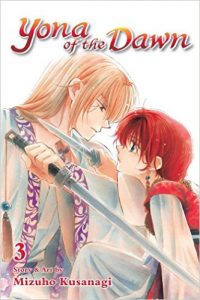
Battle Rabbits, Vol. 1

By Ameichi. Released in Japan by Ichijinsha, serialization ongoing in the magazine Comic Zero-Sum. Released in North America by Seven Seas.

Back in my pre-blogging days I used to write up the week’s manga shipping list on my LiveJournal, similar to Manga the Week of but with less commentary. I noted the Japanese company the work came from, and what genre it fell into – shonen, shoujo, seinen, josei, or “whatever Wings is”. The last was my running gag for Shinshokan’s flagship magazine, which by all rights should probably have fallen under shoujo, but always had a bit more action and fantasy than your typical Margaret or Hana to Yume works. Of course, this was about 7-8 years ago, and now we know there’s also GFantasy, and indeed Comic Zero-Sum, which is where today’s title comes from. Battle Rabbits not *quite* BL, as there’s never any actual follow through, but I would say it caters to BL readers who don’t mind just being teased. And oh do they get fanfic fodder here.

battlerabbits1

I had actually forgotten this was a Zero-sum title until it arrived. Based on title alone, I was expecting a different kind of Seven Seas series, catering to their flagship demographic. And to be fair, there is a young girl wearing rabbit ears in this first volume. Mao is cute, and a bit of a ditz, and there are precisely zero readers who would get this title for her, because oh those guys. We start with our hero, Kaguya, who really should have known what was going to happen just by looking at his name. As a child, his father was murdered by a mysterious demon, but no one believed him and called it a suicide. Now he’s in high school and still dreams of getting revenge. Which, good news! A delinquent with a grudge against Kaguya gets possessed and attacks him, and we find out that Kaguya is actually a Battle Rabbit – which technically are supposed to defend the Earth but in actually seem to, as many of these titles are wont to do, stop people whose personal life problems are making them turn into monsters and heal them.

Despite the delinquent clearly being tsundere for our hero, the real BL tease comes in the 2nd half of the volume, when we meet Hijiri, leader of the Battle rabbits’ base on Earth. It turns out Kaguya is not only a Battle Rabbit but basically King Battle Rabbit, and thus everyone’s calling him “Young Master” and such in the best Little Lord Fountleroy-sama tradition. Hijiri meets him by putting a ring on his finger, uses mind control to get him to agree to fight as a Battle Rabbit for them, and later pops up in a dream literally in a wedding dress marrying him. So yeah, the authors (who have mushed their names together as a single pen name) know their audience. I’m less taken with Kaguya himself – I liked the idea that his need for revenge is just too emotional a reason to actually fight, but when he’s reluctant he’s far more generic. Oh yes, and Mao, the female Battle Rabbit, does the third-person speaking thing, for those who don’t like that style.

If you enjoy handsome guys looking cool and saving the day with a smile and a smirk, you should get a lot out of Battle rabbits. I’m not sure I’d be desperate to continue it, but as I said before, this series has a demographic and knows how to hit said demographic right in its sweet spot.

A Certain Magical Index, Vol. 7

By Kazumi Kamachi and Kiyotaka Haimura. Released in Japan as “To Aru Majutsu no Index” by ASCII Mediaworks. Released in North America by Yen On.

There is a certain amount of religion in Index, more and more as the series goes on, in fact. The whole point of the Magic side of Index is that it’s made up of various religious factions who are at odds with each other and themselves, and even an Angel has gotten in on the act. That said, I’m not really sure Kanachi has anything deep to say about religion in particular. I think he’s just using the basics as fodder for what he wants to do, which is tell stories where cool things happen. Which is fine, and there’s lots of cool things going on in this volume of Index. I quite enjoyed it. But I also grew up Roman Catholic, and the group of nuns that are introduced here adhere far more to the “Spanish Inquisition” type than the more modern Catholic Church. In fact, the text goes out of its way to say “Roman Orthodox”, and casually says the word Catholic doesn’t really apply to them anymore. Which is true, because what we have here is not a convent, it’s a paramilitary unit.

index7

Introduced in this volume: Laura Stuart, Orsola Aquinas, Agnes Sanctis, Lucia, Angeline, Saiji Tatemiya. Yes, Yen’s translation spells it Agnes, not Agnese. I think that’s fine. For anime and manga readers expecting Itsuwa, she was added to the adaptations but isn’t in the light novel. No worries, she’ll turn up later. This takes place a whole week after Book 6, which is huge in Index terms. for Railgun readers, Misaka’s not in this one, probably as she’s still in California dealing with events in the Railgun SS novel. For Accelerator fans, the Accelerator manga’s start takes place around this time.

Laura Stuart is the most important of the names mentioned above. For all of the amusing “Your Japanese sounds stupid” jokes and occasional dojikko moments she gets, she’s clearly meant to be to the Magic Side what Crowley is to the Science side, i.e. a chessmaster who’s always thinking 10 moves ahead of everyone else. As Stiyl notes, she’s the one who told all those lies about Index that kicked off the series in the first place (a popular fan theory is that she’s Index’s mother, possibly as that makes it much worse), and certainly nothing that happens in these pages seems to surprise her – everything turned out as planned. That said, simply due to her nature and the way she’s written the reader tends to find her more sympathetic than Crowley (who, as we learn here, is likely also a magician in any case).

Much of the volume deals with a grimoire called The Book of the Law, written by Crowley, which is supposed to be undecodable, except Orsola thinks she knows how to decode it. Orsola is basically the one Roman Orthodox nun we meet here who isn’t a villain, and her tendency to underplay horrific injuries and forgive those who have attempted to kill her must surely strike a familiar chord with Touma. As for Agnes and the others, they’re zealots, thinking nothing of lying to Touma and the others about absolutely everything as, well, they’re non-Catholic heathens, so who cares? That said, Touma, who possible has been spoiled for the 11th novel, says he can totally see him being on Agnes’ side later. Touma tends to be on the side of whatever he thinks is right at the time.

There’s more I could discuss, including Index (who once again gets a lot to do) using a whole lot of magic given that she’s someone who supposedly is unable to use magic (I suspect that Laura may be responsible for that as well), but I think this is getting a bit long. Suffice to say this is a strong volume of the Magical Index series that will please its fans, unless they’re hardcore Catholics, in which case please note that Index is to actual religious theory of today what Goofy is to an actual dog.

Complex Age, Vol. 1

By Yui Sakuma. Released in Japan by Kodansha, serialized in the magazine Morning. Released in North America by Kodansha Comics.

The genres that make up the Japanese manga industry have been becoming more fluid over the last few years, and there are titles and even entire magazines that don’t quite fit the label. That said, I still try to always put where the manga first came out in my reviews, both as a helpful reference and because it can be useful to see if you’re going to like something. Jump shonen titles are very different from Magazine shonen titles, and both of those are equally different from a Sunday title. A title that runs in Betsucomi is probably never going to fly in Hana to Yume. With seinen and josei it’s a bit less regimented, but you still see it. All of which is a fairly long preface to explain that I was rather surprised to see that Complex Age ran in Weekly Morning, a seinen magazine, rather than the josei magazine Be Love, where I would have expected it.

complexage1

Complex Age stars Nagisa, a mid-twenties OL who also has a hobby of cosplay that takes up most of her time and money. She creates the costumes herself, and goes to show them off at the latest Comiket and other such events, along with her friend Kimiko. Her obsession is a long-running magical girl series that isn’t quite PreCure, but it’s close enough for jazz. She is, however, running into several problems. She still is trying to keep her cosplay a secret from her office life, particularly as some of her coworkers seem like the sort who would use it against her; another, younger girl comes along and looks absolutely perfect for the role that Nagisa is cosplaying herself; and Nagisa is getting to the age where it’s harder and harder to realistically play a 14-year-old magical girl. She’s also really tall, which also doesn’t help. This culminates in someone at the even calling her a “giant old lady”, causing her to snap and have a bit of an emotional breakdown.

I’m trying to think of a better way to say it, but I can’t: this is a very good series. The characters all have a depth and nuance that takes them beyond a level where I would normally expect them to stay. Nagisa’s friend Kimiko in particular amazed me. At first I thought that she might be setting up Nagisa for a horrible fall, and couldn’t imagine why, given they’re best friends, but it turned out to be – pardon the term – far more complex than that. As for Nagisa herself, after the beginning emotional turmoil, she actually proves to be far more mature than you’d expect, helping her new protege even as she inwardly writhes. And while new protege may look the part, there’s a lot more to cosplay than just looking right. The manga shows that cosplay can be a money-sucking hobby, but it never belittles it. And there’s a nasty cliffhanger that immediately makes me want to get the next book.

There’s a one-shot at the end of this volume that was the basis of the ongoing series, and it won an award. It’s quite different, showing a married woman as opposed to Nagisa’s OL, and seems a lot starker, ending in a literal bonfire where she cuts off her old cosplay life and moves on. It was well-told, but I preferred the ongoing tale, and I hope that Nagisa can find an ending that allows her to not be completely cut off from what she loves.