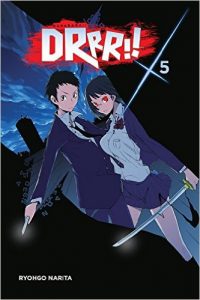
Durarara!!, Vol. 5

By Ryohgo Narita and Suzuhito Yasuda. Released in Japan by ASCII Mediaworks. Released in North America by Yen On. Translated by Stephen Paul.

Lately these days when I’m reading light novels I come at it from a different perspective than most North American readers, in that I really am reading it in this format first. I haven’t seen the anime for, say, The Irregular at Magic High School or Strike the Blood, so my opinions tend not to be swayed in advance beyond shamelessly spoiling myself on TV Tropes. But DRRR!! is different – I’ve seen the anime multiple times, and also read Yen’s manga (though the novels have finally passed the manga series timeline-wise), and therefore know where the books are going to go, even if I may be surprised by a narrative quirk or inner monologue. This also allows me to enthuse about characters I love finally showing up, even if it is somewhat baffling as to why I love them.
drrr5

Case in point: Vorona, one of the two Russians who arrive in this book as professional goons-for-hire. I love Vorona. She’s in my top 5 favorite DRRR!! characters. That said, you’d be hard pressed to see why here, as she’s merely a quirky villain. She speaks in a clipped, soundbite way that not only works very well for a Russian who’s learned Japanese, but also contrasts with all the other Russians speaking Japanese around her, who speak it much more fluently. She’s a repository of useless information, which she doles out to her goofy and somewhat dim partner Slon – be it why cows eating grass makes them fat or why the number 13 is unlucky. And, like the rest of the cast in this series, she’s a little bit broken on the inside, finding her thrills in killing and finding progressively stronger people to fight against. She thinks she’s found someone interesting in this volume with Celty, who is seemingly easily killed only to show up later. Book 6 onward will show more of why I love her.

Knowing the anime can also be a drawback as well, of course. Mikado is written here to be a hopelessly naive dupe, in over his head and trusting Izaya of all people, even thinking to himself that he’s “really a nice guy”, which is so untrue you wonder how on earth Mikado can even survive day-to-day. But as the astute fan knows there’s far more going on in Mikado than just naivete. Aoba can sense it, I think – he sees Mikado grinning as he’s being blackmailed towards the end of the book – but he pretty much thinks he can use Mikado as the public face for his own machinations. This is definitely the first book in a two-book arc, and we’ll learn later on it’s not as simple as that.

As ever with a Narita volume, there’s too much going on here to talk about everything in a review. I didn’t mention Shizuo’s subplot, as Izaya seems determined to irritate him as much as possible, be it sending a young yakuza princess to kill him or framing him for murder. It’s a great plot, and gives us the best interstitial art of the entire series, as Shizuo tries to convince Akane he’s not a bad guy by winking and sticking his tongue out. And Anri’s involved as well, as she also falls under Vorona’s large category of ‘strong monsters that I can try to kill’. And there’s Chikage, the gang leader lothario who’s determined to destroy all the men in the Dollars gang – but don’t hurt the women or you’ll be in trouble. The big downside is, of course, this is all setup. It’s those early episodes of the season that no one liked as they were all preparation for a payoff. Stay tuned for the payoff in Vol. 6.

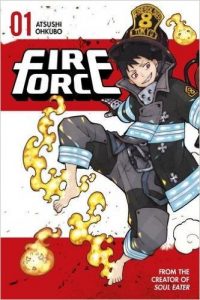
Fire Force, Vol. 1

By Atsushi Ohkubo. Released in Japan as “Enen no Shouboutai” by Kodansha, serialization ongoing in the magazine Weekly Shonen Magazine. Released in North America by Kodansha Comics. Translated by Alethea & Athena Nibley.

It was always going to be difficult, following up on a series as popular as Soul Eater. And so Ohkubo decided to move to a bigger company (this is discussed in an absolutely hilarious afterword where he bemoans, like so many other artists who write for Magazine or Sunday, not getting into Jump) and started a brand new series. This is a bit more realistic than Soul Eater was, which sadly means a bit less gonzo background art details, but it’s still not quite in the real world. It’s a sublte first volume – I went through most of it thinking this was something of a step down from his last work, but as I reached the end of the volume I realized that I wanted to learn more about these characters. Which is all you can ask, really.

fireforec1

Our hero, who looks like Soul with black hair because manga artists have a style, let’s face it, is Shinra, a boy with a tragic past who has dedicated his life to being a hero, and the best way to do that in this world is to become a fireman. Why? Because all over the world people are spontaneously combusting for no reason, and turning into demonic creatures as they do. Shinra joins a squad dedicated to stopping these former humans and sending them to their eternal rest (they even have a nun/exorcist on hand). There are, of course, a few problems. He has a bad habit of grinning widely when he’s nervous or upset, something that always causes people to get the wrong idea. And he’s never done this before, so quickly has to get used to the fact that as a firefighter in THIS world, they will always be dealing with death – in fact, as is bluntly pointed out, they are murdering these people.

Did I forget to mention most of the cast has superpowers? Of course I did, because frankly, a firefighter manga is what I want. But yes, Shinra can run so fast his feet catch fire (or maybe it’s the fire that lets him run fast), and another girl on the squad can’t create fire, but can manipulate it beautifully. We also meet Arthur, who I suspect changed his name to be more apropos. He’s dedicated himself to being a knight – and has a past history at school with Shinra, so they don’t get along, as they both war as to whether knights or heroes are better. (The astute reader, of course, realizes they’re both idiots.) Probably my favorite character was the captain, who has no powers at all, but is a really good firefighter – and dispenses excellent advice.

So yes, a solid first volume, with a better plot and character but less style and moxie than Soul Eater’s first volume. There’s also some fanservice, ranging from mild (a brief shower scene with the two female firefighters) to pointless (one firefighter from another squad seems to have the ability to be constantly groped – mo, really, it seems like it’s her superpower). And we’re also meeting some villains, who no doubt will tie into the death of Shinra’s family. All in all, it’s a promising start.

Princess Jellyfish, Vol. 3

By Akiko Higashimura. Released in Japan in two separate volumes as “Kuragehime” by Kodansha, serialization ongoing in the magazine Kiss. Released in North America by Kodansha Comics. Translated by Sarah Alys Lindholm.

After waffling a bit about the first two omnibuses of this series, the third settles in more comfortably into something I’m really enjoying. The characters develop a bit more, though that’s not always a good thing. The humor can be first rate much of the time. And the overwhelming sense of impending doom is done with a light but necessary touch, as we never forget even from the start that Amars’ home is about to be taken away from them – indeed, the owner (Chieko’s mother, who amusingly also seems to be a giant otaku, this time for Korean actors) signs off on selling it, so we’re left wondering what can possibly be left to save it? Ah, but in the best Mickey Rooney/Judy Garland tradition, Kuranosuke has the answer – we’re gonna put on a show!

jellyfish3

Actually, the show was my favorite part of this whole volume – not the fashion show that serves as the cliffhanger ending, but the college drama that they all go to see in order to fill up seats, that fires up Karanosuke’s arrogant fashion heart and leads to all this. College productions can be hilarious at times, and the idea of a huge number of Ophelia clones fighting it out over Hamlet is exactly the sort of play you’d likely see in a hardcore drama department. Likewise, the shoestring budget and slapdash costumes also fit in, even if they upset the aesthetic sense. It’s nice to see Tsukimi manage to overcome her introversion and get everyone sewing so we can get the jellyfish dresses, even if I did groan as Kuranosuke once again forced her into a big social situation without telling her.

And then there’s Inari. I still don’t like her – by design, she’s the villain – but I also wasn’t fond of the plotline in this volume. Her faked suicide looked and felt offhand, as if she threw it together uncaringly, though I was fine with Shu being upset about her doing it. The fact that she started to fall for him for real after he hit her upset me a bit, though I know it wasn’t meant to be taken that way. In reality, it’s that he actually cares about her well-being and isn’t just another male body on the sexual corporate ladder. Still, I wish we could have had that without the violence. That said, I was amused at how she seemingly falls apart a bit after that, to the point where she can’t even blackmail him properly.

The rest of Amars also fare well, getting things to do to flesh them out. Mayaya gets the most, of course, as she’s the one with the body of a model and the personality of a fruitcake. We get into the background of the cast in greater depth here – Mayaya hides her eyes as they’re evil-looking, similar to the hero in Toradora!. But everyone in Amars is quick to remind her that they all went through that sort of thing – they were all bullied in school for being different. I’m not sure how long Mayaya’s actual modeling career may last – and I note that if she ends up with the Benz freak it would be hilarious – but it’s amusing and inspiring at the same time.

To sum up, while I still have a few issues with Princess Jellyfish, I enjoyed this omnibus a lot more, and it’s a solid josei title for young women or anyone.