The Devil Is A Part-Timer!, Vol. 4

By Satoshi Wagahara and 029. Released in Japan by ASCII Mediaworks. Released in North America by Yen Press.

As this series goes on, and more and moe horrible demons attempt to break into Japan for some reason or another, it has become more and more apparent that Maou and company are eventually going to have to go back to Enta Isla and deal with the giant power vacuum that they have left in their absence. I don’t expect it will be permanent – the whole point of the series would be lost if you take Maou away from McRonald’s for long – but Maou seems a responsible enough guy, and Emi definitely is, to try to fix what they may have inadvertently broken. We see part of that in this book as well, even though if you don’t look too closely it feels like a typical “beach episode”.

devil4

The best part of the volume is when the author builds on the character development we’ve seen in prior books, particularly in regards to Chiho and Emi. Chiho is starting to realize that, as the only person in Maou’s circle without any power, there’s little she can do beyond be emotional support, and is resolving to better herself so she can help in other ways as well. (Her declaration that she wants to be one of his Four Generals is possibly the funniest part of the book.) As for Emi, she’s made of stronger stuff than I had envisioned at the end of the last book, and it only takes a few well-worded lectures from Chiho to have her helping out Maou in both his attempt to restore a beachside cafe and also defeat an invading demonic army – without killing them, much to Suzuno’s surprise. Emi is realizing that not everything is clear-cut.

There were parts of the book that didn’t work as well for me. I enjoyed Amane more as a relaxed and absent-minded shop owner more than I did a Guardian of Earth, and I felt that this was shoehorned in just a bit in order to avoid padding out the already substantial volume with too many fights. And I was just as annoyed as the rest of the cast with Camio’s unfortunate tendency to peep every other sentence due to being trapped as a cute little bird. On the other hand, the best part of the book was once again seeing how well Maou can do middle management when he tries hard. Seeing the run down and decrepit beach cafe transformed into a bustling popular spot is impressive, and shows off everyone’s talents (and comedic foibles) at their best. Yes, even Lucifer, who is still unloved and unlovable, but proves here to be far more aware of external events than some of the other demon generals around him.

While not the best volume in the series – the ending also felt very rushed, and I suspect the book may have been heavily cut in editing – this is still a solid addition to the series, and will please those who have been following Maou and Emi’s adventures in the past. I am hoping that the next volume will give us more fast-food shenanigans – that’s where the series seems to do its best.

Sword Art Online, Vol. 7: Mother’s Rosary

By Reki Kawahara and abec. Released in Japan by ASCII Mediaworks. Released in North America by Yen Press.

As I was reading this volume, I kept thinking that there was a pacing issue, and that events were happening far faster than I was expecting. As I came to the end, the reason why occurred to me: other than the first book, this is the only stand-alone Sword Art Online novel. In the main series, Books 2 and 8 are short story collections, 3-4 and 5-6 are two-volume arcs, and 9 onward is an epic 9+ volume arc. But this book completes its story in one compact volume, and it’s even pretty short compared to some other books in the series. Once the brain has adjusted to that, the reader can see what’s really going on: this is one of the best books in the series, where Kawahara finally balances storycraft and emotional manipulation perfectly, to the benefit of Asuna, who’s the co-star and narrative focus of this book.

sao7

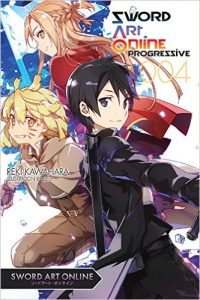
Fear not, Kirito isn’t the other star of the book; for once he only has a small supporting role. (Though he does appear on the cover, apparently at the request of the editor.) No, the other star is Yuuki, the spunky girl with the sword you see next to Asuna on the cover. The first half of the book introduces her to us and has as its main mystery why she is so good with a sword – to the point where she can defeat Kirito, twice. She defeats Asuna as well, but Asuna gets closer than anyone else, so Yuuki introduces her to the rest of her Guild and asks for her help in taking down the boss of one Level – in a party of seven. Boss fights normally have at least 50. Clearly there’s another reason why they’re so desperate, and as Asuna discovers it despite Yuuki’s best efforts, we get the last third of the book, which will put a lump in your throat.

The second half of the plot is Asuna’s stormy relationship with her mother, who has demanded that she transfer out of the SAO survivor school and also set up a marriage for her (with her second cousin, because Japan). The repressed frustration and anger that Asuna feels whenever she talks to her mother will be achingly familiar to many readers, and it’s through Yuuki and her own struggles that Asuna finds the strength to fight back and stand up for her own life and experiences. (As an aside, I note that Yuuki seemed quite happy when she talked about getting married to Asuna in order to get around one of her problems.) SAO may have been a traumatic death game in many ways, but it did allow Asuna to really grow and reach out to others, and her refusing to be put back in her mother’s little box is a triumphant moment.

I’m trying to avoid spoiling more than I usually do in a review, but the book isn’t perfect. I am not a medical person, but even I could see that a lot of the details of the medical treatment and cause for it was a bit sketchy here. Also, I grow rather weary of the plot continuing to talk about how noble and good Kayaba was long after his death, given that he trapped 10,000 people in a game where they were allowed to die as his thought experiment. That said, Asuna and Yuuki are pitch-perfect in here, and for once the emotional and gut-wrenching final feels fully earned (Bonus points for not featuring sexual assault as a plot point, at last). Even if you gave up on SAO during Fairy Dance, I’d recommend getting this volume, as it’s one of the best in the series.

Black Bullet: The Destruction of the World by Fire

By Shiden Kanzaki and Saki Ukai. Released in Japan by ASCII Mediaworks. Released in North America by Yen Press.

When an author is writing a grim dystopia of a series, they have to be very careful sometimes. Because let me tell you, as a writer, the temptation to have horrible things happen to your characters can be unbearable. And I imagine this is particularly true in Black Bullet, where the only levity of the entire series of books is provided by wacky lolicon jokes. (We do get more of those here, and they’re worse than ever.) It’s entirely possible that the events of this book, and the ending in particular, are part of a long-term plan to advance the growth of Rentaro as a character and stop having him try to take on everyone’s problems. But I can’t help but hear the author, in a Beavis and Butthead sort of voice, telling me no, killing off 20 or so innocent young children in a horrific way is really brutal, and therefore cooler.

blackbullet3

(As a side note, that cover has so much stuffed into it that it verges on the incoherent. As long as I’m complaining.)

This book, which starts the popular light-novel schtick of a two-volume arc, begins with a bunch of killings as well, but those at last are plot-relevant and not there to make you gape at the page in a stunned silence. One of the monuments that protects the Tokyo area is breaking down, and once it collapses the Gastrea from outside will enter and basically kill/convert everyone in the city. As a result everyone has to band together to head off the monsters until a replacement can be built. This includes our heroes, who are asked to put together a strike force in order to be part of the maneuver. Of course, there’s a problem with this – Rentaro is a high school aged kid who’s moved up 10000 ranks in the last two books, and no one likes or trusts him.

This does lead to the best parts of the book, as we see him and Enju slowly trying to get anyone to work with them. The pairs he ends up with are not the most original in the world, but they bounce well off of a miserable stoic like our hero. We also get some lovely scenes between him and Kisara, who gets slightly more to do here than in the previous two books. I suspect her burning desire for revenge is going to come back and nite her in the ass one of these days, but as long as we get scenes of her and Rentaro staring at the stars and almost but not quite confessing, I’ll deal with it.

The volume ends with the beginning of a protracted battle that I suspect will take up all of Book 4. It’s a battle to save the citizens of this city, including the Cursed Children. So ending the book the wey it does sort of kicks the feet out from under the reader, making them, if not Rentaro, think “is it really worth saving a world like this?” More importantly, is it really worth slogging through so much death and hopelessness? Black Bullet continues to be well-written, and has good introspection, but if I wanted grimdark, I’d be reading American mainstream comics.