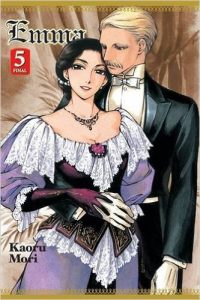
Hayate the Combat Butler, Vol. 28

By Kenjiro Hata. Released in Japan as “Hayate no Gotoku!” by Shogakukan, serialization ongoing in the magazine Shonen Sunday. Released in North America by Viz. Translated by John Werry.

It is not uncommon for long-running harem comedy series to introduce a new girl who quickly captures the hearts and minds of fans who have grown weary of the natural staticness of a typical harem plot. Indeed, it’s not uncommon for Hayate the Combat Butler iteslf, as Athena grew quite popular when she was introduced, but she was part of Hayate’s tragic backstory, and also heralded a certain amount of drama. With Ruka Suirenji, a pop idol who apparently likes to sell doujinshi on the side, we get something more akin to the typical Hayate heroine, and much of the first half of this volume is about showing off how cute she is and how much chemistry she has with Hayate. Who she thinks is a girl, something that I’m sure will go bad for him later on.
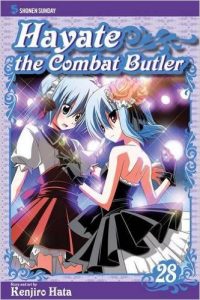
hayate28

Of course, this doesn’t mean that the old favorites are getting ignored. To no one’s surprise, Athena has returned, though only for a brief cameo before we get introduced to Alice, a cute young girl who looks just like Athena did when she and Hayate were kids – a fact not lost on him, and clearly there’s some magic age-regression going on here. This ends up leading to some ship tease with Hinagiku after Alice (Athena’s child form) decides that Hayate and Hina are her mama and papa. (Best joke of the volume has Hayate wondering if it was that time when–and getting cut off by Hina with a sword to the head, as jokes about her chastity are a bit much even for her.) And even Maria, who’s been so absent from the manga lately that she’s slipped to 5th in the popularity poll (Athena is second, for the curious) gets a sweet ‘let’s go to the public baths’ scene with Hayate, who for once does not get accused of peeping.

This volume sees Hata starting to balance out his ongoing storylines and his desire to write gag comedy a little better than he has before. Aika appearing as Alice’s minder ensures there will always be a snarky comment handy, and even though she regresses a bit, Nagi is still able to see what a really dedicated writer of bizarre incomprehensible doujinshi can do. And there’s still room for one-shots, such as a typical day in the apartments implying that Hayate survives on one hour of sleep a night, or a drunken Yukiji winning the attention of manga artist Ashibashi (who we now see is actually named Koji as if it wasn’t obvious enough who Hata based him on). Rest assured that things are still funny, even as the plot grows more complex.

By now I highly doubt that Hayate is winning new readers, and its die-hards likely support the manga while also reading the scans online, which are about five years ahead of Viz’s release. But it is worth supporting This is a funny title that also has doses of sentiment and even a bit of action. It remains an underrated treat.

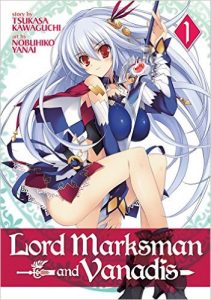
Lord Marksman and Vanadis, Vol. 1

By Tsukasa Kawaguchi and Nobuhiko Yanai. Released in Japan by Media Factory, serialization ongoing in the magazine Comic Flapper. Released in North America by Seven Seas. Translated by Elina Ishikawa. Adapted by Rebecca Schneider.

I’ve mentioned before that Media Factory publishes both my nemesis and my weakness. They put out two magazines for young men, basically sister publications. Comic Alive and Comic Flapper. Comic Alive tends to produce series, usually based on a popular franchise, that I can’t abide, with the worst otaku pandering, fanservice-laden drivel. Comic Flapper also, of course, publishes series based on popular franchises, but it tends to skew a bit weirder and less mainstream than Alive. And as a result, despite some problematic things, I usually find myself enjoying a Flapper series. Lord Marksman and Vanadis is a fantasy series based on a light novel with a cool hero and a bunch of girls, so I admit I was a bit wary. But sure enough, Flapper wins again. This was a good start, and I want to see more of it.

vanadis1

Now don’t get me wrong, there is service here. We get not one but two ‘walk in on someone bathing’ scenes, a ‘we are fighting and I accidentally grope your boob’ scene, and another nude scene when the childhood friend of the hero cleanses herself to go to the temple and pray for him. But the series, at heart, is grounded in its plot and worldbuilding, which is always the way to win me over and get me to read your harem series starring your really cool guy. Tigre is a young Count called on to fight in a territorial war for his lord against a rival kingdom who have a Vanadis with them – who are apparently young women who can fight with amazing weapons. We find out how amazing when Tigre’s group is almost completely wiped out (honestly, I thought it was a complete massacre bar him, but a couple of the named characters show up later). He’s subsequently captured and brought to the Vanadis, who wants to test his skills, given his archery actually caused her to make an effort in the battle.

Our heroes are types that you will see in most fantasy manga and light novels, but they hew towards the ‘sensible’ end of the spectrum. (The exception is the bodyguard, Lim, who is allowed to be the tsundere hair-triggered temper girl that Elen herself cannot be because she is the Vanadis. Also, we need SOME comedy in here.) Tigre’s capture, as well as the death of his lord in the battle, leads to real consequences as various territories vie to see who can gain the most power, and decide that Tigre’s village is the perfect one to raze off the map to do so. I knew he was going to have to escape to deal with that, and also knew that he would be stopped. I’m impressed that he actually asked his captors to help him defend his village, though – it’s the sort of ballsy decision that makes you see why Elen likes him so much.

So there’s not much original here, but it’s well told, and avoids most of the wretched cliches of such genres while skating past the ones it can’t quite avoid. Our hero is cool and amazing in archery, but is shown to be useless in most other forms of combat. As for Elen, well, it’s only the first book, I’m sure we’ll find out her weaknesses later. If you enjoy this genre, it’s a very good start.

Emma, Vol. 5

By Kaoru Mori. Released in Japan in two separate volumes by Enterbrain, serialized in the magazine Comic Beam. Released in North America by Yen Press. Translated by Sheldon Drzka.

The final omnibus of Emma picks up where the last one left off, and is mostly a collection of side-stories, some of which are only vaguely related to the actual Emma series. Mori tries to explain why she did various stories in the afterwords, but it’s not hard to see that she’s simply getting bored, and using the excuse of a popular series as a way of testing her abilities and letting herself draw whatever she wants. Sometimes this is excellent. The scene with the Molders in their bed, and the flashbacks to how they met, is amazingly sexy, as the author herself tells us, and you really see how much the two adore each other, even if Wilhelm remains as stoic as ever. On the flip side, Teo’s Amazing Adventures in the Wild is a nice excuse to draw a wordless animal story plot, but the resolution hangs disbelief by the neck till it’s dead.

emma5

This volume is at its best when it’s dealing with the murky world of Victorian emotions – or, as the series ends, Edwardian emotions, as we move into a new century for Emma’s wedding. The three-part story of a troupe of opera singers and a love triangle is well-done if melancholy, and as ever benefits from multiple minor plot points flittering throughout the main one. Eleanor meets her college student again, and this time it’s more romantic than the last volume – indeed, Mori seems to revel this time around in seeing how many people she can try to hook up, and even the kids seem to have chemistry with each other. There’s even a series of Emma 4-komas in one chapter, mostly following the other characters, as we learn Grace is cute when she’s embarrassed, Hans has no weaknesses (except when he does), and that the butler is just a big softie.

Of course, it all eventually DOES come back to Emma, as her marriage to William is the last quarter of the book. It’s mostly a very good time, but there are reminders that this is still a bit of a status thing – Grace is still upset with William for breaking up with Eleanor, and even though she realizes it’s not Emma’s fault she’s still awkward around her and has to excuse herself. And the Campbells are, of course, not there. But for the most part it’s a glorious event and a party, and there’s a wonderful heartwarming moment where Emma has to write her name and is almost forced to admit she doesn’t have a last name, till William tells her to use Mrs. Stowner’s. Wedding, saved, everyone dances, bride gets completely smashed (in a genteel, repressed way – this is still Emma).

Despite dragging things out a bit with the side stories, Emma is still a wonderful series, and I’m very happy that Yen gave it this deluxe hardcover re-release. It may have some historical inaccuracies and unbelievability, but it’s so emotionally moving that you don’t really care. It’s also a series with a huge cast where, by the end, I was almost able to name everyone without resorting to the internet, which is am impressive feat. Very happy to have read this.