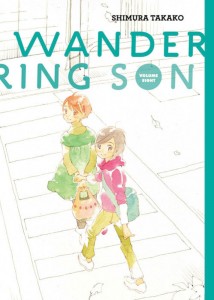
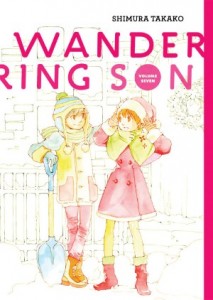
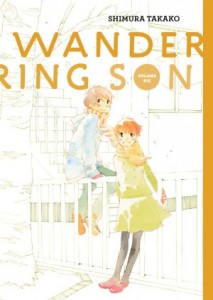
Wandering Son, Vol. 3

By Shimura Takako. Released in Japan by Enterbrain, serialization ongoing in the magazine Comic Beam. Released in North America by Fantagraphics.

One of the things that impresses me most about this manga is how much everything seems to be in flux. Nitori and Takatsuki’s gender identity disorder is the most obvious, but nothing else seems to be clear-cut at all, just as kids feel right around middle school. In this volume we see their secret get revealed to the class, and though a majority of the fallout focuses on Nitori and Takatsuki’s feelings, we also get to see how it affects people like Sasa, who’s just concerned that her friends are all pulling apart, or Seya, who’s falling for Nitori without really knowing the truth, but whose feelings continue to be an issue even after he finds out.

We also meet a new character, Makoto, who takes a surprisingly large role in this volume. He’s surprisingly mature, being a bit more confident in his desires, more ‘intellectual’ in his speech and manners (watch his cutting remarks to Maho when she’s about to insult him), and no doubt also far more emotionally fragile than he lets on. He reminds me a bit of Saori, but she still wears her heart on her sleeve. He’s also shown to be quite attracted to Nitori, which is something we haven’t really gotten into given the age of the protagonists, but no doubt will as the manga advances. What will happen when sexuality starts to come up?

I was pleased to see us moving beyond the school in this volume, with Maho dragging her brother along to her modeling audition. I continue to enjoy reading about Maho, a very ‘bratty big sister’ character whose head you can nevertheless easily get inside. Loneliness and lack of self-confidence lead to some of the more impressively awful scenes in the book, as she sets up Seya on a ‘not date’ with her brother dressed as a girl. That said, after Makoto dresses her down, I think she’s starting to think more about what she’s doing. The final scene, showing her and Nitori defending each other against the overly pushy modeling crowd, is quite heartwarming.

Then there’s the scene with Takatsuki and Yuki. This is a manga that takes place in a slightly lighter, fluffier world than reality, so things don’t turn too dark, and there’s a sense of ‘easily forgiven’ to the whole thing. At the same time, though, Takatsuki’s panic and fear is palpable on the page, and reminds you once again that these are just *kids*. Yuki’s behavior also ties in with Maho’s earlier, and the modeling girls at the end, in that they’re treating Nitori and Takatsuki as objects, even if it’s unconsciously. Takatsuki, who’s already upset that they both got found out but that Nitori is taking the brunt of the class’ reaction, is especially upset by this. Neither she or Nitori are dolls that people can play with as they please, or substitutes that they can live vicariously through.

It took a while for me to get around to reading this volume, but as always I was immensely impressed when I finished it. As I said, this isn’t quite ‘reality’, but it still handles everything realistically, and shows the emotions that everyone goes through. The middle school years are a giant state of flux, and therefore a great place to examine the gender issues that Wandering Son does. Roll on, Volume Four.

Wandering Son, Vol. 2

By Shimura Takako. Released in Japan by Enterbrain, serialization ongoing in the magazine Comic Beam. Released in North America by Fantagraphics.

In Volume 2 of Wandering Son, as you would expect, we begin to discover that just because you have someone to share your dreams does not necessarily mean that they become easier to achieve. Shuichi gets more of the focus here, and he’s starting to realize just what he’s getting into with his desire to be a girl. His sister is angry and suspicious of him… while at the same time being fascinated about dressing him up. Classmates are being cruel as only children can. But it’s actually a simple classroom assignment to write down what you want to be when you grow up that almost breaks him this volume. The future is scary.

In volume 1 it was Saori that drew my attention, but in this volume it seems to be Maho, Shuichi’s sister. She’s clearly presented unsympathetically at times, and I get the feeling that things will only get worse in that regard. But I love how things are never as cut and dried as “good guy” and “bad guy” in this series, especially with the children. After all, Shuichi may be the hero, but Maho is having to deal with being a young girl as well, not to mention her brother is dressing up as a girl, to the point where one of her classmates starts to fall for Shuichi. The characters develop from their situations, which is all you can ask for in this sort of work.

Meanwhile, the young woman we met in Volume One, Yuki, gets her own secret revealed. It’s not particularly surprising to me – I was more surprised that she was unaware of Shuichi and Yoshino’s identities. Yuki’s boyfriend, though, does lead to one of the funniest (and most cringe-inducing) scenes in the entire volume, where he looks at Yoshino suspiciously and then decides to verify her gender. Yoshino’s reaction made me laugh, but at the same time, I’m amazed she didn’t slug him… or run off. Yuki notes that it’s very rare to have two friends like Shuichi and Yoshino are. In addition to the transgender issues, the core of each volume is, of course, the friendship they have, and I hope that it continues to develop.

The second half of the volume is a class trip, and shows us that Shuichi is having difficulties with the other kids in his class. He’s so softspoken that he tends to get picked on, and one boy in particular is pressing him to see just how far he can take it, calling him “faggot” and mocking him on the bus. You don’t have to be familiar with transgender issues to understand what’s going on here (though this being manga, I would not particularly be surprised were that bully redeemed a ways down the road). Then there’s Saori, who, unlike Shuichi and Yoshino, can’t just sit back and let injustice go. She’s reminded of Anne of Green Gables, a book which most Western readers will know, and it leads to a truly wonderful scene. I like Saori, but given her high-strung nature I worry that she’s going to have even more trouble growing up than our two leads.

As with the first volume, the second one ends with an essay by translator Matt Thorn, this one dealing with transgender and homosexuality in the united States and Japan. (Neither Shuichi nor Yoshino’s sexuality has come up in the manga yet, but I’m fairly certain it will at some point.) Matt’s essay is excellent, noting the similarities and differences in the prejudices among cultures. Wandering Son, of course, will be dealing with family, and friends, and classmates. It’s not really going to have the option of viewing transgender issues from a distance the way a lot of Japanese folks can. Let’s hope Shuichi and Yoshino can weather the storm.

Wandering Son Volume 1

By Shimura Takako. Released in Japan by Enterbrain, serialization ongoing in the magazine Comic Beam. Released in North America by Fantagraphics.

I will admit I sometimes get intimidated by manga that are ‘important’ or ‘worthy’ in some way. Given a choice between discussing the latest gegika masterpiece from Drawn and Quarterly and the seventeenth volume of shoujo series X, I’m going to take the easy route every time. It’s the sort of book that reminds you that you’re actually meant to be reviewing, not just rambling on. And I felt a bit like this while seeing Wandering Son’s fancy, well put-together hardback sitting on my pile. Which is amusing, of course, as the manga itself is quite unassuming and easy to read.

Wandering Son is about a time in life when every single interaction with anyone is fraught with awkwardness. Especially for a shy kid like Nitori. Things are in flux, and you start to get a sense that even though you really want to do something, that doesn’t necessarily solve the problem if it will just lead to laughter and being thought of as ‘weird’. Yoshino is more self-confident, both in her general personality and in her feelings regarding how she wants to be seen, but her own body is the one reminding her that things aren’t simply cut and dry.

And then there’s Saori, who winds up driving much of the plot in this first volume. Saori interested me quite a bit, if only as she made my skin crawl at times with her trying to force things onto people. The combination of the dress and suggesting the play was interesting enough, but then there’s her reaction after Nitori returns the dress. Christianity is growing in Japan, but I think for a young girl such as herself, the appeal of penance and forgiveness is what’s drawing her more than the faith itself. I’ll be interested to see how this pans out.

The mood of the manga itself is sort of ‘slice-of-life’, but the plot really doesn’t follow the same format as your typical school 4-koma. The basis of this story is transgender issues, and that’s what you get for these first eight chapters. It just so happens that the issues are part of Nitori and Yoshino’s lives, so they aren’t presented with a huge amount of heft the way they would in an after school special. The other classmates have not made much of a name for themselves (indeed, the author admits she hasn’t yet come up with a name for Nitori’s perky friend yet), but I expect that will change.

As for the art style, it’s handled with an amazing deftness. The characters are subdued much of the time, but not in a way that, say, Adachi’s Cross Game characters are. We do see a lot of emotion here, particularly towards the end where Yoshino’s growing up gets thrown back in her face by the class troublemaker (via a proxy, another thing I found quite true to life). But what I liked best was seeing the looks on Nitori’s and Yoshino’s faces when they did try to dress as the other gender. Nitori’s look of bashful happiness as he wears the hairband. Yoshino’s stunned joy and pride after she’s ‘hit on’ by a woman at a fast-food place. They’re expressions you remember, and make for a stronger work.

Fantagraphics has done a great job with this. It’s a handsome volume, well-bound and with sturdy paper. Matt Thorn’s translation and adaptation are seamless, and his essay on the use of honorifics is both enlightening and amusing, inasmuch as he wouldn’t want to use them for most titles, but this is an exception.

So intimidation aside, in the end this is simply a well-crafted story, well-told. You want to read Volume 2 right away to find out how Nitori, Yoshino and Saori continue to deal with these feelings as they grow older. I’m very pleased that it was brought over here, and hope that it sells well enough so that we might see other titles in a similar vein. Not necessarily transgender, but handling difficult issues with such a light touch.