Monthly Archives: January 2012

Pretty Guardian Sailor Moon, Vol. 3

By Naoko Takeuchi. Released in Japan as “Bishoujo Senshi Sailor Moon” by Kodansha, serialized in the magazine Nakayoshi. Released in North America by Kodansha Comics.

I had forgotten how much compressing the 18 original volumes into 12 (and 2 side-story books) would speed things up. That’s right, we’re already at the end of the first arc and starting the second! Indeed, you can definitely tell that, had Sailor Moon not been a huge success, Nakayoshi would have likely ended it here, right before Chibi-Usa arrives. But then, had that happened, we wouldn’t be discussing it now.

For fans of the anime, that’s Sailor Mars on the cover. You might not recognize her as she’s looking cool, calm and collected. :) In the actual manga, though, things really aren’t going so well. Mamoru has been possessed by Metallia, and even if Jupiter and Venus manage to kill off Beryl, things aren’t going to end quite that easily. (Speaking of which, a couple of things to note: a) there’s an ongoing gag about Venus’ sword being too heavy to use. Done for comedy in Vol. 2, it’s now quite serious, as Venus has a lot of trouble actually wielding it. That said, even if Jupiter (who is much stronger) gets in the first blow, it’s Venus who actually kills Beryl. b) Wasn’t there a shot of archaeologist Beryl being possessed by Metallia in a previous volume? I guess we’re assuming, like the Four Generals, that once they were converted to evil, they couldn’t be saved. Keep an eye out for villains killed in Sailor Moon going forward, and see how many were once human…)

Unfortunately, Mamoru is still evil, and so it’s up to Sailor Moon to kill him for the good of the world. Which she actually does, even using Venus’ huge sword. And then, very startlingly, she proceeds to reverse the sword and kill herself. Or at least, so it seems. I dunno, maybe it’s because of the anime episode 45 and 46, but I find the ending to the first arc in the manga somewhat confusing. It would appear that both Sailor Moon and Mamoru were ‘saved’ from a deadly blow from the sword; Mamoru by a crystal containing the essence of his four Generals, and Sailor Moon by Mamoru’s watch. This… seems a bit too pat. On the good side, Moon is just as awkward with a heavy sword as you’d expect. Honestly, none of them look comfortable with it.

The action then moves to the North Pole, where, in order to wake Sailor Moon and Mamoru, the senshi decide to sacrifice their lives. This involves using their transformation pens to somehow use all their power to wake Sailor Moon, and again kind of pales in comparison with the anime. But that’s not the manga’s fault. But now Sailor Moon is alive, and can use the power of love, the power of prayer and the power of basic light over darkness to defeat Metallia. Now she’s finally reunited with an unpossessed Mamoru, and they kiss. And then she… finds out her friends are all dead. Oopsie. (Note we see them in pools of blood, which are all drawn as ‘clear fluid’ rather than the typical ‘black blood’ you see in monochrome. I suspect this may be to make it less horrifying – they’re drenched in it.) Luckily, Sailor Moon can resurrect the dead with her new powerup, which she proceeds to do. (If you’re rolling your eyes at this, get used to it – it’s not the last time we’ll be seeing it.)

Yay! Happy ending, everyone’s alive and going back to school, Usagi has a boyfriend, and all is well… wait, who’s this kid? Yes, Chibi-Usa drops in, and sets the stage for the second major arc in the manga, which is generally called Sailor Moon R in deference to its anime counterpart. Chibi-Usa… is a brat at times, even in the manga. But at least in the manga it’s very clear that she is, at heart, a very scared child, and that much of her behavior is due to panic and stress as much as anything else. She arrives out of the sky with her mind-controlling ball that looks like Luna and immediately proceeds to ingratiate herself with Mamoru, get accepted into Usagi’s family, and get on Usagi’s nerves. And she’s also after the Silver Crystal… which the villains are also after. Is she a villain?

Yes, we get a new set of villains here as well, with the Black Moon Family. More on Prince Demande later, as he’s a truly horrible ass, but here we just get to see bits of the main villains. Instead, they send out disposable minions, each with the powersets to match up against a specific senshi, to capture them. And it actually works quite well, as first Mars, then Mercury are captured by the enemy and… well, not killed, but moved off the board for a while. This, by the way, results in the deaths of the minions. This is not the anime, no redemption for you! There are also, by the way, some lovely scenes of Ami, Rei, Makoto and Mamoru interacting with their friends in daily life. The friends don’t get big roles, but it helps to show that the cast are (mostly) quite popular and well-liked.

I’m not sure if there were any extras in this volume in Japan; there aren’t any here, I can tell you. But regardless of that, this was a solid volume of Sailor Moon. More battle-oriented than most, which means I like it a bit less than the others, as Takeuchi’s battle scenes can get confusing. But as we leave our heroes, the Senshi are now down to three. And somehow, I have a feeling that the start of Vol. 4 will end with Jupiter getting abducted as well, as that’s how these things go. Is this what happens when you find yourself on the cover?!?!
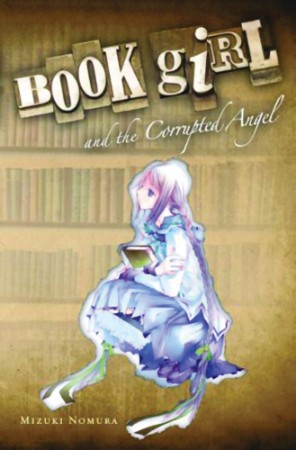
Book Girl and the Corrupted Angel

By Mizuki Nomura. Released in Japan by Enterbrain. Released in North America by Yen Press.

As I noted in my previous review of Book Girl, the plots and mysteries in these novels all seem to take the same turns. So rather than focus on how Konoha finds once again how his life mirrors that of the guest star this week, I have some thoughts that occurred to me as I read it, which will contain spoilers for both this book and the previous three.

First of all, as the author notes in her afterword, the cliffhanger from Book Three is not touched on here at all, except for the fact that Konoha reveals that yes, he did actually know about it and this is not a “secret” being kept from him. The reasoning for this is because Nomura-san felt that if she moved on to the ‘finale’ right now, it would do Nanase a disservice. Which is true, I suppose, except that for a book that is meant to be her focus book, Nanase gets startlingly little to do here. I’ve had issues with her in the past three books – I felt she was the flattest of the characters, and looked forward to seeing what happened with her here – but so much of the action in this book revolves around her being a touchstone to the other characters, an ideal, rather than interacting with her as a person.

That said, her scene with Konoha in the abandoned house of Mito’s family is brilliant, and a good thing too, as it’s likely to be the last decent interaction she’ll get with Konoha. Nanase may be a tsundere, but she’s never been able to repress her emotions at all. Whereas Konoha is *all* repressed emotions – except they keep slipping out of him with every panic attack he has. Their confessions and commiserations are done over cell phones, even though they’re sitting next to each other – which is both heartwarming and also quite sad. And then, finally, Nanase confesses. And Konoha, neither as the narrator nor in dialogue, ever acknowledges that she has for the rest of the novel. Not even when people confront him on it point-blank, or refer to it obliquely. Indeed, his narration can be quite aggravating as he tries to think of things to do to cheer Nanase up – you can hear your teeth grind as you read it.

For all that Konoha has been supposedly growing with each novel, he still shows signs here of being nowhere close to a functional human being. Which is absolutely fine. I mean, Konoha essentially has post-traumatic stress disorder, among other problems. As he learned in the previous Book Girl, these aren’t the sorts of things that can be resolved in a nice, pat 30-minute TV show. His joy at talking with Mariya-san earlier is based around the fact that he constantly seeks others that he can emulate, and thinks that the quiet, chai-loving joys of this music teacher give him hope. Of course, this is then stomped to bits over the rest of the book. Honestly, the real ways that Konoha grows in this book is in relation to his writing. Slowly he is coming to realize the joy that reading Miu Inoue has given to others, and that it’s not just because they’re shallow or are seeking escape in a happy fantasy world. He is accepting his own work, which will (we hope) eventually lead him to accept his own self.

Tohko, of course, is the primary reason this is happening at all. Despite having a vague harem-atmosphere in the broadest sense, the meat of this series has absolutely nothing to do with “who will Konoha end up with?” Which is good, as it’s unlikely to be Tohko, the titular Book Girl. She’s absent from a lot of the investigation for once, as she’s preparing for college exams. Of course, she blows off her practice exams in order to solve the mystery. She’s fulfilling several functions in Konoha’s life, but perhaps the most important is keeping him writing – even if he refuses to admit that what he writes for Tohko is the same thing as what he wrote as Miu Inoue. His writing is a gift, a real talent, and by Tohko not allowing that to die, even under a purportedly selfish guise of “wanting snacks”, she can help to heal his heart. Tohko is not really a love interest here – more of a muse, with a bit of therapist thrown in.

The book examined here, by the way, is The Phantom of the Opera, as stated on the back cover. With a bit of Dumas’s Camille thrown in. It’s a book that has most people nowadays thinking of the adaptations instead, as Tohko acknowledges, but it also prepares us for a lot of high emotion. Konoha’s fits and panic attacks seem even higher-strung than the prior books, and the denouement of the mystery consists of a lot of people screaming at each other. There’s a lot of sordid things happening here, as with previous Book Girl novels. Enjo Kosai, or “compensated dating”, comes up as a main plot point, and it’s not glamorized at all – it’s sordid and disempowering. The actual finale of the book, on the other hand, is quite quiet and beautiful – and leaves a little bit of hope, which is all you ask for a series like this.

As I said, the cliffhanger from Book Three is not resolved here, but Miu Asakura, the girl from Konoha’s past, does pop up here and there in Nanase’s backstory and narration – and doesn’t sound at all pleasant. Well, we couldn’t expect all happy smiles and forgiveness, now could we? Even though we don’t meet her here, she is enough of a force that Nanase’s final statement manages to be a cliffhanger on its own. After being faked out last time, I’m not sure if Book Five will resolve it either – there are eight books in the series, after all. But certainly I want to read more, and July, which sees Book Girl and the Wayfarer’s Lamentation (these titles always sound so sad) seems very far away. Recommended.

Durarara!!, Vol. 1

By Ryohgo Narita, Suzuhito Yasuda, and Akiyo Satorigi. Released in Japan by Square Enix, serialization ongoing in the magazine GFantasy. Released in North America by Yen Press.

Unlike my fellow reviewers on Manga Bookshelf, who have already come at this volume from the perspective of one who is unfamiliar with the franchise, this is my third go-round with this material. I had seen the anime based on the light novels, and following that I had read a translation of the first book. It’s quite similar to the trajectory I followed with the Suzumiya Haruhi series, and I must admit that my primary worry was that the manga version of DRRR!! would be as uninspiring as the Haruhi manga has (mostly) turned out to be. Fortunately, my fears were quelled – this is a quite decent adaptation, and I think folks coming at it for the first time will have a lot of fun, even if they may get a bit confused as well.

As you may have noticed from the cover, the DRRR!! series is known for its impressive cast size. The wraparound cover is actually impressively designed, and catches the eye quite nicely. It’s an ensemble piece overall, with no cast member supposedly standing out as the “star”, but if I had to pick the lead characters, they would indeed be the five people on the front cover and the leather-clad figure on the spine. Other successful parts of the adaptation include the chatroom conversations, which are a large part of the original novels. It can be hard to make such things interesting in a manga medium, but showing the hands typing manages to keep us guessing while still giving clues as to the actual identity of the participants.

The manga rearranges some plot beats to make it flow better, particularly the scenes with Seiji and his stalker. You actually manage to feel a little sympathy for him, however brief that is, before his ill-thought-out actions. Though honestly, in this manga it can be hard to find sympathetic characters. Minako certainly qualifies as one, at least in these first few books. Most of the cast, however, just have that “off” feel to them, and you come to realize that you’re dealing with a bunch of weirdos and freaks here – many by design. The best example of this is the chapter dealing with Izaya, who is the closest the series gets to a villain. Certainly he’s absolutely horrible in Chapter 4, but notably he doesn’t actually go through what what is implied – there’s a certain sense that he’s acting the villain for fun, rather than out of malice. Which is why, even if he drops those suitcases off the highrise, they are invariably empty.

As you would guess with a spinoff manga, while this is written with the neophyte in mind, a lot of the book gains extra depth after you’ve read it through once, or if you already know the source material. Erika’s line about “just a few books for us to use tonight” goes from confusing to chilling, a morbid punchline to the typical otaku (buy three copies of everything) habit. Instead of trying to guess the plot, you end up surprised by how much of the plot is woven seamlessly into the early sections – Masaomi’s reaction to the color gangs, for example, or Celty’s horrible flashback to Shingen and a young Shinra. The sign of a good tie-in is that it can pander to its base without sacrificing new fans, and I think DRRR!! does that here.

It’s not necessarily perfect – the art seems to be a lot more “moe” and cutesy than the original character designs for the novels were. Mikado and Shinra especially suffer because of this. It also meanders a lot, but then so did the original. I think a series like this will benefit from having a few more volumes out to better digest everything. Looking forward to April, when we’ll get Vol. 2. Will it have a special guest artist to raw in the fans the way this volume does with Black Butler’s Yana Toboso?

And yeah, I have no idea why the chapters are variations on Wa. But then the title Durarara!! is itself meant to be based on nonsense syllables.