Monthly Archives: January 2013

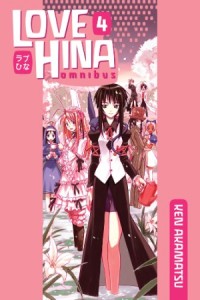
Love Hina Omnibus, Vol. 4

By Ken Akamatsu. Released in Japan by Kodansha, serialized in the magazine Weekly Shonen Magazine. Released in North America by Kodansha Comics.

I admit I put this volume on the back burner for a while. If ever there was a series that reminded me how much one can change and grow in 10-12 years, it’s Love Hina, which has lost a lot of the luster it originally had. This is an omnibus of three parts, appropriately since it covers three volumes. The first is the best, as Mutsumi helps to draw Naru closer to Keitaro and he heads off to America for a sabbatical. The second volume is all about introducing Kanako, Keitaro’s adopted sister and reader identification figure. Lastly, Keitaro returns and everything goes south for Naru, as the final volume is a chase of epic proportions to try to get Naru to admit her feelings or die. Die being what she’d prefer, really.
lovehina4

I tend to defend Naru a lot, mostly as the people who hate her tend to use sexist, horrible imagery in that hate, like many of the worst bashers in any fandom. Their hate is summed up by “she needs to be more nice to me… I mean him” and multiple uses of the word ‘bitch’. That said, Naru is certainly at her most frustrating here, dragging out the ‘do I really love him’ question to appalling lengths. Naru’s terrified of the future and things going wrong, and I completely identify with that. But add in Akamatsu’s comedic exaggeration and you want to cry at how much she can run away from her own problems. The end of this volume has her literally running away until there is no land mass left, to the northernmost tip of Japan.

Things are not helped at all by Kanako. I’ve mellowed a bit on Kanako over the years, and can see the appeal of a character who is designed to come in and call everyone out on the crap they’ve been giving Keitaro the last few years. Her naivete and hero-worship of her brother comes through quite well, and I liked the bond she forms with Naru (no surprise there, given Naru and Keitaro’s similarities). And given this was written in the late 90s rather than the early 10s, the incest subtext is meant to be creepy and wrong, for once. Kanako also gives us my favorite joke of the volume, where she dresses Mutsumi up as Keitaro to test everyone’s love… complete with ‘attachments’, so to speak. (“My brother’s would be at least that big.”)

I was reading this volume on public transport, which could be awkward at times. After a while, all the fanservice in Love Hina tends to mesh together so much you don’t notice it anymore, which is surprising given it’s everywhere. Characters are nude or near-nude through all three volumes of this, reminding me once more that Magazine skews much older than Jump or Sunday. And that’s not even counting the goth-loli Kanako, or everyone dressed as maids, or the Halloween costumes, or all the other service that’s here. Akamatsu works hard to please his audience, but you feel a little guilty about it all.

Honestly, any chance to read more Mutsumi is always welcome for me, but Love Hina is a classic example of what should have been a nine-volume manga dragged out to 14. Luckily, that means the next omnibus (only two volumes) is the last, and should wrap everything up for Naru and Seta. Oops, I mean Keitaro. Yeah, best save that little issue for Vol. 5’s review…

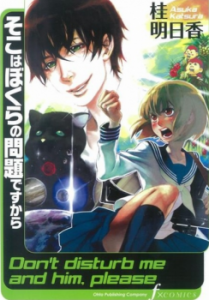
Don’t Disturb Me and Him, Please

By Asuka Katsura. Released in Japan as “Soko Wa Bokura No Mondai Desu Kara” by Ohta Shuppan, serialized in the magazine Manga Erotics F. Released in North America by JManga.

I… am not sure where even to begin. What the heck was this? Not since Sasameke have I been left with such a feeling of vague confusion and disgust. This one didn’t have quite the kick in the balls ending that Sasameke did, but it certainly matches it for weird gag humor out of nowhere and appalling over-the-top grotesqueries being presented as comedic. Which, to be fair, works at first, but as the manga goes on and tries to also have a real plot, the flaws inherent in the entire work become more apparent.

disturb

Given that the manga actually tries to have a plot, I suppose I should sum it up. Yaeko is a high school girl who reacts cutely whenever she’s tormented (or, more accurately, reacts in a highly amusing way), and thus has always been prey for perverts who want to dress her up, strip her, seduce her, or just rape her. Including her family. And her best friend, who in fact rapes her at knifepoint in the first chapter. While escaping said best friend by running nude through the streets at night, she’s helped by Rokuro, a gorgeous man carrying a teddy bear… who happens to match the description of a guy who’s been propositioning little kids around the neighborhood. After a series of misunderstandings, she injures his right hand, only to discover he has a high-stress job that absolutely needs doing. And so she moves in with him to be his right hand while it heals.

The reader, honestly, is meant to identify with the perverts here, as Yaeko’s reactions to everything are the best part of the manga. They are so over the top it goes beyond comedy into farce, and she frequently will be dressed as, say, a soldier or a Greek Statue for one panel only. She’s obsessed with proving that Rokuro is a lolicon, to the extent that she tries to frame him by going to a park and telling kids to pose for photos (realizing, a bit late, that this makes her a pervert – she’s even wearing the standard manga pervert outfit). Her complete lack of common sense is what drives the humor, along with her need to scream almost every line.

Sadly, Rokuro is not nearly as interesting – or indeed interesting at all. In the final chapter, we get an attempt at a backstory that explains his retiring personality and his tendency to chat up little kids, but for most of the story he’s a non-entity who exists to make Yaeko panicked and insane. He has a faux-girlfriend who (naturally) has a shotacon complex, who mostly seems to inhabit the manga so that the two of them have a third character to bounce stress off of. (Yaeko’s best friend, for obvious reasons, doesn’t fit this description. Which is a shame, as she was easily the most appalling (and therefore funny) part of this whole manga.)

I suspect this worked better serialized, but even them I think I’d be exhausted by the end of 20 pages or so. The author is better known for Blood+ and La Portrait de Petite Cosette, neither of which I believe are anything whatsoever like this. It has little to no internal logic, tries to tack on a heartwarming ending that is then ruined by both its heroine and hero, and is amazingly offensive at times (and by at times, I mean most of the volume). I will admit that I laughed at first at many of the situations, but by the time the final chapter rolled around, I was exhausted. (There were also several typos and misspellings, more than usual for a JManga release.)

I can’t possibly recommend this, as it’s bad, but if you’re in the mood to stare at your screen with your mouth open, you may want to try Chapter 1. If nothing else, it’s very different from anything else JManga has put out, and indeed any other Manga Erotics F titles I’ve seen.

Book Girl and the Undine Who Bore a Moonflower

By Mizuki Nomura. Released in Japan by Enterbrain. Released in North America by Yen Press.

One of the main themes of the Book Girl series has been elements of the past seemingly overlaying with elements of the present, and our heroes and other protagonists finding themselves trapped in a seeming reimagining of past crimes. Konoha, our hero, is especially notorious for seeing his relationship with Miu mirrored and kaleidoscoped in virtually everything he interacts with, but it also plays out with Takada, Akutagawa, and the other members of the cast. Including a girl from the 2nd novel named Hotaru Amemiya, whose presence is felt in this 6th book of the Book Girl series.

BookGirlv6Final

This novel takes place chronologically between books 2 and 3 (Famished Spirit and Captive Fool), during Tohko and Konoha’s summer break. That said, it reads better having come after the others, and has significant foreshadowing for the last two books, so it’s well-placed here. It also delves into the story of Maki Himekura, which isn’t too surprising, given she’s the one remaining main cast member who didn’t get a book of their own. I had worried that Famished Spirit would be all we saw of her, but that was Amemiya’s book, and its consequences play out a bit here, as we see Maki unchained, to a degree. Or rather, that’s what she wants to be.

Each Book Girl novel focuses on a specific work, and this one is no exception. I admit I’ve never read Kyoya Izumi’s play Demon Pond (I’m not even certain if it’s available in English), but its plot it helpfully laid out by Tohko along the way, so there’s no real need to. This book is also heavily imbued with demons and the supernatural, just like Famished Spirit, and even though most all of the ghostly elements are eventually explained as being all too human, the book has an atmosphere of tension, sort of like the old haunted castle romances of the turn of the 20th century.

This book takes place at the Himekura summer estate, so Takeda, Akutagawa and Kotobuki are absent. We do get to see Ryuto, however, Tohko’s cousin, and it becomes clear that Maki isn’t the only one deeply affected by the events in Famished Spirit. He and Maki clash immediately, with physical as well as verbal abuse. Not a surprise given how they’re both extroverted, flamboyant characters. As for Maki herself, she’s trapped in a situation that fans of Japanese manga with rich girls will know all too well – her life is already laid out for her and she can’t escape the thumb of her all-controlling grandfather. This helps explain (though not excuse) some of the rather unpleasant things she does in this book.

As for Konoha and Tohko, things are seemingly the same as ever. We get a classic Konoha panic attack here (though he’s just been kidnapped and is lost in a forest during a downpour, so I’ll grant him this one), and Tohko once again has a long speech at the end where she lays everything out for the cast, something that always seems a bit affected in these books, but fits the character perfectly. However, we also get a few hints of the final two books. Ryuto gives Konoha some prompts that, when eaten, given Tohko an altogether different attitude, and the final few pages of the book show Tohko in a highly melancholic state over the fact that soon she won’t be able to be with Konoha anymore. (The answer being ‘she’s graduating’, but given who Tohko is and the way this scene is written, it makes it *sound* as if she may have some wasting disease or something. I doubt the series is that downbeat, however.)

All five previous books of this series have bold type showing the inner monologue of the volume’s protagonist or antagonist, be that Takeda, Akutagawa, or whoever. Interestingly, the epilogue to this book’s bold type not only gives us a hint of Maki’s eventual fate (not sure how I feel about it, but that’s just the shipper in me talking), but reveals who the actual author of these pieces may be. If you’ve been reading along, it’s not much of a surprise, but the fact that we’re seeing it shows that we’re definitely getting all the cards laid out now. All that’s left is the final Book Girl story, which is so epic it will take two books to cover.