Monthly Archives: January 2013

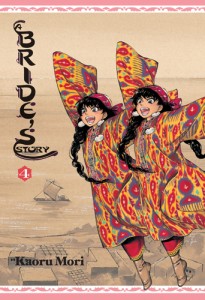
A Bride’s Story, Vol. 4

By Kaoru Mori. Released in Japan as “Otoyomegatari” by Enterbrain, serialization ongoing in the magazine fellows!. Released in North America by Yen Press.

I reviewed the two previous volumes of this series as Bookshelf Briefs, but continued to have the same issues I had with Volume 1. The quality was excellent, but I had trouble connecting with many of the characters due to Kaoru Mori’s standard operating procedure of placid people with vaguely repressed emotion. This was not helped by the release of her Something And Anything collection, which showed she could write loudmouths and comedy as well as the rest of them. And so, seeing this new volume was coming out and had a slightly more upbeat cover on it, I wondered if it would get me more involved emotionally.
Mori_A-Brides-Story-v4

Oh yes. Hyperactive tribe of loudmouths for the win! Actually, we do start off in Amir’s area, with ominous foreshadowing about her family’s clan, as well as a cute little story where the tribe’s resident tsundere, Pariya, finally meets a guy who may not be terrified of her. But the bulk of the story continues to follow Dr. Smith as he heads towards the West slowly (and thankfully does not run into the well-written but depressing angst that Vol. 3 gave us). Here he meets the twins of the title, who are rambunctious hellcats who can’t sit still and who are so much of a pair that a suitor for them would almost have to involve a pair of brothers so they aren’t separated. The bulk of this volume is dedicated to their trying to catch themselves a man, and their family’s eventual success at this task.

As I noted, this entire tribe seems a lot more lively than Amir’s. It’s not just the twins – their parents may be more mature, but they’re just as over-the-top. Indeed, the mother’s reaction to her children being unable to sit still for even two seconds is comedy gold. And for all that it looks as if the twins are trying totally stupid things to get themselves noticed and married off, when their mother and aunt talk about how they both got married, the stories are based off of coincidence and luck. This does not help to provide a good influence. And of course the couples contrast nicely, as each girl is matched up with a quieter, more cynical young man (childhood friends, of course) and the two couples learn how to take their own path and be slightly different. It’s only slight, too – I liked how it’s shown the two twins really are nearly alike, even in personality, and only differ in subtle ways that have to be picked up on.

Not all is sweetness and light, thought. I already noted the ominous first chapter with Amir’s tribe, but there’s a constant reminder here at how many folks die young – particularly women in childbirth. Pariya’s suitor notes her attitude, and his father says that the girls with ‘too much energy’ are the best. Likewise, the twins’ mother gives them one last request – stay healthy, above everything else. This is very much a series from another time, and it gives a poignancy to all these matchmakings.

Vol. 5 only came out in Japan recently, I think, so it may be a while before it hits here. In the meantime, we have a wedding to attend. Let’s hope this one is filled with more unambiguous joy than the others we’ve had so far. Though I have a feeling that, even as this series focuses on ‘different’ brides every arc, that we’ll soon be wandering back to Amir’s village.

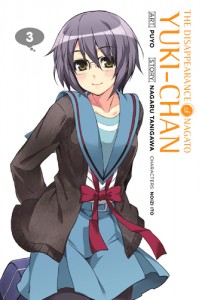
The Disappearance of Nagato Yuki-chan, Vol. 3

By Nagaru Tanigawa and Puyo. Released in Japan as “Nagato Yuki-chan no Shoushitsu” by Kadokawa Shoten, serialization ongoing in the magazine Young Ace. Released in North America by Yen Press.

A Quick Guide to writing manga AUs for the otaku fan, by Sean Gaffney.

I’m assisted today by Puyo, author of the Disappearance of Nagato Yuki-chan, a spinoff of the Disappearance movie filtered through the sensibilities of Puyo’s Haruhi-chan gag manga. With that in mind, let’s examine a volume of this series closely, keeping an eye out for handy tips.

yuki-chan3

The first thing to learn is that you have to know your audience. In this case, the audience are fans of the Haruhi franchise who read Kadokawa Shoten’s Young Ace magazine. They’re a built-in fanbase, and know the source material inside and out. This has its uses. You don’t have to delve so hard into character introductions, as everyone reading it knows who you’re writing about. And it means that your character interaction can be subtler. Take a look at page 27, which features Mikuru. Her dialogue, “I’m not very assertive, though, so I appreciate it when people can push me into doing things” is a redemptive reading for the original series’ Haruhi. This Mikuru is free to admit that she’s not simply being bullied and assaulted by a girl she can’t say no to, but is grateful for the assertiveness training.

In fact, this is another of the main bonuses to franchises like these, especially ones based on a light novel with a first-person narrator. Due to the viewpoint, the reader’s observations and biases are linked with the main character, as you rarely see scenes outside his purview. Even a straight manga adaptation, such as Haruhi’s, is forced by its source material into this narrow path. But in Nagato Yuki, the viewpoint is third person, which means we have the opportunity to see people in perspectives other than Kyon’s. This is particularly helpful in regards to Haruhi and Ryoko (or, as I like to call them, OTP), Both these characters change when they’re around each other. Ryoko, normally forced to be the perfect oneesama around Kyon and Yuki, lets out her childish immaturity near Haruhi. Likewise, the genki Haruhi is forced into the straight man role around Ryoko, and shows a genuine concern for her. Both characters benefit immensely from this.

The key in writing these sorts of AUs is to deviate from canon an acceptable amount, but not too much. In this case, the material is benefited by the movie itself, which gave us the shy, emotional Nagato used for this adaptation. Certain other AU adaptations, which I won’t name but rhyme with Bevamgelion, have taken their characters and made them 100% different from the original in almost every way, leading the reader to wonder why they simply didn’t create a new character? (The answer, as I’m sure you all know by now, is MONEY. Use your franchise well and use it wisely.) Nagato Yuki here is considerably different from the canon, to be sure, but the movie helped build a bridge, and there are enough signs of the original (Yuki’s explanations being incomprehensible, her reaching out for the stars) that it works.

Even Kyon, who has been poorly developed so far, gets a bit to do here, as his conversation with Ryoko shows that he seems more aware of Yuki’s affection than his canon counterpart, and is simply taking things slow. (As for Koizumi, well, he gets nothing. The others even acknowledge in the story how useless he is. We’ll be discussing this next month when we talk about the Kyon and Koizumi collection.)

In terms of things NOT to do – get back here, Puyo, and take your medicine – the artist’s art still needs work. His shading is too simplistic, especially in regards to hair. This means when you have Haruhi, Tsuruya, and Ryoko all standing near each other, they can be difficult to distinguish. I shouldn’t have to identify a person only by their hairband or eyebrows. There’s also quite a bit of fanservice here, but the artist wisely put it all in one eight-page chapter, along with the interstitials. And really, compared to some other Kadokawa titles I’ve seen, this is pretty tame. The readers of this book are the “D’aaaaawww, look at them being adorable!” crowd, they don’t need lots of nipples.

I apologize to the class for the cliffhanger ending, but Puyo assures us there’s a good reason for it, and reassures us that Yuki is not in fact killed by a car. That would make the rest of the series quite short. In the meantime, your homework is to compare and contrast this franchise to Evangelion – whoops, sorry, Bevamgelion – and Alice in the Country of Hearts, paying particular attention to which audience subset each separate spinoff title aims for. We’ll see you back here in May, and we’ll have a lot more to talk about with Yuki then. Dismissed!

Viz Licenses One Punch-Man

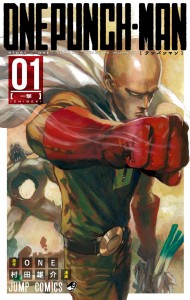
One of the most word-of-mouth popular manga of 2012 is now getting an official release in Viz’s online Shonen Jump Alpha. Technically, One Punch-Man is seinen – it runs in Young Jump’s online magazine. But I suspect that’s only for convenience’s sake, and there’s nothing in this title that isn’t hilariously shonen.

Onepunchman

That’s our hero on the cover, who is pretty much what the title says he is. But this doesn’t make him happy. Victory Is Boring. Of course, what One Punch-Man really is is a fun doofy parody/satire of superhero, kaijuu and monster comics in the Dragon Ball mode, while also having lots of genuinely cool action scenes. The writer, ONE, originally started it as an online webcomic. When Shueisha picked it up, they had the art redone by Eyeshield 21 artist Yuusuke Murata. The hero’s face when not posing manfully on the cover… simply makes me happy. I can’t wait to see this coming out over here. Luckily, I only have to wait a week!