Monthly Archives: January 2013

Psyren, Vol. 8

By Toshiaki Iwashiro. Released in Japan by Shueisha, serialized in the magazine Weekly Shonen Jump. Released in North America by Viz.

No, I haven’t really skipped Vols. 2-7. Psyren simply lends itself well to the brief, one-paragraph reviews I do for Manga Bookshelf every week, and I’ve covered them all over there. Nura: Rise of the Yokai Clan is a similar title. They’re both what I call ‘mid-range’ Jump titles. They’re not huge, breakout hits, and they tended to linger at the bottom of the table of contents when they were still running. But they fill the magazine, and they provide a good helping of ‘Friendship, Training and Victory’, Jump’s motto. The slow economy means we don’t see as many of these types over here now – Viz tends to wait for breakout hits, like Toriko and Bakuman, or more recently Nisekoi. But all this is not to call Psyren generic shonen. It has its very good points.
psyren8

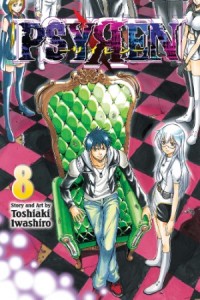
When we last left our heroes, they were back in the Psyren world, which is not particularly one of those good points. I find Ageha and company’s quest to discover the truth about their powers and trying to change history far more interesting when they’re back among the kids of Elmore Wood and their former Psyren mentors. I’m not sure the author agrees with me, but at least this time round we get a little bit more than just desolate wastelands and explosions of power. The attempts to change history are finally WORKING, and even though everything still goes to hell, this time Ageha and company have a few more allies to choose from.

If you take time to look at what’s going on in this volume, you’ll end up with the feeling that you’re being emotionally manipulated. Which, well, is what authors do. Almost every scene in this volume is there to make you squee with joy, or tug at your heartstringas, or laugh out loud (only a couple of times there – this is, for the most part, a serious series). You feel for our heroes when the bad guys take them apart (including ripping off Ageha’s foot, which looks appropriately gross), and grin when the cavalry arrives to rescue them and kick the villain’s asses. (The cover spoils the cavalry’s appearance a bit, but hey.) And the flashback describing the destruction of the world, as well as the death of many of the more adult Psyren charact4ers, is really depressing.

So, I hate the Psyren world, but I’m not alone. The reader really wants Ageha to change things so that this ISN’T the future they have to deal with. Unfortunately, I have a feeling that to do that, we’ll need to be here a while, but hey, there are checks and balances. By the way, if you have friends who read superhero comics and want to see what this manga thing is all about, Psyren would be a very good entry point for them, as it’s basically kids with superpowers they don’t quite now how to control battling a mysterious organization. There’s a little Teen Titans theme going with the Elmore Wood kids. And hey, one of the women in this volume even wears a hilariously awful fanservicey outfit which emphasizes her huge chest, even though she’s canonically shy and modest. What’s more superhero comics than that?

Psyren is not a Jump title you obsess over like Bleach or One Piece. You will forget about the series a few hours after you read the new volume. But that volume will please and entertain you, and gives you good shonen vitamins and minerals. Sticks to the ribs in your quest to stave off a hunger for more manga. Check it out.


Dengeki Daisy, Vol. 11

By Kyousuke Motomi. Released in Japan by Shogakukan, serialization ongoing in the magazine Bessatsu Comic (“Betsucomi”). Released in North America by Viz.

I’m trying to think when Dengeki Daisy went from ‘shoujo series I quite like’ to ‘one of my top recommendations for shoujo period’. Probably around Vol. 8 or 9, when the thriller aspects of the title were at their height. Of course, this is not to take away from the comedy or the romance, but Daisy blends all three quite well. Judging from the cover, you might think that this was another melodrama like We Were There, and certainly there are a few dramatic angsty elements. But what’s most thrilling about this title is that it feels almost like a movie – action revelations, lots of running around, kidnappings and threats. A modernized Republic serial, without all the stupid bits.

dengekidaisy11

This volume mostly deals with Teru’s friend Rena, who has come a long way from the ‘princess’-type we saw early in the series. She’s somewhat trapped in an arranged marriage due to her family’s business, and is not very fond of her fiancee. Nor should she be, as he is a jerk through and through, something that the author really doesn’t try to hide at all (she even apologizes to the reader for all the face time he’ll be getting). Amusingly, he’s also shown to be a second-tier bad guys, and the true villains such as Chiharu have little respect for him. But this doesn’t mean he’s not a danger to Rena herself, and the cliffhanger is set up beautifully. It also gives Teru a chance to experience what everyone else in her group goes through when she’s kidnapped or threatened… and I don’t think she likes it any more than they do.

Earlier in the volume, when everyone thinks that Kazuki is merely a jerk fiancee, they set about trying to support Rena and cheer her up – while at the same time allowing her to handle the situation, which she feels she needs to do. I love the way that this manga handles its romances. Both Kurosaki and Kiyoshi (who has a crush on Rena) want desperately to simply sweep in like a white knight and solve all their respective love’s problems, keeping them safe from all harm. But both know that that’s just selfishness, and try to keep a balance between protectiveness and simply being there when needed. (To be fair, this cast does get into danger constantly, so you can see why they’re edgy.) Honestly, few shoujo mangas out right now respect their female characters as much as Dengeki Daisy.

Other things to note: Rena’s trick to inform everyone of her true feelings was brilliant, and they’re right, I hadn’t even thought of that method since childhood. Also, when Kurosaki says “wholesome high school kids read Betsucomi”, all I could think was “And unwholesome kids read Sho-Comi!”. (Kyousuke Motomi, like Mitsuru Adachi and Rumiko Takahashi, likes to plug her own work and her bosses whenever she can.) And that final page simply looks fantastic. If you haven’t been reading this series, try to catch up. It’s a complete winner.

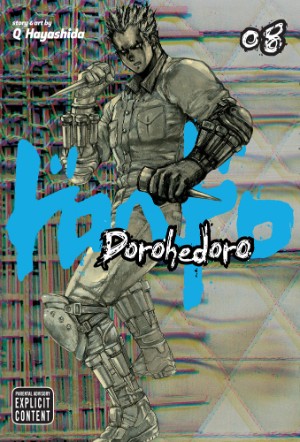
Dorohedoro, Vol. 8

By Q Hayashida. Released in Japan by Shogakukan, serialization ongoing in the magazine Ikki. Released in North America by Viz.

I’ve said a few times before that I don’t really read Dorohedoro for the plot, and it’s true. This is the sort of series that is best experienced by, when a new volume comes out, re-reading every previous volume just to remind yourself of all the little details. Since I don’t do that, I’m constantly forgetting things. But even I have to admit that the main plotline is starting to actually give us more than vague hints here. The Cross-Eyes are becoming more and more important, and Risu and Caiman’s search looks to be the same one, from different angles. Most of all, we meet a guy in a flashback who I have a sneaking suspicion is the one man tying this all together.

dorohedoro8

All right, enough of the plot. Let’s go back to talking about violence and humor, which are still this manga’s main fuel. Hayashida excels at writing grotesque action scenes filled with gore, and we certainly get that here. The highlight is probably Shin headbutting a man so hard his brain goes flying out the back of his head. I mean, this series isn’t rated M just for the breasts, you know. And quite often the violence and humor combine, such as the fate of the Cross-Eyed’s landlady, which is both horrible and yet somehow amusing. It’s hard to take an evil gang seriously when they’re such schlubs, and I can’t imagine what new bright-eyed character Natsuki sees in them.

The other thing threading through this entire series is drug use and abuse. The way magic works in this universe involves a lot of ‘black powder’ being sold to help non-magic users get a quick fix. Though they’re running out, so they’re starting to sell off some coarser fakes that aren’t as pure. No prizes guessing what the metaphor is here. Meanwhile, En is basically trying to build a new and better hallucinogenic mushroom, and finds that while it makes your wildest dreams come true, the comedown afterwards is rather harsh (poor Fujita…). I have to think at this point that En is aware that Chota is impersonating Nikaido and is just giving him enough rope to hang himself, given Chota’s pathetic attempts at impersonation.

But as always, it’s the relationships and friendships between everyone that are the main reason to read Dorohedoro. Shin may not have a crush on Noi the way she does on him, but his single-minded devotion to finding her is impressive to see. Nikaido and Caiman have swung back into their old groove, though I’m not sure how long that will last. Seeing Dr. Kasukabe reunite with his wife (who has a surprise new job!) is bittersweet but also rather touching, and I hope we see more of her soon. And then there’s Ebisu and her dream of her parents, reminding us that she is more than just comedy relief but a broken young girl.

I still can’t think of a dystopian title I’m enjoying more than Dorohedoro. I know that things will get much worse for everyone soon, but for once I’m actually looking forward to it. This cast does better when its backs are against the wall. And most importantly: will we see more of the Gyoza Fairy?