Monthly Archives: January 2013

07-Ghost, Vol. 1

By Yuki Amemiya and Yukino Ichihara. Released in Japan by Ichijinsha, serialization ongoing in the magazine Comic Zero-Sum. Released in North America by Viz.

One of the side-effects of reviewing manga and trying to hit most of the new Vol. 1s is that I get exposed to series that I wouldn’t otherwise pay much attention to. And this one definitely falls squarely into that wheelhouse. Epic fantasy isn’t really my thing, and this is overwrought epic fantasy of the finest order. That said, it’s quite good at what it does, especially since it’s apparently the debut work of both creators (who are female – I’m used to male manga creators collaborating, so this is nice to see).
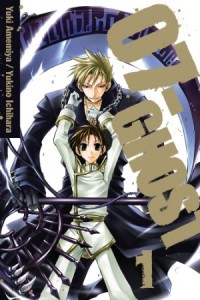
07ghost1

Teito Klein is your average fantasy bishonen, and indeed there’s more than a touch of the CLAMP influence here. He’s seen as cold by his military academy classmates, who don’t know how much he really feels. He has, however, managed to open up to one kid there, who has become just like family to him. That kid’s name is Doomed. Wait, sorry, no. It’s Mikage. They spend about 40 pages bonding and showing off that they’re skilled fighters, then Teito accidentally hears something he shouldn’t, and suddenly this military school becomes a lot more sinister and evil. Clearly the only thing to do is to run away and end up at a church filled with hot bishops, who are taking out evil wherever they may find it.

Given the authors’ past works (which consist of about 59 million Naruto yaoi doujinshi), I was rather surprised that this didn’t have quite as many BL overtones as I expected. Oh sure, Teito and Mikage have that close bond of friendship, but it actually feels like that. And Frau’s attentiveness towards Teito is somewhat undercut by his constant flirting with everyone and his porn collection. In general, this is about as gay as K-On is lesbian, which is to say that the main cast lacks any real females, so you ship what you can.

There’s a lot of religious symbolism here, with eyes given the names of archangels and discussion of heaven and hell (complete with reincarnation – as always, never let it be said that Japan settles on one religion when it can have them all). I liked the legend talking about the three dreams, which is both suitably epic and nicely sweet. I do note that I feel things went a bit too fast in this first volume. I’d have liked to see more at the military academy before Teito was captured, and we also get precious little of our main antagonist (who seems pretty ambiguous), Ayanami, who appears to have stepped out of the pages of Weiss Kreuz.

There’s a lot of goofy humor here, which helps to relive the tension caused by the apocalyptic events going on with Teito. Clearly he is a messiah figure here, and I imagine things are only going to get worse for him before they get better, which is somewhat sad given that this volume ends with his possessed best friend trying to kill him. Still, if you like CLAMP’s more fantastic titles, such as RG Veda, This should be a good read, and is a nice change of pace from Viz. (I always like seeing series in their plain old ‘Viz Media’ imprint, as opposed to Jump/Beat/Signature.)


Girl Friends The Complete Collection, Vol. 2

By Milk Morinaga. Released in Japan by Futabasha, serialized in the magazine Comic High!. Released in North America by Seven Seas.

When we last left our heroines, Mari had decided that her love was never going to be requited, and had decided to move on – sort of – and tell Akko that she’d gotten a boyfriend and had gone all the way. This leads us to the first half of this omnibus, which is Akko trying to figure out why this makes her jealous, and dealing with her own newly discovered feelings for her friend. The focus shifting to Akko is very welcome, as though she’s the outgoing one of the pair she is not necessarily more worldly or mature. We see flashbacks to her childhood that show her being very much a solitary person, and even when she made friends (via discussion of fashion and makeup) they didn’t seem to be lasting friendships. This is when she latched onto Mari.

girlfriends2

It’s interesting how Mari and Akko both have misunderstandings about the nature of their relationship, but in ways that are true to their characters. Mari is basically negative, with a “no girl could possibly like me in that way” sort of attitude. While Akko’s problem is that, after kissing Mari impulsively at karaoke, she assumes that all is now well and they *are* together, not realizing that actually discussion of such feelings is needed. This is not helped by Mari’s naivete – one of the best lines in the book is Akko’s exasperated “You don’t usually slip a friend the *tongue*, got it?” That said, this makes it all the more satisfying when they do finally connect and get together as a couple.

Of course, what does that entail? Since they’re both girls, going out together, texting each other late at night… they’ve done that before as just friends. So what’s different? Sexual attraction, of course, and unlike many a mainstream yuri (or faux-yuri) manga the author does spend a fair amount of time dwelling on this. Given both girls lied to each other about their sexual experience, each worries that they’ll screw things up somehow. (This leads to Akko looking at German Porn sites to see how girls do it, which made me laugh out loud). Eventually the two do take things to the next level, in a scene that sort of rides the edge of the OT rating that Seven Seas gave the book.

There is talk of the future, but it’s mostly the same sort of talk you’d find in books with a het romance – Akko’s going to a different school than Mari, leading to stress, but you know their love will see it through, etc. There’s a brief discussion of telling their friends and family about their relationship, but that’s not something that happens in the manga itself, nor do we see any of the fallout that might arise from being a lesbian couple in Japan. This is a seinen yuri fantasy for men that ran in Comic High!, after all. Reality is not welcome in its hallowed halls.

With all that said, I don’t think the manga suffers all that much from avoiding the harsher aspects of Mari and Akko’s relationship. This is meant to be adorable moe romantic fluff, and it succeeds admirably. The emphasis is more on romance here in this 2nd omnibus, but I was pleased to see that friendship is still given a huge spotlight – Sugi gets to be the ‘mature adviser’ type of friend, Tama-min the eccentric cutie, and we even get more development from Kuno and Taguchi, the other two girls in the main circle of friends. I was pleased to see that there was no effort made to pair up the other girls with each other… even though this isn’t overly realistic, having what’s called a “cast Full Of Gay” might have strained my credulity a bit.

It goes without saying that this is a great series that fans of yuri (and moe) will adore. That said, I do have one more very important complaint. If Akko is cosplaying Lum, then Mari should be Ataru… but she just doesn’t have the personality for it. Tama-min seems to have her cosplaying as Ryuunosuke, which she’s also unlikely to pull off, but I can see it if I squint. But if she’s doing Ryu, Akko needs to be Nagisa… which leads to even more problems. Tama-min needs to think these things through! Geez!

(Also, two of those omakes make me think that Milk Morinaga has watched too many 80s American sex comedies… Getting Lucky specifically.)

Paradise Kiss, Vol. 2

By Ai Yazawa. Released in Japan by Shodensha, serialized in the magazine Zipper. Released in North America by Vertical, Inc.

The second volume of Paradise Kiss continues Yukari’s journey into the glamorous world of modeling, even though it’s also about finding that you can’t simply drop everything and start a new career with nothing to fall back on. It’s also about her growing feelings for George, and realizing that a relationship with him is likely going to be far more difficult than becoming a top model. And of course it’s also a josei manga by Ai Yazawa, even within its pages. George is put out that the plot changed in between chapters, he’s chided for reading the manga and seeing Yukari’s inner monologues, and Yukari even gets in on the act, noting that she’s the heroine and can control who the hero is by who she falls for. It does seem a bit odd having her break the fourth wall along with the others. Yukari is the one that’s supposed to be the grounded girl among these flighty artists.

parakiss2

But Yukari’s image of herself is changing. Miwako helps her land a modeling gig that her sister is designing for (more Neighborhood Story cameos, as fans once again whine that this never got licensed), and she pulls it off quite well. She then uses that contact to get in touch with an agency that wants to promote her. Yukari’s upbringing has basically stomped her self-image into the ground, so there’s a constant feeling from her of waiting for the other shoe to drop. But no, she is really good at this. The words of praise and encouragement from everyone but George help as well, and set up the emotional climax of this volume, where she reconciles with her mother and agrees to return to school (but still model). It’s great stuff.

The problem, of course, is that she’s also fallen for George, hard. And while he clearly has a desire to see her succeed, mature, and become strong, he also does not given her any sort of support or encouragement – at least not explicitly. Yukari has a tendency to overthink everything, so pairing her with a man who’s almost impossible to read is frustrating enough. But you get the feeling that, unlike the rest of the cast, if Yukari were to fail or not measure up to George’s ideals, he would simply move on. He doesn’t emotionally connect, unlike the rest of the cast. We do get more scenes here of Arashi and Miwako’s relationship troubles, and the fact that he’s still jealous and fearful of Hiro. They are both easy to relate to. George is not.

(Poor Arashi is also the only straight man in a cast filled with outlandish characters, and you can see that it exhausts him. This is why he needs to make up with Hiro – he’d finally have someone to take the pressure off.)

George is an incredibly popular character. He’s handsome, dashing, trying to be a good lover (physically, at least – and he’s not the best at that either, as is lampshaded in a conversation between him and Isabella). But he has no interest in the give of a give-and-take relationship, and thus is the sort of guy you like to read about but would hate to deal with in real life. The one time in the volume that he really seems to open up to Yukari is when he’s talking about the clothing that he’s designed. Which is great for a manga that runs in a fashion magazine, but, like Yukari, I keep waiting for the other shoe to drop. In the meantime, though, no one can deny that this is a glorious soap opera, well-told.