Monthly Archives: September 2014

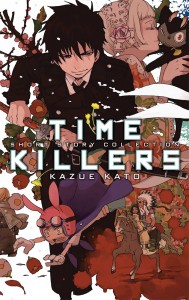
Time Killers

By Kazue Kato. Released in Japan by Shueisha, stories collected from various Jump one-shots. Released in North America by Viz Media.

Rabbits. There’s no helping it, that’s the one thing I take away most from this collection of short stories by the author of Blue Exorcist. There are romances, action adventures, tragic minimalist studies, and amusing comedies, but the rabbits seem to pervade the work. The author clearly likes her rabbits. Once you get past that, though, you’re left with a solid collection that nevertheless tells you what should be obvious: this is a hodgepodge of stories that together helped her write Blue Exorcist, which is better than all of them and her strongest work. This doesn’t denigrate Time Killers: in fact, you’d expect most collections of early works to be that way. Authors improve.
timekillers

The first story is one of the darkest, with the rabbit suit (which in this story looks remarkably like Arthur’s moth costume from The Tick) being one of the few bits of humor. A teenage boy whose life to date has been a series of tragedies now makes his living assassinating for hire, and yet continues to try to eke out an existence as a high school student. Now he has to kill the father of one of his classmates, a raging idealist who wants to save the world. It’s a terrific debut (the first and last stories in the collection are the best), and you can easily see why it was picked up as her debut.

The middle of the collection is more patchy. One story seems to be a post-apocalyptic Western where half the cast are talking rabbits, but it never really gelled for me, possibly as the main human kept reminding me too much of Naruto. There are some excellent 5-6 page short stories that show off Kato’s art and sense of pacing, both with minimal to no dialogue. Redemption also features in a few of these, with a young man who has to care for his daughter realizing that he can’t keep running from life forever (and literally getting away with murder… the comedic tone of this story is deliberately jarring, which I quite liked). There are also a few stories that just didn’t work for me, such as the one with the “magic girl rice bowl”, and the romance among aline invasion, which needed more development and room to get the reader to care about what was going on.

As I said earlier, the highlight of the volume is the final story, The Miyama-Uguisu Mansion Incident. You can see the seeds of Blue Exorcist sprouting here, and not just because the two leads look like Rin and Shiemi. The art has come to the point where it can almost carry the story by itself, and the theme of gaining enough strength to be able to save someone important to you is one that resonates powerfully for a Jump viewer. The villain is nicely evil and over the top without quite descending into camp, and there’s an air of sweet melancholy that drapes over the whole affair. It’s a fine work.

Viz hasn’t skimped on the presentation – the paper quality is high, with many color pages throughout. Any Blue Exorcist fan should pick this up, and if casual readers get it and enjoy it, go track down Blue Exorcist. Also, it has lots of rabbits and rabbit costumes. Far more than your average Jump title.

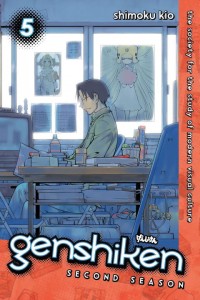
Genshiken: Second Season, Vol. 5

By Shimoku Kio. Released in Japan by Kodansha, serialization ongoing in the magazine Afternoon. Released in North America by Kodansha Comics.

I’ve reviewed the last couple of volumes of this sequel to Genshiken in Bookshelf Briefs, and have remarked several times that it almost feels like they’re trying to aim for a new demographic with all of the new cast being of a more BL tilt, and the graduation of most of the previous players. That said, there are still characters dropping in and out throughout, and Madarame has been a constant, if smaller presence. Well, that changes here. The new volume starts with a definitive ending to the most talked about plotline of the old series, and helps to set up a new one that will also star Madarame, who has never been the viewpoint character but has always been the face of Genshiken, so to speak.

genshiken2-5

The old plotline is, of course, Madarame’s crush on Saki, and the fact that she’s been sort of aware but ignoring it. Last volume she admitted this, and the rest of the club set things up so that they could be alone and he could confess. No one – not even Madarame – seriously expects anything but a rejection. After all, Saki has been dating Kousaka since the series began, and while the majority of fans aren’t really thrilled with that, their love for each other has never been in question. (In fact, the scenes with Kousaka here are some of his best, as I finally begin to understand a character I’ve always had trouble with. As for the “confession” itself, it was very Genshiken, being both hilarious and heartwarming, and the aftermath slips to purely being the latter.

It feels like an ending, as Kio himself lampshades, but there’s still a lot of things to resolve. For one, as Saki notes, Madarame is busy obliviously gathering a harem of his own. Keiko gets a lot more face time here, and we see more of why she’s interested in someone with all the baggage that Madarame has – baggage that gets worse when he decides to quit his job, saying himself he wants to see how far he can fall. As for Hato, his crush on Madarame, if it is one, is still wrapped up in his own identity, which is in flux. This is painful for him, and it’s almost reminiscent of Wandering Son at times, except Hato is far less accepting of his own desires. Having Hato and Madarame intersect like this is a perfect plot – they’re the two most interesting characters of all of Genshiken.

Other than that, it seemed appropriate to devote a chapter to Ohno and Tanaka, who are almost the forgotten couple of the manga (partly die to Tanaka mostly being together about thin gs – even here he’s the adult.) This is also quite cute, and has a nice heartwarming scene that could be construed as a proposal – that’s certainly how the club takes it. And while there isn’t much Sue, the cliffhanger makes me think we may get more of her next time. Genshiken hasn’t forgotten about its old fans, but still has plenty for new readers. If you enjoyed the series before, this volume will not disappoint you.

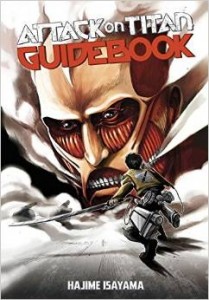
Attack on Titan Guidebook

By Hajime Isayama and the editors at Kodansha. Released in Japan by Kodansha in two separate volumes, “Inside” and “Outside”. Released in North America by Kodansha Comics.

Shonen manga in Japan get quite popular, and as you’d expect, fans want to know absolutely everything about their favorite characters, things that wouldn’t necessarily come up in the manga proper. For those people, there are guidebooks like these – they consists of bios, recaps, examinations of all the little fiddly bits, character popularity polls, favorite quotes, etc. They allow the creator to reveal some information that would likely fit awkwardly if it had to be inserted into the story proper, and let fans understand the characters and story better – OMG, Jean is an Aries! Just like me!

tit

For those familiar with these sorts of guides, the style is unsurprising, but if you aren’t, be prepared for lots of superlatives. At times it reads like a gossip magazine, with lots of punchy headlines and exclamation marks as it tells the story of the 104th training squad. These are two books released separately in Japan joined together, and sometimes you’re able to see that – the book has spoilers through Vol. 11 of the series, but much of the first half seems to have spoilers only through Vol. 9. It can also be somewhat inconsistent – the book takes pains not to discuss Reiner and Bertholt’s secrets in their bio, but has no issues revealing Ymir’s.

There’s a long interview with Isayama where he discusses the major influences on the series – many may be surprised to here one of the biggest was Muv Luv Alternative, though those who have read the visual novel itself may be less surprised – it’s darker than Higurashi. I was less surprised to hear about the influence of Saving Private Ryan in regards to the emotional reactions of the soldiers. The workings of the manga industry are briefly shown, as Isayama discusses how he was asked to move to a more expensive apartment so that he could fit his assistants in it – but then had to make the series a success or he couldn’t afford the apartment!

Where the guidebook excels is in giving a name and backstory to the minor characters like “girl who dies in Volume 2” or “that one guy whose name I can never remember”. Isayama’s art is terrible, especially at the start, and this guide is a boon for those who can’t really tell apart the 5-6 different soldiers with short blond hair. There’s also a lot of discussion of the mechanics of titans and how the vertical gear works, and to show it’s not all grim darkness there’s also some cute fake interviews with the cast, and Isayama drew some AU art based on reader suggestions, such as Sasha, Connie and Reiner forming a band.

Obviously this is not something that you want to pick up if you’re new to the series and wish to see what it’s about. Read the actual manga instead. For those who are fans of the manga, though, this gives you lots of facts and figures, reminds you of your favorite moments, and is a good go-to reference guide. Also, I think the original must call Sasha a boke about 80,000 times. “Airhead” is the translation here.