Monthly Archives: September 2014

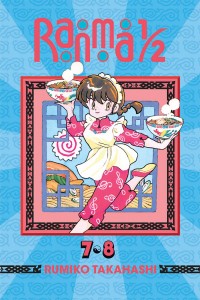
Ranma 1/2, Vols. 7 & 8

By Rumiko Takahashi. Released in Japan by Shogakukan, serialized in the magazine Shonen Sunday. Released in North America by Viz.

I’ve joked several times in the last few weeks about warning people that this volume features the debut of Happosai, but there’s a kernel of truth to that warning: Happosai is repugnant, and a polarizing figure both within Ranma fandom and within the series itself. Not because anyone really likes him – even his fans think he adds some fun comedy but don’t like him personally – but whether the comedy he adds to the series is really needed. Because Happi is defined by being a pervert – yes, an incredibly strong martial arts master pervert, but a pervert just the same. He feels up women, he steals their underwear, he literally gains strength through contact with females. He is a walking trigger warning. He’s meant to be the male version of Cologne, but Cologne’s actions all serve a greater purpose – at least so far – and Ranma learns a great deal from her. For all that Happi is supposed to be training Ranma as his successor, there’s no lessons, no training, and no point. He is a pox on Ranma 1/2, and will be here till the end of the series. He doesn’t even make horrible puns, like Cherry, his spiritual predecessor from UY, did.
ranma7-8

(breaths out) I feel better. Now let’s talk about what was fun this volume. Ranma has settled into doing what it does best, which is ‘almost anything goes in the name of comedy’. (It’s not *quite* as over the top as UY, so I added the ‘almost’.) There’s lots of martial arts battles, as we see Ranma, Akane and Shampoo compete in martial arts takeout delivery, as well as Akane and Ranma fighting to defend the name of their supposed school when a Dojo Destroyer comes to town (the Destroyer himself looks like a ridiculous over the top stereotype, and barely speaks, but I’ll gloss over that for now. And there’s plenty of comedy, as Ranma’s class puts on a production of Romeo and Juliet, which means a lot to Akane (who was Romeo as a kid, but now finally gets to be Juliet), but little to any of the various competing Romeos, including Ranma. (I was highly amused to see her yelling at Ranma for not reading the play, as in the end all Takahashi takes from the original is ‘balcony scene’ and ‘kiss’.)

There’s quite a lot of time devoted to Ranma (and sometimes Genma) trying to find a cure for the curse, and there are a few temporary cures but nothing really permanent. While this will still play out across the series, as we get further in Ranma simply gets more accepting of his dual nature, and seeing the desperation shown here is interesting. As for Ranma and Akane themselves, they’re both quite attracted to each other and sympathetic to each other’s pain once they pause to think – but they hardly ever do that anymore, so when we do see such moments (Akane bringing Ranma warm food and drink in the backlot), it’s nice and heartwarming. (The box Happi hides under in that scene, by the way, has a reference to Nura: Rise of the Yokai Clan. Wrong company! Shogakukan should be turning in its grave! Don’t tell me they aren’t dead, I’ve seen what Sunday sales in Japan are like lately.)

Miscellaneous thoughts: At one point, when Genma is at his absolute sketchiest, Kasumi calls him annoying. For Kasumi, this is a devastating comment, particularly this late in the series. Both Genma and Soun come off particularly badly in this volume, both as former disciples of Happi who want to be free of him but can’t do anything about it, and as parents who try to trick their children into marrying each other. Nabiki still exists mostly as the “normal” character – we see her deny she’s related to her family more than once in this volume – and Takahashi’s habit of showing her constantly eating is in full force here. Kuno and Gosunkugi are also as loopy as ever – Gosunkugi in particular suffers so much and is loathed by so many you can’t help but laugh at his pathetic awfulness.

Another solid volume of Ranma, though those who found the series beginning to grate at this point and hoping for more plot resolution are only going to get more annoyed as it goes on. Next time around we’ll introduce our final main cast member, and one who’s even more polarizing in her own way. Not because of her own characteristics, but because of how she gave fans who hate Akane a real alternative, and the ship wars truly began in earnest. Next time, we’ll talk Ukyou Kuonji.


Hayate the Combat Butler, Vol. 24

By Kenjiro Hata. Released in Japan as “Hayate no Gotoku!” by Shogakukan, serialization ongoing in the magazine Shonen Sunday. Released in North America by Viz.

This is probably my favorite volume of Hayate the Combat Butler to date. It manages to resolve the Athena storyline with a lot of fighting spirit, emotional turmoil, and one big “call my name” rescue by Hayate. But is also has a great deal of heart, as we see Hayate’s reunion with Athena, Hina’s heart-to-heart with Ayumu, and some strikingly normal and non-insane life advice from Yukiji. And don’t worry, there’s a good amount of humor here as well, mostly featuring the minor cast back at the hotel having to fight off a pack of mythological beasts. This volume packs a lot of stuff into it, and it’s no surprise that the emotional resolution of Athena’s storyline will carry over into Volume 25.

hayate24

We also see Nagi at perhaps her most mature, even as she insists that Hayate can protect her from anything. Nagi has been a bit of a polarizing character, being both underage *and* tsundere, but even her detractors seemed to like this scene, where she crushes the stone that represents Hayate’s moral dilemma, and announces that she will deal with the consequences no matter what. Of course, I doubt she really realizes what it’s like for a girl like her to live without money, but it’s still great to see.

Likewise, it’s always nice to see Yukiji as the big sister that she usually tries to avoid being. She senses Hina’s abject depression even over the phone, and so flies over there to set things right. (Hina lampshades that this is possible, as she notes Yukiji would have to fly all the way from Italy… which isn’t that far away from Greece, in fact.) Yukiji’s advice is blunt but necessary, as Hina (and Ayumu) both need to be reminded that even in a manga, you sometimes can’t get the happy ending you want, and that this is what life is – a series of struggles. The friendship forged by Hina and Ayumu is important right now, as they can console each other – and also note that it’s nice to be in love with a man who’s loved the same woman for 10 years now, rather than an indecisive player (which Hayate is often accused of being.)

Hina also gets to be at the final battle, as Ayumu and Aika coerce her into dressing as Red, the super sentai hero. Then a magical sword drags her to the battle (literally) that Hayate is having with a possessed Athena and King Midas. There’s little to no humor here, as we see Athena’s struggles and Hayate’s anguish in raw, unfiltered scenes. Yet even here, Hata can’t resist making cultural references – the entire finale is an homage to the end of Shoujo Kakumei Utena, with Athena trapped in a dark place surrounded by swords, and Hayate breaking through in order to rescue her from her despair. It’s hard not to cry with happiness as they embrace, Midas vanquished at last – even as Hina, making a quick exit, is trying not to cry in emotional pain.

The last chapter is pure romantic shipping fluff, as Athena gives into to her grumpy tsundere side (that 3/4 of this cast seems to possess) and tries fishing for compliments while at the same time being upset by them – witness her attack on Hayate after he notes how he was surprised how large her breasts had gotten. As the volume ends, Athena starts to tell Hayate how she escaped from the castle ten years ago, but I have a feeling that we’re also due for a parting soon – after all, Hayate is up to Vol. 41+ in Japan, and did not end with Hayate and Athena ending up together. So expect the next volume to nudge back towards the comedic status quo. For now, however, this was an amazing volume of shonen manga, and well worth the temporary departure from comedy.

Phantom Thief Jeanne, Vol. 4

By Arina Tanemura. Released in Japan as “Kamikaze Kaitou Jeanne” by Shueisha, serialized in the magazine Ribon. Released in North America by Viz.

Before I get started, I want to note that I remain immensely pleased with this series. It has a lot of what magical girl series should have, a nice sense of humor even in its darkest moments, a good deal of cuteness, and the ongoing plot is fascinating. Everyone should be picking this up. With that said, let me spend this review dwelling a bit on things that felt problematic to me in this volume.

jeanne4

To be fair, one of these things is sort of unavoidable. In her massive villain rant at the start of the series, Finn Fish reveals that Maron has been manipulated, not just since she met Finn, but since birth, as it was the influence of Satan that led to her parents breaking up. I dislike the agency that this removes, and feel that it makes her parents less interesting people – their almost shallow horribleness was a large part of what made Maron so strong and interesting. But then that’s Finn’s point, and certainly if you’re in a series where God and Satan are real, you have to expect temptation to have more concrete forms.

Less excusable is Maron’s forgiveness of Noin’s actions once they go back in time to meet Jeanne D’Arc. She immediately rationalizes the attempted rape by noting that if he’d meant to go through with it, he would have done it while she slept, and also points out that it was due to both being possessed by a demon and his love for Jeanne. Which, yes, is true, but the whole “It’s OK, you were just overcome in the heat of the moment” forgiveness rankles in many shoujo titles. We also have several moments in the second half where Chiaki is attracted to Maron so much that he forces himself on her multiple times. This is meant to be half-amusing, and he beats himself up over it, but that doesn’t actually stop the attempts, even when he knows she’s in a fragile state.

And then there’s Miyako. She gets less of a role to play in this volume until the end, clearly upset that the “phantom thief” isn’t appearing anymore. The problem is that her plotline is mostly resolved – she’s realized that Chiaki loves Maron, and that she can’t really do anything to change that. So, as she herself notes, all that’s left to do is confess to him, get rejected and move on. She is, therefore, too nice to be an antagonist anymore. And that has to be fixed, so at the end of the volume we see her abducted by Finn, and she later pops up, I suspect, clearly possessed by evil. I wish there were a more natural way to do this.

That said, there’s still so much to love about this volume, don’t get me wrong. Everything about Finn’s past and her relationship with Access is beautifully tragic, and (typical for Japan) paints God as being not all that much better when it comes to forgiveness. Yamato’s confession to Maron, and subsequent rejection, plays out beautifully, and is likely why Tanemura wanted to avoid repeating it with Miyako. And the time travel arc is handled surprisingly well and logically, and among its questionable forgiveness does have Maron assuring Jeanne that being raped does not make you less good of a person.

To sum up, see the start of this review. Even with my issues, it’s still far and away by favorite Tanemura series.