Monthly Archives: May 2015

A Certain Magical Index, Vol. 3

By Kazumi Kamachi and Kiyotaka Haimura. Released in Japan as “To Aru Majutsu no Index” by ASCII Mediaworks. Released in North America by Yen On.

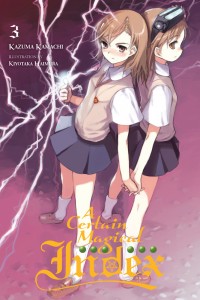
Index had a good start, but I felt the second novel was a bit rushed and inconsequential. Luckily, there’s no such issues here, as Kamachi puts out one of the strongest books in the Index series, and one with a lot of consequences, not least of which is the inspiration for side-series A Certain Scientific Railgun, which especially in the West has become more popular than its supposed parent. We continue to examine the world our heroes live in, this time entirely on the ‘Science’ side of things, and see just how far researchers will go in the search for knowledge and power, a running theme in this series on both the Science AND Magic sides. And we also meet a few characters who will prove very important down the road, for reasons that I will awkwardly try not to spoil here.
index3

Introduced in this volume: Kuroko Shirai, Misaka 10032 (aka Misaka Imouto) and her clone sisters, Accelerator, Maika Tsuchimikado (who I had forgotten gets introduced before her brother, though blink and you’ll miss her appearance.) For Railgun readers, well, you know this one. In fact, you know more than Index readers, as Railgun expanded this arc greatly.

The series may have as one of its main themes that trying to achieve knowledge for its own sake is a dangerous thing, but I can’t really ignore the fact that the series also has its unironic shonen side to it. This seems to aggravate readers, and not just in Index, as I know a lot of long-running shonen series have fans who keep hoping people will get killed off or the heroes will fail just so that manga can be more like DC Comics. Likewise, Index (who, along with Himegami, barely appears in this volume) is a lazy, hungry ball of moe, and therefore jars with anyone who wants to take A Certain Magical Index seriously. But I think it’s the tension between the two that makes it interesting – Touma goes through a ridiculous amount of hurt here, and the idea that he’s still getting up near the end of the book is laughable – but that’s what you do in shonen. You get back up.

Mikoto gets her first major role here, and I’m amused at the difference between the way she acts around Touma and the way Kuroko says that she is afterwards – dealing with Touma relaxes her, which is important given what she’s been trying to achieve. This isn’t her series, so she doesn’t get to save the day, but it’s her pain, and desire to kill herself if it will help to save her clones, that drives Touma to go beyond the impossible again and save her. She’s a serious girl, who clearly places a lot of weight on the choices she makes, even if she’s ignorant of what they mean. After this book, her popularity skyrocketed even higher, and I imagine Railgun was in development by around the 5th volume of Index.

Kuroko does appear here, but doesn’t do much beyond glomp Mikoto a couple of times and give exposition to Touma. Her lecherous habits will have to wait for a future volume for me to be irritated by them. Accelerator is more interesting. I’d forgotten that he actually had some depth here beyond “I am the villain of this arc”. He’s clearly bored with the entire experiment, demanding from the Sisters that they at least make it worth his while to bother coming out. He also states outright why he’s doing this – to be left alone. Being the most powerful Level 5 in the city means that everyone tries to challenge him all the time. This is why he gets so excited when Misaka Imouto, and later on Touma, actually manage to hurt him a little bit. It elevates the tedium. Unlike Isard from last volume, he’s not mentioned at all in the Epilogue beyond the experiment being suspended. The last we see of him is flying through the air via Touma Airways. I wonder if he’ll be back? (Spoiler: Yes, he will be back.)

This was also the first volume where I didn’t find Kamachi’s writing style difficult to get into. He’s still a very eccentric writer, and his narration can meander much of the time, such as when he’s discussing Japanese baseball pitchers, or explaining the plot of Index Volume 1 because Touma’s lost his memory and Mikoto wasn’t there. But it’s a page turner, even more than the last two, and you really want to find out what happens next. Also, his exposition, though frequent and voluminous, can be quite interesting. Not so much worldbuilding as a world textbook. Yen’s translation is quite good. Note they have a company policy of no honorifics, so Misaka Imouto is Little Misaka, and Kuroko says Big Sister rather than Oneesama. I think this is fine, though don’t be surprised if I tend towards what I’m familiar with in future reviews. More importantly, Misaka Imouto’s eccentric speech pattern is kept intact, which is hopeful news for Last Order fans waiting for Volume 5.

If you haven’t read any Index and want a volume that will show you why it’s popular, skip the first two and get this one. It really is excellent. Also, a reminder that Touma and Index spend the entire volume carrying cats around.

Kagerou Daze I: In A Daze

By Jin (Shinzen no Teki-P) and Sidu. Released in Japan by Enterbrain. Released in North America by Yen On.

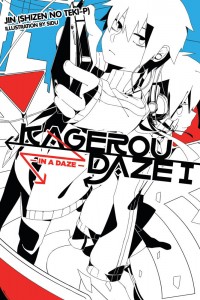
Writing something that is merely one part of a massive media franchise can in many ways be even more difficult than it is to create an original story – even if you’re the original creator. The writer has to balance out giving the fans who know everything already exactly what they’ve been expecting, and trying to create a space where new readers who may pick up the book sight unseen are encouraged to continue. Kagerou Daze is one of these books. It’s based on a series of songs created for the Vocaloid series, which became wildly popular. They thus spawned this light novel series (6+ volumes), a manga adaptation (also 6+ volumes), and an anime series with a completely different name (Mekakucity Actors, complete in one season and highly controversial.)

kagerou1

The novel is told in two parts, essentially. The first concerns Shintaro, a young man who has been holed up in his room for the past two years and whose narration verges on the histrionic, and Ene, his sentient AI whose job is apparently to annoy him so much that he forgets to be depressed. When his keyboard and mouse are damaged and the Obon holiday means he actually has to leave the house to replace them, he goes to a department store and gets caught up in one of the stupider terrorist attacks I’ve ever seen. The second and third sections are narrated by his sister Momo, a pop idol despite her best efforts who is having tremendous trouble dealing with the fame and the fact that she apparently causes it without really knowing why. She meets up with a group of teens who all have superpowers stemming from their eyes, and finds they can teach her how to control her own abilities to make everyone watch her.

So far so good, and the characters are all mostly likeable, though I think the guy whose outward persona is ‘be a jerk until people relax around each other’ is trying a bit too hard. There’s typical anime ‘types’ here – said jerk; the grumpy NEET; the ditzy younger sister (I know she’s bad in school, but 2 out of 100 is pushing it); the stoic girl with a side of tsundere, the shy to the point of extremes girl. The problem for me is that after finishing the first book (it’s quite short, probably the shortest of the recent Yen On releases), I’m not actually remotely sure where it’s going or what the plot is. There’s a cliffhanger ending of a sort, involving danger to someone we’ve never met before. There’s also interludes featuring a young sort-of couple who are apparently reliving the same trip to the park over and over again, possibly as one of them keeps dying, and it’s almost Higurashi-esque.

It’s diffuse. There’s very little to hang your hat on, so to speak. As I said above, these are based on a series of songs that, taken together, tell a sort of plot. I admit after listening to the first, “Artificial Enemy”, I am very glad that the creator chose to not end it by killing off the AI, who is annoying but probably the most amusing part of the cast. But it reads very much like a series where the author knows he can take his time to draw the plot out over several books as he has a built-in audience which will get it no matter what. That could be the case here as well – Kagerou Daze has over 2K stories on Fanfiction.net, even more than Sword Art Online. I just wish I knew more about what was going on.

Dorohedoro, Vol. 15

By Q Hayashida. Released in Japan by Shogakukan, serialization ongoing in a Shogakukan magazine to be named later. Released in North America by Viz.

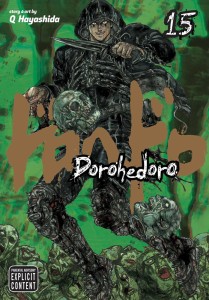
Readers of this manga will know already that it can be very, very violent and blood-filled. It’s not all buff babes and gyoza, there’s a good deal of death and dismemberment – the main reason it’s rated M, in fact. But even for Dorohedoro, Vol. 15 really pushes the envelope of what its readers can take, offering up some truly disturbing and grotesque imagery. And it’s actually rather fitting, as the main character sees his various personas fractured beyond belief… oh yes, and we find out that the main character has been a lot more characters than we may have previously believed.

dorohedoro15

This is not really news for anyone who has been following the plot of the last few volumes closely (and if you are one of those people, I commend you – I love this series, but half the time I can’t remember what’s going on), but this volume spells it out: Caiman = Aikawa = Kai = Ai. Of course, we as the reader know this, but the cast are still somewhat in the dark. The cross-eyes wonder why their boss doesn’t have the distinctive markings. Risu needs to know more about the details of his curse. And En’s group don’t really care about Ai, as they’re still trying to find a way to resurrect En, who is busy attempting to incite rebellion in Hell (and failing), thus showing us that he really is dead. But as we’ve seen in Dorohedoro, death rarely means much. (Unless you’re Natsuki. Sorry, Natsuki.)

Dorohedoro is so addictive in part due to its imagery, and there are some excellent examples here. It rains in the Hole, which is pretty much unheard of – and bad news for most sorcerers, who find it nearly crippling to them. Nikaido may now be able to use her magic to change time and other deus ex machina things, but it comes at a cost – her magic is now literally rendered as a giant gun with only 5 shots, and she’s already used one of them – four left and then she has no more magic ever. Oh yes, and she’s still dealing with the whole ‘devil horns’ thing. And as for Ai, fusing with a giant mutated monster covered with severed heads seems all too appropriate given what’s been happening with him.

This far into the series, I’m not sure there’s much to offer the new reader, but there’s also not much to make old readers drop it, either. What we’ve gotten before is what we get now. There’s some amusing humor scattered throughout. There’s some nudity and fanservice once in a while (for a certain definition of fanservice). Sometimes we get both together, as when a recovered Ebisu realizes she’s naked among a group of her close friends and completely freaks out. But most of all, Dorohedoro has finally started to answer most of the mysteries it’s been posing, and we’re eager to see what’s going to happen next. Will En be resurrected? Will Nikaido manage to save Caiman? Is there even a Caiman to be saved? Provided you can accept the fact that this volume is twice as disgusting as a normal Dorohedoro volume (is there such a thing?), you’ll enjoy pondering these questions as well.