Monthly Archives: May 2015

The Ancient Magus’ Bride, Vol. 1

By Kore Yamazaki. Released in Japan as “Mahou Tsukai no Yome” by Mag Garden, serialization ongoing in the magazine Monthly Comic Garden. Released in North America by Seven Seas.

There have been so many fantasy series released over the past few years that it can be a bit difficult to sort out the wheat from the chaff, and you find yourself looking for some plot point or character that makes the new license stand out from the pack of selkies, vampires, goblins and fairies that dot the manga landscape. I’m not sure that The Ancient Magus’ Bride possesses anything that makes it immediately leap out at a reader, expect perhaps for the skull of said magus himself. But what it does have it a strong plot, likeable characters, solid, pretty art and a desire to get the next volume in the series the moment you set the first one down. In other words, no flashy stuff here, just a very, very good book.
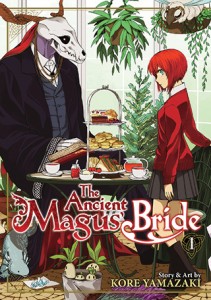
magus1

The premise is that a teenage girl who has spent most of her life shunned by friends because she can see “invisible things”, and whose mother has passed away, is kidnapped by a bunch of alchemists, who realize that she is a Sleigh Beggy, which is to say a giant magical sponge. Luckily for her, the one who purchases her is Elias, who may have a face like a cow skull and claim that he plans to make her his bride one day, but in practice seems happy to take her on as an apprentice, showing her the joys and dangers of a world where magic is slowly dying but still present, and allowing her to use her considerable power to try to help those in need.

As I said above, I’m not sure where the ‘bride’ thing is going, but given that Chise is 15, I hope it’s nowhere anytime soon. Chise herself is a fairly quiet, reserved type, as you’d expect from a child with her past – we see her pondering suicide in one flashback – but she is also very much attuned to the wonders of the world she is now part of. This can be dangerous – in the first chapters, she’s almost kidnapped again by “helpful” fairies who try to take her to their own land – but also tremendously heartwarming, as when she’s kidnapped AGAIN, but this time manages to help a dying dragon have a vivid and wonderful final dream before he passes on.

It’s a bit difficult to know what else to say in a review like this, as I don’t want to spoil too much, but I will say that I was smiling a great deal as I read it. There’s likeable supporting characters – Angelica in particular is awesome, and there are some interesting bad guys who pop up near the end as well. As I said before, the art is excellent, showing off the world it’s creating without being too complex or showy. And you really want to see Chise learning more and growing into her power fully, as well as realizing what life can hold for her and learning to love herself after spending so long on the edge of despair. There’s also some humor, mostly from Elias – or rather, against Elias, who gets beaten up for not remotely recognizing the trembling of a young maiden’s heart.

There’s nothing specifically outstanding about this title so far, but it doesn’t put too many feet wrong, and as such ends up adding up to something excellent. Mag Garden’s titles are somewhat genreless, but I think this is a title that could appeal to both men and women, even if it has a bit of a shoujo feel to it. Seek it out immediately.

A Silent Voice, Vol. 1

By Yoshitoki Oima. Released in Japan as “Koe no Katachi” by Kodansha, serialized in the magazine Weekly Shonen Magazine. Released in North America by Kodansha Comics.

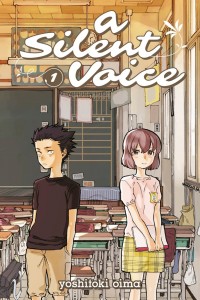
There have been many manga releases here in North America that deal with the subject of childhood bullying – it’s a theme in Japanese manga that is getting more and more of a workout lately, as the ability to simply blame the victim and look away gets harder to do. This doesn’t mean, however, that it’s always accepted or welcomed. A Silent Voice won an award for its original one-shot chapter, but took years to get released as a series – in fact, there were apparently lawsuits. This is likely due to the fact that it has not one but two things that there is a desire to gloss over and not bring out into the open – childhood bullying, and disabilities.

silentvoice1

The blurb on the back cover says the word heartwarming was made for a manga like this, and I can only imagine readers will finish the first volume and want to give the writer of that blurb a good swift kick, as this initial volume is all heartbreaking instead. You can see why this title was shied away from. It’s not shy about showing exactly how a culture of bullying works, and how quickly it can turn against anyone. It shows the apathy and outright cruelty of teachers, how parents can seethe with anger or merely stand there unable to do anything. And in the end our hero, who’s a childish brat who discovers that harassing a deaf girl is a good outlet for his anger and boredom, is driven to the point where at the end of this volume he’s looking to put all his affairs in order so that he can kill himself. This is a heavy book.

If there’s a fault in this initial volume, it’s that there’s really TOO many characters who we simply don’t like. Shoya’s boredom and desire for excitement (and lack of desire for learning) is understandable, but you desperately hope he will mature, and cringe as the book goes deeper and deeper into how he feels about Shoko’s mere presence. The children are quick to go along with what Shoya does, mostly as they find it incredibly annoying to have to deal with Shoko’s disability. And the kid’s teacher is loathsome, wanting nothing more than to shuffle these kids on and make sure they don’t do anything embarrassing, with a side dose of cruelty.

As for Shoko, she’s a bit of a cipher right now, aside from being shy, but there’s a bit of deliberateness in that. She is the outsider, the different one, the one who NEEDS special attention over the other kids. It’s notable that she’s deaf but doesn’t know sign language – a well-meaning but easily cowed teacher tries to get the kids to learn it, but that goes precisely nowhere. Shoko’s disability doesn’t automatically make her better, faster, or stronger like other cliched works – she’s an average kid, can’t sing because of her hearing… honestly, it’s seeing her insistent effort on trying to br friendly with everyone despite all the abuse that is the most heartwarming part of this series.

We end on a bit of a cliffhanger, and I suspect that this reunion will go poorly, but I really want to see more. Most of these characters are horrible, but the author does a great job of making you want to see them mature. And it’s also a good, non-shiny look at how disabled children might be treated in a society that believes the nail that sticks up must be hammered down. Definitely recommended.

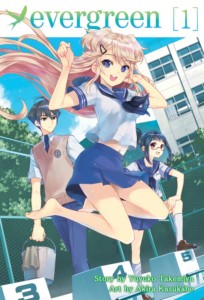
Evergreen, Vol. 1

By Yuyuko Takemiya and Akira Kasukabe. Released in Japan by ASCII Media Works, serialized in the magazine Dengeki Daioh. Released in North America by Seven Seas.

Sometimes a series has to work hard to get out from under the preconceptions it carries and also the tropes it seems inspired by. Evergreen is from the author of Toradora!, something I was rather surprised wasn’t mentioned at least on the back cover, and therefore already has some expectations since Toradora! is one of those rare harem series that actually is enjoyed by female readers. Unlike the author’s other series, this one is a manga original, though. It also has the extreme misfortune of coming out scant weeks after Kodansha’s shonen series Your Lie in April, which features a sullen teen who has given up on any hopes or dreams who is inspired by a gorgeous beauty who turns out to be rather eccentric. As it turns out, the series don’t really share much in common besides that, but there is a threat of “Manic Pixie Dream Girl” hanging over the whole thing.

evergreen1

Having gotten that out of the way, there’s a lot I enjoyed here. On-chan (if she gets a full name, I missed it) is really fun, carrying most of the comedy on her back, and having a nice love-hate relationship with Sora, who she will clearly end up with but for now is content to simply beat up. As for the two leads, the awkwardness both of them have interacting with each other is handled very well, and I like Hotaka’s imaginary “I am smooth and cool” fantasies that occasionally intrude before reality ensues. The awkwardness doesn’t just end with his relationship with Niki, though – his past guilt and physical condition have left him a bit broken, and I empathized with him a great deal when he visited his paternal grandmother, who is dying in the hospital.

I am interested to see if the plot goes in the direction that it’s hinting at, and how the manga will handle it. Hotaka’s heart condition seems to have a parallel with the sudden nosebleed that Niki got, and the visit to the grandmother reveals that there is another sibling who is supposed to be involved that we don’t know about. It’s not hard to put two and two together, but if I skipped every manga because of potential incest these days, I’d never read anything. I am pretty confident, having read Toradora!, which handles various serious plots like parental neglect and abandonment with a deft hand, that Evergreen is not likely to go down that road. And the art is quite pretty (fanservicey color page aside), making this a very smooth read. It’s only four volumes long, so I don’t think that any of the major plot bombs hinted at should drag on too long, and these are good kids, so I want to see them overcome their difficulties.

To sum up: Evergreen is not exceedingly original, and may rely a bit too much on some well-worn cliches, but its heart appears to be in the right place, and I want to see how it deals with the reveal I have a sneaking suspicion is coming soon.