Monthly Archives: February 2016

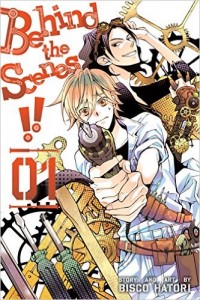
Behind the Scenes!!, Vol. 1

By Bisco Hatori. Released in Japan as “Urakata!!” by Hakusensha, serialization ongoing in the magazine LaLa. Released in North America by Viz.

It can be hard to find a balance between trying new things and doing what you know you do best. This is particularly true for manga authors, as they have a popular style or way of writing, and fans who get their new series expect more of the same, only different. As do editors. And Bisco Hatori has earned her reputation from the insanely popular series Ouran High School Host Club, which ran for almost 10 years. As a result, it’s not really a surprise that her new series, Behind the Scenes!!, also features a school club filled with eccentrics where the new character is dragged around and slowly learns what the people are really like.
behind1

The main difference is in the main character. Hatori no doubt wanted a contrast from the blunt, deadpan Haruhi of Ouran, who could get frustrated at the antics of those around her but was, for the most part, rather quiet and matter of fact. Ranmaru, on the other hand, is a new student from a fishing family who is trying to be shy and retiring, mostly due to his past school life where he ended up, for one reason or another, being the scapegoat. It’s left him with a low opinion of himself, which informs his character during the entire first volume. That said, when the chips are down he proves to be a wonderful improviser, something that the club he’s accidentally gotten involved with notes right away.

The club, on the other hand, is filled with extroverted eccentrics. They provide costumes, props and special effects for the college’s four varied film clubs, and the clubs are of course all egotistical impresarios, so they’re always changing things at the last minute. It is, unfortunately, the sort of club where the reader will need several volumes to get them all straight, with the exception of Ryuji, who is the manipulative but with a good heart sort who bullies Ranmaru into joining the club for his own good. There’s a nice balance shown between the various functions of the club and the need for last minute changes – as well as the pettiness of your typical director with a vision.

The drawback, of course, is that this all feels a bit more-of-the-same. As I said, that’s what readers and editors want, and it’s great to see more of Hatori’s standard humor, but there’s less room for experimentation, such as the sort we saw in her earlier series Millennium Snow. Nothing really surprises you, and the plot beats roll out exactly as you’d expect. There is, perhaps, less of the BL tease that was found all over Ouran, but given how much of it turned out to be simply tease, that’s likely not a bad thing. Fans of Bisco Hatori will enjoy this, but I would wait a volume or two before making judgment – I think it’s a slow burner, and so far it’s merely simmering.

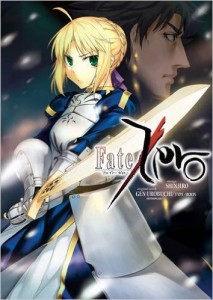
Fate/Zero, Vol. 1

By Gen Urobuchi, Type-Moon, and Shinjiro. Released in Japan by Kadokawa Shoten, serialization ongoing in the magazine Young Ace. Released in North America by Dark Horse.

I find myself somewhat relieved that I am familiar with Fate/Stay Night, the original visual novel that this is a prequel to. Admittedly, it makes it hard to judge whether this work can stand on its own for someone who was unfamiliar with this world till they picked it up. My guess is that no, it would be hopelessly confusing, which is why I am relieved. This reads like a prequel everyone wants to see to the game/manga/anime they’ve already experienced, and so it delivers a lot of cool things, but the explanations are to a degree taken as read, or at least glossed over lightly in smug monologues. That said, it’s pretty good at delivering the cool things.

fatezero1

Fate/Stay Night’s manga was never finished here due to Tokyopop’s abandonment of their manga division, so I’m assuming most of the audience here is one that’s seen the various Fate anime versions. Including Fate/Zero, for that matter, which has also been an anime (which I haven’t seen) and which was originally a light novel (which I haven’t read, and isn’t licensed). This prequel takes place during the Fourth Grail War, and features the parents or relations of a great deal of the cast – Shirou’s adoptive father Kiritsugu, his wife Irisviel and their daughter Illya, Rin’s father (who is only briefly seen, and who Rin seems to have inherited her smugness from), and a young Kotomine Kirei, who has not yet been completely horrible but give him time. Thankfully, a few of the servants are the same ones we’ve seen before. Saber is still the King Arturia Saber we know and love, and Archer is Gilgamesh, as the original Fate had made clear.

It does shake up a few things, though. Kiritsugu and Emiya are meant to contrast, and they certainly do, with Kiritsugu’s adaptation of the “needs of the many” maxim meaning he tries to find the most happiness for others by killing those who get in its way – he realizes that you can’t simply save everyone, unlike Shirou later on. And Kotomine’s father seems to be pulling strings for the Church, which is as “unbiased” as ever. The most interesting part of the manga, however, is of the whiny, seemingly bullied Waver Velvet and his servant Rider. This Rider is not the Medusa we’re familiar with, though – it’s Alexander the Great, known here as Iskandar, and he is the main reason to get this volume, as he is awesome. You’d expect him to be contemptuous of his rather whiny master, and you’d be right, but he seems to be training Waver Velvet to be a better person instead of writing him off. They have a wonderful dynamic.

Saber doesn’t get as much to do here, though she does rock a fantastic bodyguard suit, and is as empathic as she was in the original. I like her conversations with Iris, who reveals she’s literally never left the castle where she lives until just now. I’m not sure how long Iris will last in this manga – Fate/Stay Night reminds us she’s dead, and even if it didn’t this prequel is written by Gen Urobuchi, who created Madoka Magica and Psycho Pass. But it has characters we wanted to see doing cool things, and the art is decent (the artist also does the Taboo Tattoo manga), and is definitely worth getting for fans of Fate.

Hayate the Combat Butler, Vol, 27

By Kenjiro Hata. Released in Japan as “Hayate no Gotoku!” by Shogakukan, serialization ongoing in the magazine Shonen Sunday. Released in North America by Viz.

One of the stranger running plots we’ve had in Hayate the Combat Butler has been 13-year-old Nagi’s insistence on being a brilliant manga artist, an insistence that is counterbalanced by her actual manga, which is strange to the point of incoherence. This mas mostly been played for humor, focusing on Hayate and Maria’s attempts to not tsukkomi Nagi when reading her stuff, and pretend that it’s totally going to sell. Here, though, Nagi’s manga becomes the point of this next arc, as she runs into a genuine manga artist – mostly through the machinations of Ayumu – and discovers what a leap forward it would take for her work to achieve what a professional artist’s does.

hayate27

We briefly saw this artist several volumes ago, but now we get a name – Ashibashi-sensei – and we see what the life of a manga artist actually entails. This also includes an assistant, who turns out to be Azumamiya, one of the many minor characters who littered the early volumes and have now mostly been forgotten. He’s here to be annoyed that they’re doing this for Nagi at all. In any case, Ashibashi-sensei is clearly based on Hata’s former mentor Koji Kumeta, author of Sayonara Zetsubou-sensei. There’s not quite as much despair this time around, but we do get to see how totally exhausted a manga author can get, the dangers of procrastination, and most importantly, how Nagi’s work just isn’t cutting it.

Nagi can’t even bring herself to show it to him – she runs off devastated, having received actual criticism she’ll listen to for the first time ever, as opposed to people trying to be nice (Hayate, Maria), or people with the same warped worldview as she has (Isumi). This leads to a serious crisis of confidence, particularly since, when Nagi decides to simply concentrate on school work, she notices her grades are slipping as well (though she’s still in the Top 10). Nagi’s maturity, or lack thereof, has been a source of frustration for many of the Western fans of Hayate. Honestly, I suspect for those fans the solution is so eliminate her entirely – character development is not what they want. But it’s what they see here.

Luckily, Chiharu comes to the rescue, asking Nagi to help her sell doujinshi at a local event. This allows Hata to throw in a couple of chapters praising the idea of doujinshi (here clearly referring to original works, not the parodies and porn most people associate the word with), and allowing Nagi to get her groove back, mostly as she reads a dolphin-based manga that’s even screwier than hers is. I like the idea that “I can do better than THIS!” is a motivating factor. We also see what I believe is the author of that particular manga, though why she’s in disguise is something that is likely left for the next volume. Hayate the Combat Butler continues to be lots of fun, and it’s good to see Nagi finally growing.