Monthly Archives: February 2016

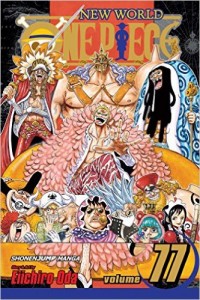
One Piece, Vol. 77

By Eiichiro Oda. Released in Japan by Shueisha, serialization ongoing in the magazine Weekly Shonen Jump. Released in North America by Viz.

I’m still a big fan of One Piece, but there’s no getting around it: this arc has dragged, and it shows. The chaos that is Dressrosa is starting to be harder and harder to follow, and while that’s clearly meant to mirror what’s going on with the actual participants, it doesn’t make things any easier. Half the Straw Hat crew have been absent for several volumes now. Oda’s constant scene shifting means we barely get to remind ourselves who’s fighting who before we move on to another location. Rebecca continues to be a thing to be protected, with even Nico Robin getting into the mix, much to my chagrin. Worst of all, a lot of things here, particularly the backstory, are things that have been done before and better in earlier volumes. One Piece is 77 volumes now, and I’m afraid it’s starting to repeat itself.
onepiece77

A good example of this is the entire flashback with Corazon and young Law. It’s supposed to be heartwrenching, and there are moments where you are truly horrified by how cynical and awful people in this world can be (I’m thinking of the hospitals Corazon visits to try to cure Law), but it’s hard not to be reminded of other backstories we’ve had before. Other backstories we see to explain silly characters are either too tragic for the silliness (why Senor Pink wears a baby bonnet) or reinforce negative behavior (literally everything about Baby 5, which may be the nadir of this arc). Again, this is the sort of thing that you’ll only see in a long-running series like this, especially one where the ‘tragic backstory’ part of the arc comes regularly like clockwork.

Some stuff worked better. Robin, Cavendish, and Bartolomeo were probably the funniest part of the volume. Robin is a Straw Hat, therefore Oda has exempted her from any romantic issues such as Baby 5 has. She’s therefore able to simply sit back and stare balefully at these two morons trying either to impress her. Cavendish’s multiple personalities come somewhat out of nowhere, but they lead to some amusing situations and don’t feel quite as repetitive as some of the other things we see here. Luffy’s concern about Bellamy, who is pretty much ready to throw away his own life at this point. Characters rarely die in One Piece, so I doubt Bellamy will, but the fact that Luffy is worried shows how desperate the situation is. Oh yes, and Doflamingo remains a thoroughly evil little snake.

There’s a few other things I could mention, such as Oda’s hilariously awful attempts at writing a tsundere character. But for the most part, I really want this arc to be over and the crew to move on. I want to see Nami and Sanji and Chopper and Brook again. I want Luffy to defeat Doflamingo so that I don’t have to keep staring at his face all the time. Most of all, I want something new. Dressrosa is filled with the angry ghosts of One Piece plots of old, and they’re merely pale shrouds of what we know Oda can really do.

Franken Fran, Vols. 1-2

By Katsuhisa Kigitsu. Released in Japan by Akita Shoten, serialized in the magazine Champion Red. Released in North America by Seven Seas.

This has been one of the long-awaited licenses, and it’s easy to see why with this first omnibus. Franken Fran is terrific. That said, one or two caveats. I feel, once again, Seven Seas’ rating is lower than it really should be. Also, this is absolutely not for anyone easily creeped out by body horror. Not for nothing has it been nicknamed ‘Squick: The Manga’. If you don’t like insects, gore, horrific scientific human/animal hybrids… again, not a manga for you. But if you have enjoyed the Kurosagi Corpse Delivery Service, or yearn for a return to some of the weirder Black Jack stories, then Franken Fran is right up your alley.

frankenfran1

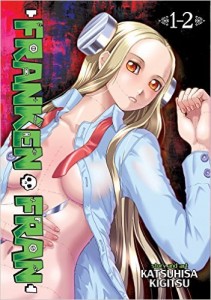
As the cover might demonstrate, there is some theoretically salacious nudity. I say theoretically because every time you see a naked breast in this series, it’s immediately offset by something horrible happening to its owner. The premise is that there is a mad scientist known throughout the world for his incredible medical skills and ability to save anyone even after death. This is not his story – he’s absent. But he’s left behind his daughter Fran, who seems to be more ‘built’ than ‘conceived’, and she too has amazing medical skills and can do anything. The stories in Franken Fran, much like Black Jack (which the series admits it’s indebted to), involve people coming to Fran asking for operations, her performing these, and the unforeseen consequences that arise.

Because make no mistake about it, there are consequences. Unlike Black Jack, or even Kurosagi Corpse Delivery Service, Fran has no real identifiable sense of morality beyond ‘life must be preserved at all costs’. Yes, even if it means that the person whose life has been saved is living on in agony as some kind of monstrous hybrid. They’re alive, so it’s OK, right? Fran also has a tendency to do things because she wants to see what will happen, which has led to a girl’s entire body being rebuilt so she can live as just a head, giving a man who is losing his sight eyes that can see ANYTHING, including other dimensional beings, and experimenting on cockroaches for the lulz, and then ending up taking their side after realizing she’s lost the war against them. Fran is usually impossible to understand.

She’s hilarious though. The reason that this series is so popular is not just the monstrous horror, but the combination of it with a truly black as pitch comedy. High school students get their every whim catered to by Fran (I want to be taller, I want bigger eyes, etc.) and the results are hysterical. A crime syndicate’s insane leader has to go up against his increasingly difficult to handle clones, and the chaos is glorious. And then there’s Kuho, the unfortunate detective who is misfortunate enough to be the only normal character in the series… or at last she is until Fran gets a hold of her. People suffer horribly in this book, and it’s funny. Trust me on this.

This omnibus gives us the first two Japanese volumes, ending with the introduction of Fran’s assassin sister Veronica, who looks to be psychotic and dangerous but turns out to be nothing next to Fran’s ‘hey, it’s for science’ mentality. In the meantime, if you enjoy any of the titles I mentioned above, or stuff like Dorohedoro, absolutely give Franken Fran a try. Don’t mind the salacious covers. This ran in Champion Red, which is only read by horrible people. They had to throw them a bone.

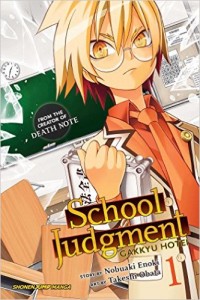
School Judgment, Vol. 1

By Nobuaki Enoko and Takeshi Obata. Released in Japan as “Gakkyu Hotei” by Shueisha, serialized in the magazine Weekly Shonen Jump. Released in North America by Viz Media.

It can sometimes be difficult, particularly for a Western audience, to remember that Weekly Shonen Jump’s demographic remains young boys in Japan, with the ideal age between 8 and 13 years old. They know the reality of writing for children, which is kids want to read about other kids a few years older than they are, which is why the less fantasy-oriented Jump series feature a bunch of middle and high schoolers. (Speaking of which, when did Bleach last attend high school anyway?) But sometimes there is a series which does give us elementary schoolers, and we have that in School Judgment. There’s a catch, though – some of the students are lawyers, and what follows is, if not exactly a ipoff of the Ace Attorney franchise, at least highly influenced by it.

school1

It becomes fairly clear a few pages into this series that you really have to leave your suspension of disbelief at the door. While true for most Jump series, the combination of 12-year-old lawyers, some of whom are also ex-convicts, and 4-year-old baby judges may make a few people at least raise an eyebrow. But it fits with the manga’s overall mood, which is over the top, a bit loud, and somehow both painfully earnest and deeply cynical at the same time. The main reason that it succeeds is the hero, Abaku, is *not* your standard Jump hero. In fact, he’s more like the cynical, grinning mentor who’s gradually won over by the shiny idealism of the normal hero. No idealism here – Abaku is obnoxious, superior, selfish, and acts refreshingly like a 12-year-old at times.

The cases we see and characters we meet are fairly standard shonen fare – the boy with the pudding bowl haircut is disliked by everyone, who knew? There’s scholastic rivalry, nascent crushes, and intense drama over whether or not to eat the classroom’s pet fish. In the midst of all this, we start to get a bit of a larger ongoing plot – Abaku clearly has a past, and may have at one point been imprisoned in Japan’s maximum security elementary school prison island. (I’m not making this up, you know.) He’s in that classroom for a reason. I was less impressed with the prosecuting attorney, Pine, who seems to be the standard “I pretend to be sweet but am secretly angry all the time” girl, destined to always lose to our heroes. I hope she gains depth in the next volume.

This is not terrific by any means – the mysteries are rather perfunctory, and I’m not sure I agree with using the Japanese word “ronpa” throughout instead of just translating it as “cross-examination” or somesuch. And the baby judges are a hideously stupid idea. Despite Obata’s usual excellent art, this reads like the work of a Jump newbie, and it will not surprise anyone to hear it only has 2 volumes to go. But it held my attention, and is ridiculous in a way that makes you smile wryly, rather than just want to put the book down. Worth a look.