Monthly Archives: February 2016

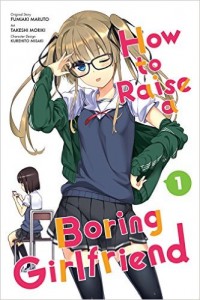
How To Raise A Boring Girlfriend, Vol. 1

By Fumiaki Maruto and Takeshi Moriki. Released in Japan as “Saenai Kanojo no Sodatekata” by Kadokawa Shoten, serialization ongoing in the magazine Dragon Age. Released in North America by Yen Press.

I think you have to be very careful when part of your work has “boring” in the title. I’m not sure if the original Japanese conveys quite the same meaning, but if the core of the work is that you feature a heroine who is meant to be uninteresting, then you’re already climbing up a larger hill than normal. Now, of course, this is something of a comedy, and the point of the whole exercise is that we have a hero who is surrounded by stereotypes of the standard light novel girl, and yet he decides to take the average, nebbish girl and turn her into heroine material. Unfortunately, at least by the end of this first volume, most of what I get from it is that the other two girls really *are” more interesting.
saekano1

That is not, of course, the boring girl in the foreground – it’s Eriri, the hero’s tsundere childhood friend who’s a famous doujinshi artist who has at least four different traits for a harem romance. The actual boring girl is sitting in the seat at the back. Our hero’s other close friend is Utaha, who is a bestselling novelist and fills the ‘cool yet snarky’ part of the otaku equation. Naturally, they dislike each other hovering over our hero Tomoya, who is something of an otaku who has grand ideals for a dating sim, but no actual talent to turn them into anything beyond cliches. He needs his two friends to actually do the work and make it good… particularly since his heroine in this dating sim is based on Megumi, who is simply there.

This is one of those series where Yen On did not pick up the light novel it’s based on, and I suspect that it would do better without the manga format. The writer of the original story jokes about the fact that the titular heroine “will never be in the center of the panel frame”, but even a cursory glance can tell you that’s not true – Megumi is present and paid attention to throughout, she’s just dull. This is the sort of series that cries out for exaggeration, and I could see her being drawn in a way like Sunako from The Wallflower, who only appears out of “superdeformed” mode in cool moments. Instead, Megumi’s presence and the delivery of the lines feel like the author explaining a joke that isn’t as good as they think it is. The premise is that we’re meant to wonder why this obvious visual novel hero is pulling away from the two cliched girls to find the ordinary one. But as a reader, I know why – cliched or not, Eriri and Utaha are far more interesting than Megumi is, and I’d like to actually know about *them*. Saekano (not to be confused with apocalyptic romance Saikano) sells its tedium a bit too well.
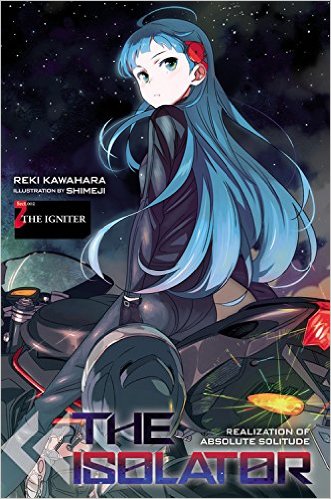
The Isolator, Vol. 2

By Reki Kawahara and Shimeji. Released in Japan by ASCII Mediaworks. Released in North America by Yen On.

The first volume of this series introduced us to Minoru, a broken young man who wishes to live his live with minimal emotional contact with anyone – and has secret suicidal thoughts. In this second book, he seems much better, even if the reason for that is because he hopes to achieve his goal, which is to erase the memory of him from everyone who knows him. Of course, as he finds out, this is not going to be as easy as he thought. Even those who already had their memories erased, such as last volume’s victim Tomomi, still feel drawn to him for reasons other than memory. And, as he grows closer and bonds with the new Superhero Organization he’s a part of, he finds that new emotional experiences are just impossible to avoid.

isolator2

It’s rather surprising how serious-minded this book is. Sword Art Online has lots of amusing comedy bits sprinkled throughout, and even Accel World throws in some light relief from Haru’s worrying and low self-esteem. The Isolator is grim, though, and even the odd joke or two (such as Olivier’s otaku-ish jokes) highlights how depressing everything here is. We meet the team leader of the troop, and she’s… a fourth-grader whose black gem gave her super analysis powers, so she’s now a scientific genius. Bored as I am of the ‘loli genius with an adult’s mindset’ type in this sort of series, the book does not let you forget that this was still an elementary school girl, and due to the nature of how gem powers work my guess is she was doing badly in school as well. I suspect she’s not a happy camper.

But the winner of the bleakest past here goes to Yumiko, who I had mentioned last time looked like she had hidden depths. Indeed, I think Kawahara overeggs the pudding here, as we get not one but *two* tragic backstories. It does serve to show Minoru, though, that he is not a special tragedy snowflake, and remind him that there are other ways to cope with grief and loss besides isolation. As with the first volume, the villain also gets a well-thought out backstory. Sadly, though, his personality is identical to all of Kawahara’s other psychopaths – you can give depth and tragic history all you want, but when the villain in the end is still laughing madly and going on about fools and his grand plan to destroy the world, it’s still not working.

The best reason to read this series is still the action scenes, which cry out to be animated at some point in the future. I’m not sure where the series is going from here – the book ends very abruptly, as if the author was working to a set page count. But I do know that while it’s gripping and a quick read, I wish it were more fun. I feel like isolating myself after reading it.

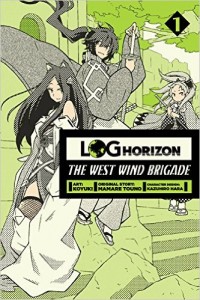
Log Horizon: The West Wind Brigade, Vol. 1

By Mamare Touno and Koyuki. Released in Japan by Fujimi Shobo, serialization ongoing in the magazine Dragon Age. Released in North America by Yen Press.

Given that Log Horizon contains a huge cast with at least a dozen named guilds, set over a wide area, it is not particularly surprising that we’re seeing spinoffs about some of those guilds. This also allows the series to show the same events, such as the moment when everyone realized they were in the game, with different viewpoints, and see how crises are solved when the lead is not Shiroe. Most importantly, it also allows us to try out a different genre, as Shiroe, as a harem protagonist, fails miserably. Soujiro, meanwhile, is not only an excellent oblivious harem protagonist, but he even has a guild that has become famous as a “harem guild”.

wwb1

In many ways this is played absolutely straight. The guild is almost entirely female, with the one non-Soujiro exception appearing to be a gay man (or is he trans? it’s unclear, and I doubt the manga will bother to get into that sort of thing anyway). The girls all have various feelings of love for Soujiro, none of which he acknowledges in the slightest, at least romantically – he’s the sort to charge in, say he will protect everyone, etc. the polar opposite of someone like Shirou, in fact. When they first discover they’re trapped in the game, we see his reaction, and it’s one of complete and total delight, contrasting with almost everyone else. As for the girls, the two that get the most attention are Isami, who is the cute girl with no confidence type, and Nazuna, who is the cool big sis type.

But I doubt readers are reading this for harem antics – or if they are, they’ll be disappointed. Where the series succeeds is in showing off new aspects of Elder Tales, or in giving us different perspectives on the same events. Sometimes this can be chilling – we see Touya and Minori getting taken into the Hamelin guild, with none of our heroes really seeming to notice the danger yet. There’s also a moment when Soujiro, defending his teammate against a guard who’s trying to dole out justice, is killed, and everyone has to frantically rush to the temple to see if they can be revived like they were before.

Mostly it’s what you’d want to see – a band of adventurers bonding like a family and looking out for each other. One of the maid NPCs, Sara, is fleshed out as well, and we see her perspective on things – these adventurers, who used to barely give them the time of day, are suddenly opening up and being friendly and rescuing them from attempted rape. (I am starting to get weary of the hints that attempted rape is rather common in this world, though I agree that this would be depressingly realistic. Thankfully, it is averted here.) If you enjoy Log Horizon and want to see a simpler, more shonen take on the world, this is a very good place to start.