Monthly Archives: October 2016

Sword Art Online: Progressive, Vol. 4

By Reki Kawahara and abec. Released in Japan by ASCII Mediaworks. Released in North America by Yen On. Translated by Stephen Paul.

After a third volume that was good but somewhat insubstantial, the fourth volume of Progressive knocks it out of the park. One big reason why is the viewpoint: we get Asuna’s POV again (3rd person) for the first half of the book, with the 2nd half back to 1st person Kirito. This not only allows us much greater insight into how Asuna thinks, but also helps to show off how the two of them view each other – Asuna in the first half is running scared a lot, partly due to this particular level featuring ghosts, a pet fear of hers, but also in general, as she feels inadequate to the floor, and Kirito is constantly two steps ahead of her. She can’t even bring herself to duel him so she can have practice at it – in a game where something going wrong means death, it weighs too much on her.

saop4

Then we see Kirito, and once again Asuna becomes the somewhat cool, noble tsundere he always puts on a pedestal. He also shows us that some of her assumptions about him are wrong – she admired his cool bluff against two enemy players, but he was actually on the verge of snapping, as seeing a status saying someone isn’t dead and actually not seeing them dead are two very different things. We also see that both he and Asuna are slowly becoming aware of their growing feelings towards each other, but are not really going to do anything about it – in fact, we even see Kirito abuse this fact, as in order to cover up his real intentions he pretends that he hasn’t joined one of the two big guilds as they’d force him to part with her. Of course, what it really is is that he feels she’s a better “leader” than he is, and he doesn’t want to get too close as he regards his role as making her “fly” so she doesn’t need him anymore. Which, of course, Asuna is somewhat aware of, and is the source of much of her own angst.

Argo is here, as you might have guessed from the cover, and she gets quite a lot more to do than usual, from dueling with Asuna to show off that she actually *can* take care of herself thank you very much, to hen showing us that she too can be vulnerable, as the new changes to the 5th floor boss almost end up taking her out. She’s a great character, and I am quite pleased that Kawahara continues to use her even though she doesn’t show up in the original series. Fans continue to debate whether this reboot will eventually reach the same points as canon – i.e., Kirito and Asuna will separate for a long period, and things will proceed as from the original. I think Kawahara realizes he doesn’t have to care about that for the next several books, and that he’s happy to simply rewrite Aincrad with new experience and better characterization than he had years ago. (He’s also written Progressive plot and characters into some of his unofficial doujinshi work – Argo shows up in one story during Kirito and Asuna’s honeymoon, and another story tells of the fate of the Dark Elves (who aren’t in this book, by the way, though I suspect they may be in the next one).)

And then there’s the other big reason this is the best of the Progressive books – a genuine threat from something outside the game itself. The second book showed us Morte, a player who seemed to want to cause chaos. We see him again here, working on more of the same, and also meet his boss. The discussion of why players would want to kill other players is brought up by both Kirito and Asuna, but both of them shy away from the actual reason – it’s a thrill and they can get away with it. The boss’ name isn’t mentioned, but signs are good that it’s PoH, who later heads up the guild Laughing Coffin, which we’ve discussed before. Again, part of the fun of reading Progressive is seeing he seeds being set for later events, and PoH is a creepy psycho. He’s clearly one of the major antagonists of the series. Even now that we’re a few years out of Aincrad, I wonder if he’ll pop up again.

So all this, plus the usual excellent battle scenes, and slightly less fanservice than usual (courtesy Asuna, who demands she and Argo be clothed during their bathtime duel). If you enjoy Sword Art Online even a little bit, you should love this one. Get ready to wait for the 5th volume, though – it’s not even scheduled in Japan yet.

Psycome: Murder Princess and the Summer Death Camp

By Mizuki Mizushiro and Namanie. Released in Japan by Enterbrain. Released in North America by Yen On. Translated by Nicole Wilder.

The second volume of Psycome takes its premise and runs with it, as we see our class of murderers sent on a field trip/survival camp, a trope that I thought was actually more Western than anything else but apparently must pop up in Japan as well. Once at camp, we get the usual combination of cliched romantic comedy antics and attempted killings, even though, of course, murder is absolutely prohibited by the staff. We see such cliches as walking across a rickety rope bridge, class skits around the campfire, late-night ero comedy at the hot springs, and a nature walk to boot. And all this is supervised by a new girl, Shamaya, the Murder Princess of the title. And unlike Kyousuke or Eiri, she is definitely here for genuine murder, as she sees fit to gleefully tell us.

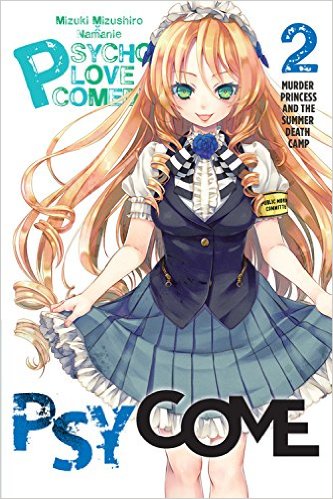
psycome2

Just as all the main cast are painful cliches, so is Shamaya – as you can tell from the cover art, she’s the pampered ojou-sama type, and also fills in as head of the Public Morals Committee, dedicated to making sure all the new freshman are following the straight and true path. Of course, after Book One we know that said path is turning teenage killers into professional assassins, so we’re not too impressed. And indeed Shamaya is fairly easily thrown off her game – at first by people merely breaking the rules (such as the three goons whose names I can’t even remember trying to strangle Kyousuke), but later on she meets her match in Maina, the baby-talking clumsy girl who’s in this school for accidental deaths so ludicrous that no one believes they’re accidental. Maina brings out Shamaya’s true psychotic nature, but unfortunately for her there’s already a better psycho in town, Renko.

The book continues to walk a fine line, and doesn’t always succeed – sometimes when it tries too hard to be earnest or serious, I don’t feel as if it’s earned it. Hence I was skeptical of Shamaya’s heel-face turn after Maina’s big speech, and kept waiting for it to be another trick. Some of the comedy also falls flat, such as the epilogue where Shamaya seems to have traded in her murderous impulses for yuri impulses. But this is offset by some genuinely good set pieces, such as Eiri’s apology to Kyousuke for being such a tsundere to him, which *does* seem genuine and earned, or Maina’s aforementioned speech, which is depressing but also uplifting. And some of the comedy managed to surprise me and make me laugh, particularly Renko’s beatboxing rap group, which has to be read to be believed.

So, as with the first volume, we’re left with a promising yet deeply inconsistent book with an intriguing premise. The epilogue promises us a new character in the third volume, which I suspect will ramp up another cliched harem comedy trope accordingly, much as I’d wish it wouldn’t. But that’s what you get when you read a series like this. If they’re going to set a series in a wacky prison school and then throw in every cliche in the book, it would feel wrong not to hit every cliche. I’m not sure I could tolerate a manga or anime of this, but as prose, Psycome is amusing, goofy fun.

Cells at Work!, Vol. 1

By Akane Shimizu. Released in Japan as “Hataraku Saibou” by Kodansha, serialization ongoing in the magazine Shonen Sirius. Released in North America by Kodansha Comics. Translated by Yamato Tanaka.

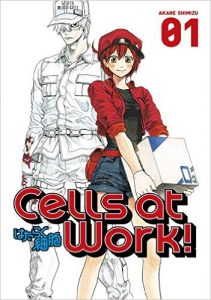
We have seen a lot of anthropomorphism in manga and anime recently, with Hetalia probably being the most famous example of it. It can be fun to imagine countries, or subway lines, or beers reimagined with human shapes and personalities. It’s been around a long time, and is usually in a humorous vein. But that doesn’t mean that it can’t also be used to teach you things. In Cells at Work!, the things we’re learning about are – no surprise – cells, as the human body is shown as sort of a messy organic factory, where various types of cells try to do their job as quickly as possible while avoiding the seemingly constant threat of invasion. Thankfully, this is not an ‘educational’ manga per se, as the main thrust is human and action, both of which we get in great amounts.

cellsatwork

Our Heroine is Red Blood Cell – yeah, don’t expect easy to remember Japanese names here – a cute, spunky, but somewhat dim girl whose job it is delivering oxygen to various parts of the body and then CO2 back to the lungs. Assuming she can ever find the lungs. And assuming she is not utterly destroyed by the various things that go wrong while she’s on duty, ranging from Pneumococcus and Influenza to allergies and scrape wounds, all of which could be complete disasters if not taken care of fast. Luckily, we have our hero, White Blood Cell, who is stoic and deadpan and more than a little insanely violent. He’s there to take out these monsters (some of whom resemble typical magical girl show villains, which is what makes it so amusing) and help explain things to Red Blood Cell, who seems to need a lot of things explained.

Much of this manga gets by on the sheer ridiculousness of what is going on, which helps make all the discussion of T-Cells and Memory Cells go down easier. We see overenthusiastic B-Cells, airheaded Mast Cells, yandere princess Macrophages (possibly my favorite), and trembling and scared Naive Cells. Each of the four chapters shows something going wrong, and what needs to be done to fight it. The fights involve a lot of things blowing up, crowds running and screaming, and lots of property damage, so in that way it’s a very fun shonen action manga. The humor is what I keep coming back to, though – especially a JoJo’s Bizarre Adventure cameo where I was not expecting one to be. And then there’s the Platelets, who are absolutely adorable little moppets who will make you go ‘aaaaaw’.

You really do learn a lot about cells here, and the color frontispiece seems to imply we’ve only just scratched the surface of the cells we can talk about. The main characters are definitely Red Blood Cell and White Blood Cell, though, and while there’s no romance (how on Earth could you pull that off?), their growing friendship is also a highlight. I had no idea what this manga was going to be like when I heard it was licensed, but now I’m totally sold. Give me more.