Monthly Archives: October 2016

Yona of the Dawn, Vol. 2

By Mizuho Kusanagi. Released in Japan as “Akatsuki no Yona” by Hakusensha, serialization ongoing in the magazine Hana to Yume. Released in North America by Viz. Translated by JN Productions, Adapted by Ysabet Reinhardt MacFarlane.

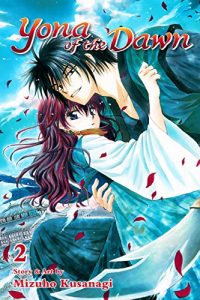
I said I had wanted more plot development, and I get a lot of it here, very well told. We do indeed see there is a Fire Tribe in addition to the Wind tribe, and their young prince is appropriately a hothead (and ex-suitor) of Yona who is appalled when his hotheaded plan ends up turning into disaster. We also do not lose sight of Su-won, who may have started off the series by murdering Yona’s father but is not going to be just another insane shoujo villain. The idea that Yona is dead fills him with grief, and also allows us to see more flashbacks. Intterestingly, we see that Hak has actually told Su-won he wants to see him married to Yona and ruling as King. There is a silent “but not like this” that is very palpable, however.
yona2

Of course, this series is not 2 volumes long, and Yona is not dead. But before that, we get a nice look at Hak in his natural habitat, as we see another cliche of romance manga used quite well, which is the sheltered rich girl arriving in the town of the peasant boy and seeing how his simple, non-affluent lifestyle is much happier than she could have imagined. Hak is a good general who cares about his tribe, but is also able to let those who are his contemporaries (in age, if nothing else) get away with mouthing off to him provided it’s not an emergency. We also get a Tiny Tim sort, Tae-Yeon, who is adorable and inspiring and also needs his medicine. The world may be filled with political machinations, but here there are just good people.

And them there’s Yona herself, who does get to wield a sword in this volume, though she’s still shaking off her princess roots. Forced to pretend to be a lady’s maid at first, that doesn’t last long, as there’s no way that she can accept “just live here in hiding for the rest of your life” while people are suffering. I was very pleased that, rather than demand to come with Hak, she announces that she’s leaving, and wants him to come with HER. He calls her quite selfish, but it’s not the bad kind of selfishness. And, as long as we’re counting tropes, I loved the scene where she cuts off her long hair with a sword in order to escape the Fire Tribe leader. Not only is that sort of scene always badass, it gives supposed evidence of her death to the King later on.

But she isn’t dead, and despite the ridiculousness of Yona and Hak surviving a fall from that height (which the author herself points out in a 4-koma at the end), they seem to have been taken in by some allies. I’m not sure what will happen next, but given the type of manga this is, no doubt it will involve destiny and power struggles and possibly cool horseback riding? And more swords! The sky’s the limit, really. Oh yes, and some cute romance would be nice, but not necessary.

Kitaro Meets Nurarihyon

By Shigeru Mizuki. Released in Japan as “Gegege no Kitaro” by (among others) Kodansha, serialized in various magazines. Released in North America by Drawn & Quarterly. Translated by Zack Davisson.

It is interesting reading these old late 1960s Kitaro manga, showing off the wonders and terrors of yokai to a Japanese audience, now that we are in something of a yokai glut here in North America. Oh, yokai are never going to pass vampires, or even monster girls. But you get things like Kamisama Kiss, which puts yokai in a supernatural shoujo romance. And Natsume’s Book of Friends, almost a spiritual successor to Kitaro, as he walks around solving problems and getting involved despite himself. And of course there’s the Shonen Jump series Nurarihyon no Mago, which wasn’t a huge hit, but got over 20 volumes, so could be said to be a mild hit in Japan. It did alright here as well.

kitanura

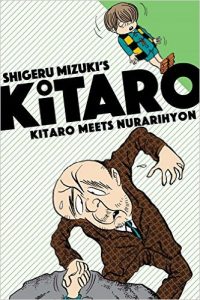
The Nurarihyon seen here on the cover is of the same type as Nura from the Jump manga (or, to be more accurate, Nura’s grandfather, who fits the stereotype better), but of course this Nurarihyon is not remotely a hero. He’s closer to the actual legend, an old man who walks into your house, drinks your tea, acts as if he owns the place, and leaves. Compared to the other yokai we see in this volume, he doesn’t have that many superpowers, but that just makes it all the more chilling when he gets rid of Kitaro and Nezumi Otoko so easily. Of course, Kitaro *is* the hero, so he manages to escape and trap Nurarihyon in a place he’s not going to be coming back from anytime soon. In fact, I would argue Kitaro’s solution is equally chilling.

These stories sometimes do feel their age, and not just due to the technology of the times. Kitaro is very much a morally ambiguous hero, getting involved when it looks as if humans are directly threatened with yokai but otherwise mostly getting pulled into things by the morally corrupt Nezumi Otoko, who even this early in the series has made his transition from rapscallion to scallywag, so to speak. He’s such a lovable creature you want to forgive him for being a greedy gluttonous and occasionally murderous swine. Oh yes, and somewhat sexist as well – one story has an old yokai try to seduce Nezumi Otoko merely as she’s watched a TV show with a May-December romance and wanted more fun in her life. Kitaro’s response amounts to “you are an ugly old woman, back where you came from!”, which left a sour taste in my mouth. Kitaro, at this point in the series, does not really reach for sentiment.

It does have plenty of creepy scares, though. The Wanyudo has always freaked me out a bit, and so seeing it in a story involving supposed lost diamonds made me shiver. And did I mention vampires earlier? Well, there’s one here, who’s employing Nezumi Otoko to find him fresh victims, but he runs afoul of a hair-based yokai who’s actually succeeded in possessing Kitaro (is this going to happen once a volume?). In essence, though, what we have here is Kitaro as he was at the height of his powers – warts and all. If you appreciate manga history, or just want a good spooky book for your kids, this is a great title to pick up.

Platinum End, Vol. 1

By Tsugumi Ohba and Takeshi Obata. Released in Japan by Shueisha, serialization ongoing in the magazine Jump Aquare. Released in North America by Viz. Translated by Stephen Paul.

The creator team of Ohba and Obata has brought Japan and North America some of the most iconic manga out there in Death Note and Bakuman. In addition, Obata’s art has also been seen in Hikaru no Go, All You Need Is Kill, and, erm, School Judgment. OK, possibly not that last one, but otherwise, they’re all acknowledged hits and big influences. So I always feel guilty that I’ve never really warmed to any of them. I found Hikaru no Go pretty dull, Death Note’s nihilism wasn’t my bag, and Bakuman’s casual sexism rubbed me the wrong way. Yet hope springs eternal, and here they are with a new series. Can they build on the strengths of past works, or will I be grinding my teeth again?

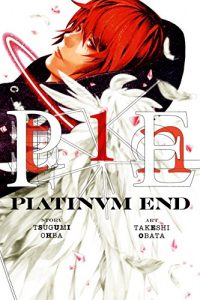
platinum1

A little of both, really. I’m not as familiar with Death Note as most other readers are, mostly as I didn’t warm to its premise so never really read it, but it strikes me that a lot of the same themes I hear that it had are cropping up here. Our hero, Mirai, begins the story as, sadly, many manga protagonists do, by resolving to kill himself. He ends up being saved by an angelic being, Nasse, who explains he’s been chosen to participate in a war of sorts to see who gets to become the next God. He also has powers to a) fly, and b) make someone fall madly in love with him… for 33 days. Naturally, there are other participants as well, from the sleazy (a guy who decides to use the love arrows for orgies) to the so-called moralistic (the guy who becomes a vigilante superhero), to the girl Mirai has a crush on (who is the cliffhanger ending).

Ohta and Obata love grey, morally ambiguous works, and this is no exception. The star of the volume is without a doubt Nasse, who would love it if Mirai simply used his newfound powers a lot more indiscriminately. She’s supposedly an angel, but is 100% fine with murder and other morally reprehensible acts. Luckily, Mirai isn’t, and after his first horrific but accidental use of his powers, tries to think seriously about what to do and how to use them carefully – especially as he realizes that the God War involves killing off every other candidate. Nasse, though, is fine with absolutely anything as long as it gives him “normal happiness”, whatever that is, because that’s what he wished for from the start. It’s really creepy, to be honest.

Where the manga succeeds is where all Obata manga succeed – the art is fantastic, with dynamic poses, violence and fanservice when it’s appropriate, and a nice ability to read the character’s emotions from their expressions rather than just the dialogue, something many other artists have issues with. And the premise looks like it could go to interesting places… or nasty ones. The odd morality of the angels, though, reminds me more of Franken Fran than anything else, and likely will determine if I continue this series or not.