Monthly Archives: December 2016

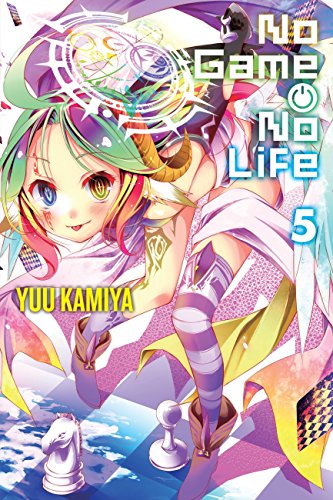
No Game No Life, Vol. 5

By Yuu Kamiya. Released in Japan by Media Factory. Released in North America by Yen On. Translated by Daniel Komen.

I was not quite as grumpy with this volume of No Game No Life as I was the previous one, despite the fact that it has many of the same problems. It could be that it had more interesting things happen – one fight takes up well over a third of the book – or that the denouement of the Siren thing was slightly amusing, which it was – emphasis on slightly. I suspect, however, that the main reason is that this volume was delayed and delayed and then delayed again, to the point where it now hits nine months after the last. Does absence make the heart grow fonder? More likely I was able to settle in after having forgotten literally everything about the last book, and it took a while to recall. The publisher may have figured this out as well – Vol. 6 has already been delayed a month or two as well.

I’ll start my mentioning what I didn’t care for, and then move on to what I enjoyed. As I observed in the previous volume, Sora and Shiro’s development continues to annoy me, mostly as the author has seemingly forgotten that the dichotomy between “invincible gamers” and “social incompetents” was what made them so fascinating. Here, as in Book 4, they almost never have a breakdown or completely lose it. Part of that is the nature of the game they’re playing in the first half – it requires them to be touching, basically, as they have to function as a pair of wings. But I suspect it’s more that the author just enjoys writing them as smug winners. We do get a little bit more time in their heads this volume, which is both good (Sora) and bad (Shiro’s incestuous feelings).

There’s also the resolution of the Dhampir/Siren plot, which was all right, but I wish more had been done to overcome the “Sirens are bimbos” stereotype. As it turns out the way to solve the riddle and wake the princess is simply not to do what she asks for – if you’re an unattainable love that she can never have, you win. Naturally, this is done with a lot of mental and emotional abuse, supposedly justified because she was so annoying, really. And then there’s Plum, whose surprise reveal wasn’t much of one, but whose other revelation – being a secret mastermind manipulating things – worked much better.

And then there’s Steph, who remains the main reason that I’m reading these books. I sympathize with her over the top suffering, of course, but more to the point, she’s developing more and more into a leader and keen observer every book, and people are starting to take notice – particularly Izuna, who is able to get past her verbal tic to realize that Stephanie is not as dumb as she thinks she is, or Sora and Shiro make her out to be. Of course, in the long run, I suspect this is shaping up for Stephanie to rule over everyone once Sora and Shiro win the game. I also liked the backstory with the Flugel race, and how imagination, curiosity, and the desire to create are what they desperately needed – but only Jibril had. There’s hints of some intriguing backstory, which I’d like to see more of.

So overall a mixed bag, and I think those who have been grumpy about this release won’t stop being so. But it’s still worth a read if you can tolerate twinked-out protagonists and their slangey dialogue.
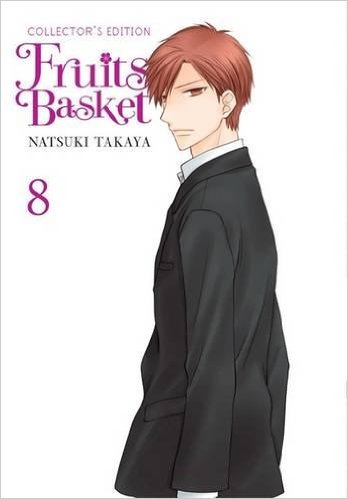
Fruits Basket Collector’s Edition, Vol. 8

By Natsuki Takaya. Released in Japan by Hakusensha, serialized in the magazine Hana to Yume. Released in North America by Yen Press. Translated by Sheldon Drzka.

This volume sees the completion of the ‘Yuki and Kyo are mirrors of each other’ arc, as we finally get long flashbacks to Yuki’s childhood. We’d seen bits and pieces before, but now we truly see how wretched it was for him, and also how his own life interacted with Tohru’s as a child, and not just Kyo’s. One interesting thing is that we see, not a kinder gentler Akito per se, but an Akito who is at least less mercurial and violent. Sadly, it doesn’t last. Of course, there’s also another purpose to all of this, as the Yuki/Tohru ship is sunk here. I never shipped it, but if I had I’m not sure I would buy Yuki’s reasoning either. That said, we also start to get the setup of Yuki paying more attention to Machi, and also begin to see into her own tragic past.

In between tragic flashbacks we have what is no doubt the funniest arc in the entire series, as it’s the cultural festival and Tohru’s class is doing Cinderella. Of course, the casting is a bit… off, and so after attempting to get everyone to act against their better natures, the script is rewritten (and, my guess is, relies heavily on improvised dialogue). As a result, we have Cinderella-ish, in which Hanajima’s gloriously uncaring Cinderella goes up against her adorable and caring older stepsister Tohru and the grumpy Prince Kyo. Interestingly, this actually ties into Kyo and Tohru’s main story as well, as Cinderella accuses the Prince of being content to “lock himself away forever”, and this clearly strikes a chord with Kyo, who replies seriously, and Tohru, who breaks character to try to stop it.

The second half of the omnibus is mostly taken up with the backstory of Kyoko, Tohru’s mother. This serves several important purposes. First, it fleshes her out, shows us what Katsuya, Tohru’s father, is like (he’s sort of a kinder, gentler Shigure – don’t hurt me, Furuba fans) and how much his death devastates her, to the point where she’s considering killing herself. But more importantly, it serves to show us that Tohru has totally put her mother on a pedestal, and that Kyoko was not remotely the perfect all-loving mother she seemed – in fact, even after her recovery and desire to be a good mother to Tohru, she still seems to have the wild mood swings which have dogged her most of her life. And, once again, we see how the lack of love in a family can lead to things like this – as Katsuya tells Kyoko’s parents, parenting isn’t something that can just be abandoned when you find it too difficult. Something that most of the parents of the cast also need to hear.

There’s still a lot to resolve – the curse, Haru and Rin’s relationship, and whether or not Kureno will watch that DVD all come up in the last chapter – but I’m especially grateful that this is the last review I will have to play “hide the gender pronoun” for. Stay tuned for omnibus 9, containing the volume that broke Furuba fandom more than any other.

Bakemonogatari: Monster Tale, Part 1

By NISIOISIN. Released in Japan by Kodansha. Released in North America by Vertical, Inc. Translated by Ko Ransom.

As I mentioned in my prior review of Kizumonogatari, this volume originally came first, but at the request of the agent and author they decided to do Kizumonogatari, which is first chronologically, followed by this series if Kizu sold well. Which it apparently did, as we now have not only Bakemonogatari in 3 parts coming to North America, but also its sequel Nisemonogatari (in 2 parts). This release is in three parts to match the Japanese digital re-release, and contains the first two stories in the series, Hitagi Crab and Mayoi Snail. We are reintroduced to Meme Oshino, our specialist in the supernatural; Tsubasa Hanekawa, our specialist in being the perfect class president; and Koyomi Araragi, our specialist in tsukkomi… and also finding trouble and women.

There are a few surprises in this volume. First of all, we not only get references to what happened in Kizumonogatari, but also something that happened to Hanekawa during Golden Week, which has several hints (involving a “sex cat”) but no actual explanation. More importantly, if you’d only read Kizu you may have assumed that Hanekawa was the obvious girl that Araragi was going to end up with. Thus you may be thrown off to be introduced to Hitagi Senjogahara here, who not only manages to make a much bigger impact on Araragi from the get-go, but by the end of the volumes has confessed to him and become his girlfriend. Given that the Monogatari Series uses many, many common tropes of the harem series – most deliberately – it’s somewhat startling to see the “first girl win” immediately. But then, by sheer force of personality Senjogahara is amazing. She’s seemingly rude, uncaring and vicious, but her backstory certainly explains why that would be the case, and once things turn for the better, she’s still rude, but the uncaring and vicious are replaced by a surprising sensitivity.

The other story in this volume involves Mayoi Hachikuji, a young elementary schoolgirl who seems to be beset by a spirit that keeps her from finding her way anywhere. As with most stories in Monogatari, the truth is far more complicated. I’m not sure whether Nisio wrote this series from the start intending it to become an anime, but if he did it does not surprise me that he adds a “loli” character straight off the bat. That said, the series is a lot more overt about calling attention to Hachikuji’s young age and “developing” body – both in adding fanservice and showing off how creepy it really is. Nisioisin’s series have a large amount of having their cake and eating it too, and this is no exception.

If anything throws off the casual reader besides the token loli, it may be the crushing verbiage. Due to being split into three, this is a much shorter book than Kizu, but it still feels pretty long, mostly due to the endless dialogue which meanders on and off point at will, and is filled with subtle references, kanji puns, explanation of kanji puns, and boke and tsukkomi routines. It’s a credit to the translator that this rarely feels awkward or out of place, and a surprising amount of the original is kept, using a very deft touch. (Note to suspicious Americans: yes, Araragi did mention the 90s sitcom Full House in the Japanese version.) One exception that I think many people were looking for is the ‘tore’ confession response by Araragi, which is adapted into English somewhat awkwardly but I can see why there, you don’t want to kill the most heartwarming scene with more kanji discussion. Well, unless you’re a Nisio fan.

To sum up, if you like amusing characters, fun dialogue, and endless scenes of Araragi shouting comebacks, this is a great volume to get. You can also see just how much the anime cut out to make things fit – check out all the conversations we missed! And stay tuned, as Part 2 will introduce the perverse Kanbaru and the polarizing Sengoku.