Monthly Archives: December 2016

The Seven Princes of the Thousand-Year Labyrinth, Vol. 1

By Atori Haruno and Aikawa Yu. Released in Japan as “Sennen Meikyuu no Nana Ouji” by Ichijinsha, serialized in the magazine Comic Zero-sum. Released in North America by Seven Seas. Translated by Beni Axia Conrad, Adapted by Ysabet MacFarlane.

As I continue to read more and more manga, I find myself becoming familiar with not only the differences between genres, but also the difference between specific Japanese publishers and how they work in those genres. A Jump manga and a Sunday manga are too very different beasts, and both are also different from Magazine. If I’m reading a shoujo manga from Hakusensha’s Hana to Yume, I expect two to three times as much dialogue as I would if the manga was in Shueisha’s Betsuma. And sometimes you can be reading a manga and without even knowing who the publisher is, you can correctly identify it based merely on the style. Such is the case with this new Seven Seas title, which may be one of the most Comic Zero-Sum things I’ve ever seen.

This is not a bad thing, to be fair. Seven Princes knows what it wants to be, and does its job very well. It wants to be Zero-Sum doing a survival game manga. Being Zero-Sum, instead of teenagers locked in a school, we get beautiful and slightly eccentric young men locked on a fantasy world castle/dungeon combo. Our hero is the only one who isn’t famous, or so it seems at first. Ewan wakes up one day to find himself trapped in a deep pit. Luckily, he’s rescued by another man who was trapped in a different part of what turns out to be a prison. Evading deathtraps and meeting up with others, they gradually realize that they are participating in a legendary ritual to determine who will be the new Emperor. Unfortunately, that ritual seems to involve a lot of deadly puzzle games – one participant is already dead when we meet him, and two more seemingly die by the end of this first book.

I say seemingly as I have experience in this genre, both good and bad, and know that fake deaths and “they never saw the body” are common occurrences. One of the fun things about this title is that it knows its cliches, and feels free to blithely abuse them when it suits. One character is introduced to us as the one female participant, something that is so unlikely in this world of “it’s not quite BL but close enough” that several of the characters immediately think “there’s something odd about her”. And sure enough! Likewise, Ewan may say that he’s just a typical young student, and not a famous thief/detective/singer/etc. like all the others, but he not only has the shiny “we can get through this if we all work together!” attitude that most survival game leads need, but he can also apparently read ancient lost scripts with ease.

I do wish there was a bit more humor – the few attempts at it mostly revolve around the thief and detective hating each other in amusing comedy ways, but for the most part this is meant to be serious business. Old-school manga fans may recognize the artist from such works as Butterfly (never completed here as the publisher stopped doing manga) and Dark Edge (different publisher, ditto). This is only four volumes, so hopefully will have a bit more luck. Recommended to those who like dark fantasy, survival games, or hot guys getting close to each other.

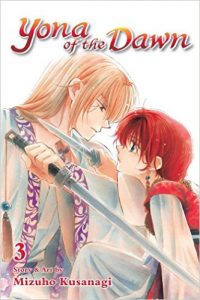
Yona of the Dawn, Vol. 3

By Mizuho Kusanagi. Released in Japan as “Akatsuki no Yona” by Hakusensha, serialization ongoing in the magazine Hana to Yume. Released in North America by Viz. Translated by JN Productions, Adapted by Ysabet Reinhardt MacFarlane.

Yona of the Dawn has clearly been a fantasy series from the get go, but with this volume we also see it starting to take on the quality of myth. Or rather, of creating a myth, as it turns out that Yona’s red hair (something she’s always disliked) is part of a prophecy that has been bandied about. Not to mention that the priest we meet at the end of Vol. 2 turns out to be able to literally communicate with God, and also mentions a “red dragon” who will unite the land. So good thing Yona is the protagonist, then, as she certainly has her work cut out for her. Luckily, she manages to gain a few more allies than just Hak in this book.

yona3

First off, we have Yun, who I suspect was brought in by the author to fill the ‘tsukkomi’ role, but in non-meta terms, he’s got a destiny that’s bigger than just taking care of an absent-minded priest, and Yona is where he can find it. His backstory once again reminds us that this land is filled with strife, politics, and suffering, something that Yona too is gradually discovering as she realizes how much she really wasn’t aware of as the pretty princess. The other new ally is Gija (please, no romanization arguments, Japan asked for the G), who is one of the Four Dragon Warriors who wield tremendous power (as seen by his reptilian right arm), and whose ancestors have been waiting an awfully long time for Yona to show up. Being a blond second love interest sort, he and Hak naturally don’t get along, and I suspect this will be a source of amusement in the future.

This is Yona’s volume, though, and she’s really fantastic in it. She’s determined to not be useless if they get attacked by enemies again, but saying you want to learn to use a sword and bow and actually having the nerve to take a life are too very different things. Yona clearly has some skill (used, in best romantic comedy fashion, when Hak provokes her), but she’s a princess who was raised by a pacifist. Hak explicitly says that by teaching her to fight, he’s defying her late father’s order to never let her touch a weapon. Violence and strife will come to Yona, but facing them head on will not be easy. Something that she realizes as we move on.

Note that this story is not all serious murmurs about fighting and destiny. Yona and Hak may or may not be the main “will they get together” couple, but they are hilarious together, with Yona’s faces when she’s aggravated with him being particularly funny. (The start of Chapter 15 verges on magical.) And Yun, as I noted before, has a nice ability to be a grumpy snarker, having absolutely no time for Hak and Gija trying to figure out who is the best man to protect Yona. No doubt all of them will try, but I’m hoping that as the series goes on, Yona will learn more and more to protect herself. Can’t wait for the next volume.

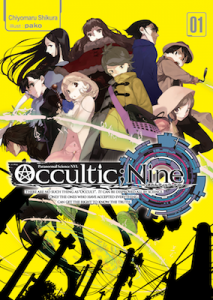
Occultic;Nine, Vol. 1

By Chiyomaru Shikura and pako. Released in Japan by Overlap, Inc. Released in North America digitally by J-Novel Club. Translated by Adam Lensenmayer.

Of the three initial licenses by the fledgling J-Novel Club, this was the one that people had heard of. The creators are responsible for such titles as Chaos;Head, Steins;Gate, Robotics;Notes, and other series with highly eccentric casts that abuse the common semicolon. Now we have Occultic;Nine, which is not connected to the other series that I know of (aside from the punctuation), but does have the advantage of an anime currently airing, as well as a visual novel coming next year. The plot of this book is not quite certain yet, except that it deals with a large group of people who are somehow interested or connected to the occult. The narrative viewpoint bounces back and forth between them (with one notable exception). And as a light novel, it’s not too bad.

occultic1

Our hero, if such a word can be applied to an ensemble cast, is Yuta Gamon, a teen loser who spends most of his time running a blog devoted to mocking the occult with the help of his mysterious, airheaded, and large-breasted friend Ryoka, who is not quite Mayuri from Steins;Gate but seems to fulfill much the same function. (She is the only character without a narrative viewpoint, which unfortunately makes it look like she was added simply for people to talk about her boobs.) Yuta is teeth-gratingly irritating in a way that most people who have been teenagers will likely be very familiar with, but ultimately harmless, and also seems to be getting mysterious messages on his ham radio setup. As the book goes on, we also meet a girl who tells people’s fortunes, someone who curses people via black magic, an occult reporter, a seeming detective (though honestly he could easily be faking), etc. Interspersed randomly throughout this (very randomly – the author admits in the afterword he added it after the book had been written) are the actions of a vast conspiracy doing… something.

This is very much a Volume One, promising a lot of cool things but not really delivering until the last few pages, which are easily the best part of the book, as Yuta discovers a corpse and unfortunately makes himself the prime suspect. But for the most part it’s there to show us the world these characters live in and slowly start to bring them together. I understand the anime compressed this entire first novel into one episode, which doesn’t surprise me. The characters are interesting, though. I particularly liked Miyuu, who despite her fortune telling powers is easily the most normal character in the book, and her determination is admirable. The whole thing reminds me a lot of the Durarara!! series, where you get a bunch of things thrown at you that won’t make sense till about Books 3 or 4.

The book’s main flaw, of course, is that at times it’s a bit TOO disparate, and can read sort of like waiting 200 pages for anything to actually happen. But if you enjoy a book based around mood, with a bunch of eccentric, annoying, yet ultimately sympathetic characters and an ominous undertone (what’s with the bodies in the lake?), Occultic;Nine is a good read worth your time. Though it will put Gloomy Sunday in your head (I like to think they heard the Billie Holiday version).