Monthly Archives: February 2017

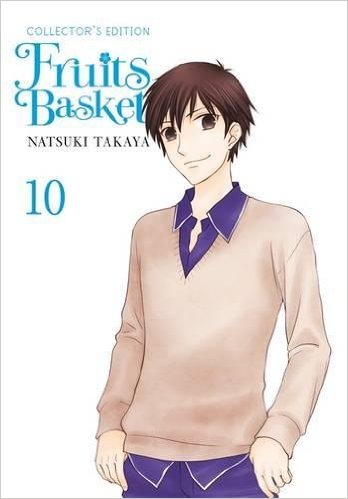
Fruits Basket Collector’s Edition, Vol. 10

By Natsuki Takaya. Released in Japan by Hakusensha, serialized in the magazine Hana to Yume. Released in North America by Yen Press. Translated by Sheldon Drzka.

Yen Press’ rush release of these omnibuses has been a bit disorienting at times, and because I’m giving each of them full reviews it sometimes feels like I was only just talking about the last book and here’s another one. (It’s been about 3 1/2 weeks since I reviewed Vol. 9). That said, one can never, ever run out of things to talk about when discussing Fruits Basket, so no worries on that end. As Takaya herself says, we’re beginning the home stretch here, and many mysteries are being cleared up now that the biggest of them all has been revealed. We see why Kakeru has been so on edge around Tohru, and finally meat his semi-mythical girlfriend Komaki (who for a moment looks as if she may stay with a ‘hidden face’ before getting revealed a bit later), and we get Kyo starting to explain exactly why he feels tremendous guilt and pain when he thinks about Tohru’s mother.

Speaking of Tohru, this volume is probably her low ebb. Her inability to reveal the fact that she loves Kyo is shown to have explicit ties to her idolization of her mother and the trauma of her passing, as well as a somewhat understandable complete misunderstanding of how loving someone actually works. Shigure, who in the past gave her nice, calm, friendly advice, is perhaps getting a bit too attached to her, as he now proceeds to slam at all of her buttons at once, trying to break past her traumas and get her to admit what she doesn’t want to. It hasn’t worked on Akito, and there’s no reason it’d work on Tohru, but it does show how he may feels about her now, and winds up with Shigure wondering, to the reader’s horror, what might have happened if he’d dreamt of Tohru rather than Akito.

As for Akito, well, much of the book is spent with her holed up and avoiding everyone, having a massive sulk after recent events. We finally get some backstory regarding his father (who reminds me of Yuki quite a bit, something I think Akito herself is also aware of), as well as, unfortunately, more insight into Ren, who we see Akito seems to get her selfishness and tendency towards insane tantrums from. Akito at least is seeing the cursed Sohmas gradually break away from her – more on that later – but Ren is given no real reason for her abusive nature beyond being a petty, selfish and violent person. Her attack on Akito is unfortunately, not so much for her as because it gives Akito a knife, which leads to bad things later on.

I’d mentioned two more curses break here, one right after the other – Momiji and Hiro’s. Hiro, possessing an actual warm and loving home life and with his angst over Kisa and Rin mostly being resolved, is not much of a surprise, and the revelation is quite heartwarming. Momiji is more startling, particularly in the somewhat unrealistic way he’s grown up and, frankly, become almost unrecognizable – I’ve talked before about when Takaya’s art morphed from its early Furuba faces to late ones, and despite her hurting her hand after Vol. 8, I think it’s more around here that we see it. Momiji is no longer cursed, but of course he can’t return to his family, and he already knows he’s not going to win Tohru’s love, despite his words to Kyo. So what’s left is a deep loneliness, but also a yearning to make a brilliant future for himself.

More to discuss, as always! Ayame angering an already angry BL fandom by admitting that Mine is his girlfriend, and showing off some casual cruelty towards a love confession when he was in high school that will make your jaw drop (Hatori is appalled, Shigure just amused). Kagura may barely appear in the series anymore, but she makes her appearance count, getting upset at Tohru waffling about her love for Kyo to the point where she belts Tohru in the head – which a) should give Tohru a concussion and possibly hospitalize her, given this is Kagura, and b) leads to a wonderful bit where Rin witnesses this and loses her shit, screaming that Kagura has no right to hit anyone. (Kagura, very pointedly, apologizes to Rin but not Tohru.)

And now everything is terrible, basically. (I didn’t even talk about Shigure’s scenes with Ren, in which acid meets… well, even more corrosive acid.) Kureno is stabbed (and hey, that maid wasn’t fired after all!), Akito is walking around town with a knife and not in the best frame of mind, and Kyo is telling Tohru that he a) thinks he killed his mother, and b) thinks he killed HER mother. Can things possibly get worse? Hell yes. In any case, Fruits Basket: still wonderful.
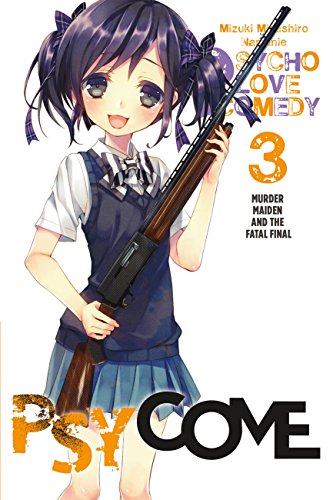
Psycome: Murder Maiden and the Fatal Final

By Mizuki Mizushiro and Namanie. Released in Japan by Enterbrain. Released in North America by Yen On. Translated by Nicole Wilder.

The good news is that this is a much more tonally consistent book than the first two, and has a better idea – most of the time – as to when to be over the top funny and when to have the reader genuinely disturbed. Renko remains the best character, getting in so many hilarious lines I can’t even bother to count them but also getting a really surprising amount of character depth (though I could have done without the epilogue telling rather than showing us all that character depth). Eiri continues to be the girl that Kyousuke SHOULD end up with, and I am very happy to hear that she’s the focus of the next book. Maina was less annoying as well this time around, and though Shamaya is back she seems to have lost the unpleasant implications of the end of the last book and just become another garden variety psycho. What I’m trying to say here is that I enjoyed everything about this except for the two lead characters and the main plot.

I knew going in that I wasn’t going to warm up to Ayaka. The “little sister obsessed with her big brother to an unnerving degree” is something already greatly exaggerated and overused by anime in general, and so turning the dial to 11 is not as successful as I think the author wants it to be. We’re meant to be amused at first and then gradually horrified as we realize that Ayaka is far more mentally unbalanced than she really should be for a “comedy” light novel, but since she enters the book hitting the high note and then only gets higher after that, we’re merely exhausted. That said, the larger issue here is Kyousuke.

There are hints, particularly at the end of the book, that Kyousuke’s entire family is, shall we say, a bit unusual, but even so, his reactions to Ayaka’s behavior beggar belief. I could be wrong here by dint of being an only child, but I’m fairly certain even the most doting brother would have noticed what was going on with Ayaka long before he did. It’s one of those cases where the revelation can’t come until the climax of the book, and so the hero ends up being unnecessarily stupid. The plot – when it arrived – was actually quite interesting, involving Ayaka deliberately being recruited into the school by their teacher, who can see a future assassin in her no doubt, but the fact that we didn’t find out about that until 90% of the way through the book is frustrating. And the subplot – involving everyone studying for finals, which have awful punishments for the bad students and setups for the next volume for the good students – was simply dropped at the end, making the “Fatal Final” a giant anticlimax.

And so, having spent much of this review being annoyed, let’s return to my original paragraph. This is a better book than the first two. The writing is more consistent, and there were some nice heartfelt scenes almost despite itself. But I don’t think Psycome will ever stop teetering on the edge of being a flaming ball of disaster, as seen in the Kamiya Family this time around. As long as it teeters and doesn’t fall off, I’ll keep reading.

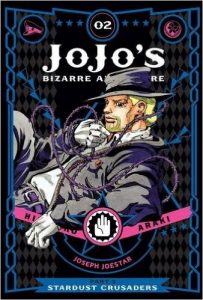
JoJo’s Bizarre Adventure: Stardust Crusaders, Vol. 2

By Hirohiko Araki. Released in Japan as “Jojo no Kimyou na Bouken” by Shueisha, serialized in the magazine Weekly Shonen Jump. Released in North America by Viz. Translated by Evan Galloway, original translation and adaptation by Alexis Kirsch and Fred Burke.

I had worried with the last volume if I wasn’t going to like Jotaro as much as his predecessors, and indeed that still seems to be the case, though I’ve somewhat come to terms with it. Things are still “we must do as many cool things as possible”, but there’s a notable element of humanity missing from this new series, instead relying on set piece after set piece and slowly moving the story around the globe, presumably ending up confronting Dio, though he barely shows up here. I also noticed the first major “we have to change this or the band will sue us” adaptation fix, as Soul Survivor (a Santana reference, so clearly the translators did an excellent job there) replacing the Japanese Devo. (Couldn’t they just say Deevo or Divo or something? They did with Kars, after all.)

It’s always worrying when I’m discussing translation choices in the first paragraph of a review. JoJo’s is one of those series I decided to write full reviews for every volume, but that was much easier in the days of Jonathan’s histrionics and Joseph’s amusing banter. The trouble with Stardust Crusaders is that while it’s not exactly bad, there’s nothing to really grasp and think deeply about. It’s all surface. Now, to be fair, Araki does surface very well. There are some striking fights here, and some of the gory deaths are both horrifying and somewhat amusing, in the best JoJo’s tradition. But even when a major plot point does appear, such as Kakyoin supposedly still being under the influence of Dio, it ends up being a bit too confusing for its own good, as it turns out that the Kakyoin that’s betraying them is actually a spy. (Also, is he named Rubber Soul or Yellow Temperance? Was the name adapted out as well?)

We also pick up a bratty little kid along the way, which I don’t really have too much of an objection to – bratty kids hanging out with heroes is very much a shonen manga trope. I was rather annoyed when she randomly decided to take a shower in the face of ever-present danger, which seems to have been solely to have her be named when faced with such danger. She looks to be about 11 years old, so this was especially annoying. We don’t need that kind of fanservice. I’m not sure how long into the series she’ll last – she doesn’t even have a name to date – but she certainly seems to have taken a shine to Jotaro. As for everyone else, they pose, they shout, and I can’t even remember most of their names.

After spending its first two volumes influencing the majority of modern Jump manga, Stardust Crusaders seems to be coasting, confident that it’s popular enough not to worry about getting cancelled, and relying on violence, set pieces, and attempting to look cool. I miss the earlier style.