Monthly Archives: April 2018

Umineko: When They Cry, Vol. 17

Story by Ryukishi07; Art by Eita Mizuno. Released in Japan in three separate volumes as “Umineko no Naku Koro ni: Requiem of the Golden Witch” by Square Enix, serialized in the magazine Shonen Gangan. Released in North America by Yen Press. Translated by Stephen Paul.

(If you aren’t spoiled about Umineko by now, best not to read this review.)

It does feel something of a cheat to be introduced to Will and Lion and then have them barely appear for the entirety of this next omnibus. Indeed, the author lampshades it. But it’s also something of a necessity. Battler wasn’t able to solve this. To a large degree, neither was the reader. And thus Will is here to reveal the culprit and have them explain everything. We’re not getting ALL the answers here, and the story plays a bit coy with the culprit by using Clair as the personification of the backstory. But here we learn about Yasu’s life as a servant in the mansion, her interaction with Battler, and what exactly it was that led to everything that happened in 1986. Yes, we finally learn Battler’s sin, and it’s the sort of thing that’s very hard to blame a young boy for but also very easy to.

That said, one of the answers we get spelled out here will, I suspect, frustrate the reader immensely. The Riddle of the Epitaph has always been fairly hard to figure out, but here we find that not only would it be hopeless for Western readers, even more Japanese readers were never going to get anywhere. Not because of the tortuous alternate kanji readings that infest every aspect of it, but simply because the one clue that would have started things off is deliberately hidden from us till this book, which is Kinzo’s “hometown”. Even Yasu, who ends up solving the riddle right at the end of the book, needs Genji to explicitly give the hint of “Taiwan” to start the ball rolling, and it’s *still* frustratingly obtuse. I credit the translator for not simply giving up and throwing his hands in the air.

I was, admittedly, about ready to throw my hands in the air when we got to the final scene, where “Beatrice” dons her regalia and is presented to Kinzo so that he can grovel and apologize to her. What Kinzo has done to Beatrice is so loathsome that even Genji, putting out feelers to see if he can get away with revealing who Beatrice really is, all but asks “Are you just going to rape her again?”. Ryukishi07 means this scene to be somewhat sad and pathetic for Kinzo, but I still can’t get over my intense hatred and loathing for the man who abused his family and made them into what they are in 1986. That said, the rest of this volume is excellent. The scenes of Beatrice and Shannon in the Golden Land are very well-adapted and help explain why Beatrice is so fixated on (and in love with) Battler. The art is also very good, conveying several times the “…wtf?” face that is the only reaction to events here.

We have one more large omnibus to go, and clever readers will be wondering what Bernkastel is up to. But Yasu’s story is not quite finished either, so put up with the backstory a little more. As for those dissatisfied with the riddle’s solution, well, can’t help you there. Umineko fans will find this essential, though.

The Magic in This Other World Is Too Far Behind!, Vol. 1

By Gamei Hitsuji and himesuz. Released in Japan by Overlap. Released in North America digitally by J-Novel Club. Translated by Hikoki.

If you’re going to lure people in to reading another isekai these days, you need a compelling concept. Not necessarily a strong concept – vending machines and hot moms will also do – but a concept where a potential reader will think “that actually sounds like it might be interesting enough to wade through more interminable “you have been summoned here to defeat the demon lord” claptrap. Too Far Behind! (as I will call it going forward) isn’t lights out, but it’s a pretty decent idea. Our hero, his not-quite-girlfriend, and their cynical best friend are teleported to another world, and told to fight the bad guys. The concept is that we follow the best friend, who is not given tremendous superpowers by the journey, but does already have some secrets up his sleeve. As a result, we have the inverse of the usual isekai themes – the protagonist comes into the story already having cool powers, and finds the world he’s now in is completely inadequate.

Suimei is our protagonist, brought to another world with his friends Reiji and Mizuki. Reiji is the actual hero, imbued with tremendous strength that will help him to defeat the demon lord. Mizuki and Suimei were caught up in the summoning as well, but have no new powers. Mizuki will help Reiji anyway, as she has a crush on him. Suimei, however, heard the story of millions of demon lord foot soldiers hankering to hunt some humans and puts his foot down – there’s no way he’s getting involved in something this dangerous. And so, while the hero and his not-girlfriend (and the princess, who has already fallen for the hero almost immediately) train so that he can save the world, Suimei holes up in the castle and seemingly sulks. Of course, Suimei has a secret that he’s never told his friends, and that no one except the court mage has discovered – he’s actually a magician!

I’m going to say this right off the bat: this story introduces us to Felmenia, talks about how strong and powerful she’s gotten with her magic, and then proceeds to write her as a ditzy dojikko deep down. When Suimei reveals his true self, she’s so impressed by how big and powerful his magic is that she can’t help but fall in love with him – at least after a battle where he proceeds to humiliate her (which, I will grant you, even he admits was petty of him). Basically, it’s that kind of plotline for Felmenia, and I couldn’t help but sigh and sort of rub my temples. Once I got past that, though, I was surprised how enjoyable the rest of the book was. Suimei is a cool protagonist without being emotionless, and we occasionally see him make mistakes and let his emotions get the better of him. Reiji is not belittled by being the hero, and we appreciate his motivations and more straight-ahead “shonen hero” thinking. As does Suimei, who’s just concerned Reiji is going to die. Even the King is one of the nicest kings I’ve ever met in an isekai. And Felmenia is fine, once I got past what type she was going to be. She’s cute and very earnest.

The book ends with Suimei setting off to another kingdom to research how to get back home, and I suspect Book two will introduce a new heroine. This isn’t breaking any isekai rules, it’s just looking at them from a different perspective. Fans of the genre should be relatively happy with it.

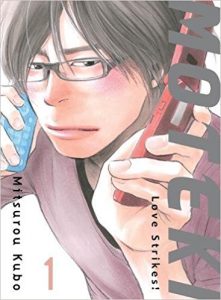
Moteki: Love Strikes!, Vol. 1

By Mitsurou Kubo. Released in Japan by Kodansha, serialized in the magazine Evening. Released in North America by Vertical Comics. Translated by Ko Ransom.

Several years ago, when I was in New York City on a trip, I used to go to the Japanese bookstore to pick up random manga magazines and see what sort of things they had in them that would never be licensed over here. One of the more interesting ones was Evening, a magazine put out twice a month by Kodansha, meant as a complement to the mainstream Weekly Morning and the otaku-oriented Afternoon. Evening wasn’t as experimental as some magazines, but it tended towards manga for adults, with adult problems and solutions that didn’t necessarily come easily. Moteki is one of those titles, and I had bought it in Japanese back then thinking it would never be put out over here – it wasn’t the sort of thing publishers would look at. But then Yuri on Ice became THE PHENOMENON, and here we are. And I’m pleased, because Moteki is quite a good story, even if it can be extremely uncomfortable at times.

Yukiyo is our hero, though I use the term loosely. He’s almost thirty and seems to be coasting his life away – content to work temp jobs that are easy to get and easy to quit, living in bachelor-land, and having no luck with women, or so he thinks. Then all of a sudden his co-worker seems to be coming on to him; his old classmate is back in his life and going on trips with him; the girl he crushed on is back in his life as well; heck, even the high school delinquent girl is back and screaming at him that he’s a moron. It’s his moteki, which is to say that period in your life where guys suddenly tend to get very popular. There’s just one problem – Yukiyo is a passive wimp who keeps waffling about what kind of signs he’s getting from the women, and thus doesn’t really accomplish much of anything.

There is a certain self-awareness to this manga, both in the comedy extras – the author hooking Yukiyo up right away, and being reminded that this manga is supposed to be read by fellow losers – and in the main text, with everyone happy to point out to Yukiyo just what he is or isn’t doing. I think this is a very good thing, as it saves the manga from being a bit too didactic. Yukiyo can be very hard to take, and thus we appreciate it when the characters say this for us over and over. He does seem to be improving by the end of the volume, but… is he really? The girls also get some focus on their own where we can hear their own frustrations and insecurities – Itsuka is my favorite, and also probably the closest mirror to Yukiyo, but none of them are purely there as props.

Moteki is a relatively short series, and the second omnibus will wrap things up. I’m not sure if it will resolve a romance – this sort of title is the kind that tends to go for “I don’t need to resolve the relationships as long as I show personal growth” – but given how much personal growth is needed, I’m fine with that. If you don’t mind excruciating passive guys getting called out on their shit a lot, Moteki is an excellent examination of adult love lives.