Monthly Archives: April 2018

Infinite Stratos, Vol. 1

By Izuru Yumizuru and CHOCO. Released in Japan by Overlap. Released in North America digitally by J-Novel Club. Translated by Holm Hinners.

I knew this one was going to be difficult, and kept repeating to myself as I read it, “Remember this came out in 2009, before all those other ones.” But it’s hard. I never saw the Infinite Stratos anime (I know, you’re shocked), which itself is almost five years old at this point. And we’ve had endless works of a similar type or variety since then, intentional or not. Guy arrives at a school, lots of girls, his relative is a higher-up, gotta pilot a giant mech… I should go re-read my review of Hybrid x Heart to see if I’m repeating myself from there. I have no doubt this series was a big influence on them. Which is fine, and I tried, but man, this feels really tired. There are too many tsunderes, the lead’s obliviousness had better be faked or else I’m going to have to rip his arms off, and the occasional interesting plot moment gets derailed at every point for harem antics.

So: in the near future, powered suits have been invented that revolutionize the world. However, only women can pilot them. As a result, men are somewhat second-class citizens now. But guess who is, for some unknown reason, the only man who can pilot an IS? That’s right, our hero Ichika, who is now going to be attending the all-female high school where he can learn how to be a fearsome mech pilot. The mechs, judging by the illustrations, are more Bubblegum Crisis-style suits than Gundams, and the documentation on them is thick and difficult to memorize, particularly if you are a dense male lead. Fortunately, Ichika will have help from his childhood friend Houki (grumpy tsundere), the British Cecilia (haughty tsundere), and his OTHER childhood friend Lingyin, aka “Rin” (standard garden-variety tsundere). Oh, and his older sister, who hits him in the head a lot, but means well. We think.

There are a few things this does well that I can appreciate. Ichika may be the only man in the world that can pilot an IS, but that doesn’t make him immediately the best pilot in the school, though a lot of that is implied to be simple ignorance of how the suits actually work. It is also refreshing, though perhaps unappreciated by me, that the book doubles down on the harem antics so quickly. Most of the stories of this sort that I’ve seen before try to balance out the plot and the harem equally, but IS doesn’t really seem that into its plot, which is a shame as it’s implied that enemies were trying to either kill or kidnap Ichika towards the end – likely related to why he’s the only man who can pilot an IS. And, it has to be said, in 2009 harems and tsunderes were HUGE. Not so much in 2018. I can easily see why this got an anime.

We’ve only had about 12 volumes of this since it began, mostly due to the author’s poor health (which he discusses in the afterword), so it’s not as big as it could be. I will say this: most of the series that have derivative plots that we’ve seen over here before are manga-only, so if you wanted to read actual harem prose, you’ve come to the right place. I’d recommend this book to those who like the anime as well.
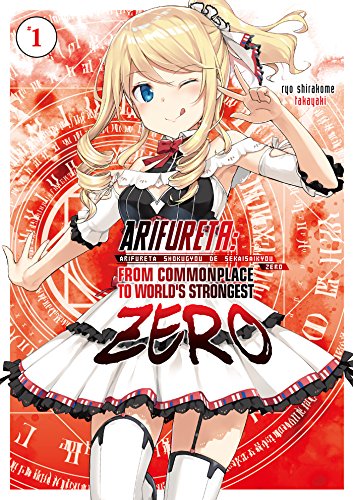
Arifureta Zero, Vol. 1

By Ryo Shirakome and Takaya-ki. Released in Japan as “Arifureta Shokugyou de Sekai Saikyou Rei” by Overlap. Released in North America digitally by J-Novel Club. Translated by Ningen.

If a spinoff of Arifureta was going to be done, the Liberators were the only obvious choice. And, despite the novel starting out trying to make us think that Oscar was going to be the main character (which he is to an extent), this is all Miledi’s plan and all Miledi’s book. As such, enjoyment of this book will depend on how much you enjoyed Miledi in the second novel. She’s deliberately written to be annoying, and even though we get a tragic backstory here to explain why she does that it can still make you want to grit your teeth at times. That said, her drive to try to change the world and go up against the gods is laudatory, and her recruitment of Oscar (and later on Naiz) also allows plenty of scenes of her getting physically and emotionally abused for comedy purposes. (She reminded me of Shea a bit, to be honest, without the trolling that Miledi does all the time.)

(The author wonders if we were surprised at Miledi’s appearance, but honestly, this is pretty much exactly how I imagined her.)

As I said, Oscar is the focus at the start of the book, a synergist (much like our hero in the main series) trying to keep a low profile to avoid the Church. Said low profile falls to bits once Miledi arrives and starts harassing him, but honestly the church is so evil anyway that it was somewhat inevitable that it wouldn’t last. We also get a pile of adorable plucky orphan children, and once Oscar and Mikedi team up to find Naiz we get two more plucky adorable children, all of whom are put in deadly danger by events of the plot. And do you want tragic backstories? You’ll love Miledi’s, whose childhood was pretty crappy and then got much, much worse. There are also several very cool fights, as you’d come to expect from Arifureta, involving clever manipulation of gravity, creating impossibly hard shields via a cool umbrella (apparently a reference to Kingsman, though I kept thinking of Ryouga Hibiki), and teleportation badassery. And, as I said before, Miledi being really, really annoying.

This actually came out a mere 4 months after the Japanese release, so I would not hold your breath for the second volume right away. That said, I can’t imagine fans of Arifureta not enjoying this, even though the regular cast are nowhere to be seen. You get a good sense of the three leads and why they made the dungeons that they did. It also reminded me that Miledi’s spirit is technically still around in the main series, and I wonder if she’ll do anything else. (I also wonder if she and Oscar will ever hook up. Probably not, I suspect.) Basically, this is exactly the sort of thing you’d like a spinoff to be, and I will definitely enjoy more of it whenever it comes out.

Monster Tamer Girls, Vol. 1

By Mujirushi Shimazaki. Released in Japan as “Kaijuu no Shiiku Iin” by Houbunsha, serialized in the magazine Manga Time Kirara Forward. Released in North America by Yen Press. Translated by Amber Tamosaitis.

When I reviewed New Game!, I went into a bit of detail regarding the classic Kirara work, i.e. “a group of girls doing but really just relaxing and chatting a lot”. It’s a shame, because it would help to pad out the word count of this review, as there’s a lot of that happening here as well. To be fair, Monster Tamer Girls does have the girls taming monsters a hell of a lot more than, say, K-On! has the girls playing concerts. This is a world where monsters are still being analyzed to a degree, and as such, even though it’s treated as a typical high school club, the need for girls like Ion and her friends is absolutely needed. Sadly, Ion is rather shy and tends to still be wary of monsters, which is why we also have Sora, who has no talent for taming but is spunky, outgoing, and really loves monsters. Stop me if you’ve heard of this type of twosome before.

As you might guess by the cover, if you were expecting cute Pokemon-style monsters you’re in for a surprise. The main monster we see here is essentially a dinosaur, and even the short cute one that follows after the girls quickly grows to enormous proportions. Joining our two main heroines are Tsukiko, an overly serious monster tamer with horrible naming sense, and Kotomi, a teen genius in the graduate program whose chief job seems to be providing yuri subtext, although honestly there’s plenty of that to go around. And then there’s Kyouko, who is not only a level above every other monster tamer girl (she’s a monster charmer), but is also the girl who saved Ion from a monster when she was just a kid. Sadly, Kyouko is straining her voice from too much abuse (as a former chorus student, I can attest to how easy it is to do that), and also worries that Ion does not have what it takes to do the job.

As a first volume, this did its job very well, and manages to be a “monster” series without the fanservice that usually goes with that sort of thing, possibly as the girls aren’t the monsters in this case. Sadly, it apparently wasn’t interesting enough for Japanese readers, as the second volume will be the last one. I think it will definitely appeal to those who like relaxing, girls-in-school type manga, and I’d argue its main audience may be the yuri fan. There’s no yuri here, but, y’know, girls hug other girls and say they missed them, so it’s not all that hard to connect the dots. This may actually be a good series to wait till summer and get both volumes as a gift for someone else. And since the fanservice is nonexistent and the yuri is all hypothetical, I wouldn’t object to younger readers looking at it either.