Monthly Archives: October 2018

Yona of the Dawn, Vol. 14

By Mizuho Kusanagi. Released in Japan as “Akatsuki no Yona” by Hakusensha, serialization ongoing in the magazine Hana to Yume. Released in North America by Viz. Translated by JN Productions, Adapted by Ysabet Reinhardt MacFarlane.

As I’ve mentioned before, Jaeha is my favorite of the Dragons, and I suspect I’m not alone there. He fits into a lot of characterization buckets that appeal to me. Indeed, he frequently puts himself in those buckets, behaving a specific way either because he wants to be seen that way, or in order to distract from how he’s really feeling. And traveling with Yona and company is troubling him, as he’s falling for Yona hard, which would be fine except that a) he totally sees the writing on the wall with Yona and Hak, and b) he worries that it’s his dragon blood MAKING him feel this way for her. As a result, in this volume we see Jaeha at his most reckless, sneaking off to a brothel partly to piss off Hal but mostly as he senses there’s something wrong about the new town they’re in. And unfortunately, Jaeha’s “always save the girl” mode also kicks in, leading him to be drugged with something quite potent.

Fortunately for Jaeha, his attempts at acting like everything is TOTALLY FINE and he is just being a horndog are doomed to failure, so Yona ends up rescuing him. Unfortunately, rescuing the town will take some doing, as its residents are in various stages of addition. Once again, Yona decides to stick around to see if this is something that can be fixed, with relatively little argument for once. Indeed, for part of the volume Yona and company are seen as they might be from the outside – as the most obviously suspicious ones. This is because we’re introduced to the young and idealistic princess of the water tribe, Riri, who is there to remind us of what Yona used to be like back at the beginning of this series. Indeed, she’s even got her own female equivalents of Hak and Jaeha as her bodyguards, though one of them might not survive an end-of-volume stabbing.

I do find it amusing that no one seems to recognize Yona, but instead Hak is the one that they find familiar – he’s not exactly an unknown face either. This ia a fantasy world with little modern technology, which is probably why The Dark Dragon and the Happy Hungry Bunch can get away with as much as they do, but they’re getting famous too, and eventually Su-Won is not going to be able to run into Yona on the battlefield and just go “whoops”. This series is long-running, and we’re nowhere near finished, but I am wondering what the endgame for it is going to be. In the meantime, Yona is far more concerned with saving Tetra (the Jaeha-ish bodyguard who was stabbed) and showing off that, even if her sword skills are rough and unpolished, facing off against Hak is a lot harder than facing off against nameless goon #2.

I feel like I’m ending each review the same way, but it’s always true. Yona of the Dawn is one of the best series Viz is putting out. You should be reading it.
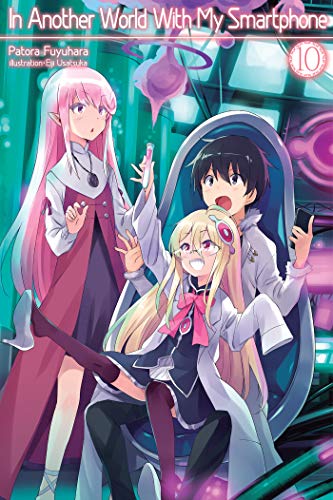
In Another World with My Smartphone, Vol. 10

By Patora Fuyuhara and Eiji Usatsuka. Released in Japan as “Isekai wa Smartphone to Tomo ni” by Hobby Japan. Released in North America digitally by J-Novel Club. Translated by Andrew Hodgson.

Three-fourths of this volume is a fairly typical Smartphone volume, with the added bonus of actually resolving some long-standing plot developments and introducing a “new” character who, while I may not love her, certainly has the ability to put a lot of things in motion. Unfortunately, that leaves one-fourth of Smartphone which is absolute garbage, having all the worst tendencies of this series wrapped up in an awful bow. Touya’s sociopathy, villains who sneer and cackle but are also cowardly and ugly, barely disguised hatred of China. It’s all here, and it sucks. I’ve talked before about how I sometimes wonder if Touya is meant to occasionally be a deconstruction of some sort, but it just doesn’t hold up all that well. The author thinks that having the occasional character remind Touya that he’s in danger of becoming a monster, and Touya essentially going “Oh, OK”, will take the curse off of it. It does not.

The cover features Sakura, whose backstory is finally revealed as Touya, hilariously, realizes he could have cured her amnesia all along with a simple spell. The recovery of memories allows us to be introduced to yet another smothering father type, a running gag in this series (to the point where the girls all admit that Touya will certainly become one of those as well), and also allows Sakura to join the harem, which is now “complete” at nine wives, though some of them girls are a bit wary of accepting that it’s a closed circle now, given Touya is, well, Touya. They’re more concerned about succession than actually jealous, though. The cover also features a young girl who, I’m sad to say, is Professor Regina Babylon, now in the present day and also in the body of a child-sized gynoid because, I think, the author finds it amusing. She’s just as perverse as ever, and when she and Cesca team up it’s bad news for everyone. I could have easily done without the spanking, though.

Touya also finally admits to his wives that he’s not from this world, something which they accept fairly easily. He also starts to show them anime, which may be a mistake, especially with the Professor watching Gundam. We also get a short story developing Ende and the Phrase, and explaining what happened in the past and why the Phrase keep on attacking Touya’s world. It is, at heart, a love story, and I liked Touya admitting that, despite the hideous loss of life, if it were him he may have been the same. (This is not hard to imagine given how much Touya doesn’t care about Yulong or anyone in it, though admittedly he only seems to meet bad guys there due to the whims of the author.) I suspect the majority of the Phrase are still evil, though, which means expect to have more giant robot battles in the near future. Which now include Sue, who is getting into the swing of things very fast.

Despite wanting to punch Touya and the author in the face for the Daydream Believer chapter (which also ruins one of my favorite Monkees songs), I’m still somehow still reading Smartphone. It’s one of the rare series which is at its best when doing dumb harem slice-of-life, as Touya needs to be constantly belittled by near everyone or else he becomes a monstrosity. Oh yes, added points to the illustrator, as the first three black and white illustrations in the book each made me laugh out loud, combining the text and a picture perfectly.

The Promised Neverland, Vol. 6

By Kaiu Shirai and Posuka Demizu. Released in Japan as “Yakusoku no Neverland” by Shueisha, serialization ongoing in the magazine Weekly Shonen Jump. Released in North America by Viz Media. Translated by Satsuki Yamashita.

For all that Ray insists that he’s not going to sacrifice his life at the end of the last volume, he is a small child running at full speed against a number of demons who are essentially horses in this scene. Sure, he’s rescued, but it was an impetuous thing to do. And of course there’s also Emma, who is almost literally working herself to death to get this escape on the road. So I really enjoyed the scene in this volume where Dona, Gilda and the other kids tear into the two of them for taking everything on themselves. The Grace Field kids are ALL smart – sure, Ray, Norman and Emma were the tip of the top, but they’re all bright lads and lasses who can see what’s really going on here. If you’re going to escape with everyone, everyone has to work as a unit and decide things as a unit. Which is good, as when they get to the map coordinates it’s a big bunch of nothing.

We also get a lot of answers this volume as to how this world works, and while Emma tries to paint it in as optimistic terms as she can, it’s not good news. They’re on the wrong side of a great divide, this has been going o0n for a thousand years, and I suspect if they do make it back to humanity, they may have to watch out for being killed there as well. Despite that, Emma is right, there is some hope. And honestly, we learn that being at their own farm was possibly the best place to be, given that most demons seem to eat the equivalent of fast food – which is to ay humans kept in tanks and barely cognitive, there to be eaten and forgotten. It’s a chilling sight. There’s also the demons who rescued them at the start, who seem to be “religious converts” but may be a lot more sinister than that. I wonder about them…

In the meantime, there’s a new area to explore, and to no one’s surprise, it’s not quite as barren as expected. Now they’re in an underground shelter, and meeting an actual adult human who… seems to be one of those “I am a jerk on the outside, but wait till you see my soft core” types. Sadly, he’s the cliffhanger, so we’ll have to wait for next time to see what his deal is. Ray and Emma are pretty good about having a healthy level of suspicion about their “saviors”, but also being willing to trust people. When you don’t have much choice, that’s where you are. I suspect that the next volume of The Promised Neverland will begin a new “arc”, but I also suspect it will involve a lot of almost getting captured and escaping, because that’s why we read the series. Well, that and seeing the kids be cute.