Monthly Archives: October 2018

JK Haru Is a Sex Worker in Another World

By Ko Hiratori. Released in Japan by Hayakawa Shoten. Released in North America by J-Novel Club. Translated by Emily Balistrieri.

Before I begin, let’s state the obvious: this book is for those over the age of eighteen. The review will not have strong language itself, but reader discretion is advised.

Wow. I didn’t know much about this going into it. When I first heard about the license, I thought it sounded absolutely dreadful, but I was assured that it was not actually meant to be a servicey title and that it would reward the patient and tolerant reader. The assurance was correct, as I am very grateful to have read this title, which I thought was excellent. That said, I know several people who started to read this and were unable to get past the first two sections or so, and I can understand why. The premise sounds like your standard isekai: two kids are run over by a truck and die, meet God, and the buy gets cheat powers because this is an adventuring isekai sort of world they’re going to be dropped in. Unfortunately, it’s also virulently misogynistic. The basic roles for adult women are slave, wife, or sex worker. Haru chooses the last.

What follows is Haru going about her daily life, which involves blunt descriptions of the sex work she does. Haru’s narration is one of the main reason to get the book, as she pulls no punches about the sort of life she has to lead. The boy she came from Japan with is an absolute creep, the sort of guy who thinks he would be doing Haru a favor by letting her become his maid. This is not, by the way, a book to read for those who want to be aroused by talk of sex. There IS a lot of talk of sex, but it’s not meant to arouse you in the slightest. There are several rape scenes throughout the book, and they are as horrible as you can imagine. Haru tends to “dull her emotions” a bit during them, but as a reader you’re still horrified. That said, you do also learn to enjoy the happier times in her life as well, such as tea with her colleagues and, in the most positive and fun chapter in the book, playing “Kick the Can” with a group of kids.

About 2/3 of the way through the book there is a spoiler, which I won’t disclose, but it does tie into the main plotline and also makes sense in terms of what’s come before. Aside from Haru and Chiba (the Japanese guy), the most interesting character to me was Kiyori, a pure Japanese priestess type who wants to go adventuring, but is not allowed to without a guy. Kiyori’s the only other one whose narrative perspective we get in the book (which is otherwise Haru’s), and you get the sense as you get to the end of the book that she’d much rather be in a relationship with Haru than with any of the horrible adventurer creeps who are trying to team up with her. Unfortunately, that is not a very likely option either because, as I said earlier, virulently misogynistic world.

There are a bunch of other things in the book I enjoyed, at times the writing is very subtle. (Discussion of a reincarnation made me smile a bit, especially given the plot that leads up to it.) It apparently was a polarizing book in Japan, though not so much for the explicit sex worker content as for being an isekai at all – this is a novel, not a light novel, and fans of the publisher were upset they sank to publishing one. It’s a novel that needs warnings before you read it, but I feel that overall it ends on a positive and forward-looking note. Indeed, it feels a bit open-ended, and the final short story implies the author has a lot more they’d like to write about. If you’re tired of the standard “hero goes to another world and gets superpowers and a harem of girls” stories, this is a grim yet well-told response to it.

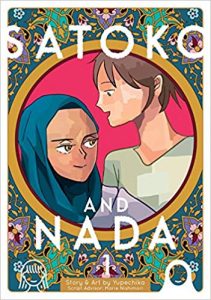
Satoko and Nada, Vol. 1

By Yupechika and Marie Nishimori. Released in Japan by Seikaisha, serialization ongoing on the online site Twi 4. Released in North America by Seven Seas. Translated by Jenny McKeon. Adapted by Lianne Sentar.

The premise of Satoko and Nada feels a bit fresher because it has an extra twist to it. When you see the series takes place at an American university, and features two roommates learning more about each other, you’d expect that one of them would be a stereotypical American. In fact, Nada is Saudi Arabian, and her new roommate Satoko is Japanese. Thus they’re not only learning about their own culture and personal foibles, but also learning about life as a foreign woman in America. It’s the sort of premise that works well as a 4-koma, as I think in extended chapters the lessons of “no matter what nationality, religion, or culture you are, you can still be friends” might be a bit didactic. Here each new strip resets things, and the result is a manga that’s light and funny while also making its aims very clear. And, if you’re just here to be entertained, Satoko and Nada does that as well.

A large number of these pages are typical “college roommate life” filtered though the culture of both women. We see Satoko gradually opening up and becoming more confident. It helps that Nada is the extrovert of the two, which also helps to show that the woman under the Niqab is not going to be the stereotype you’d expect. Satoko’s food is too bland, Nada’s food is too spicy. Satoko also seems to lack a sense of self-awareness at some points, leading to the one serious scene in the book where she accepts a ride with a sketchy guy and is thankfully rescued by Nada. Even on campus, America is not Japan (and it doesn’t seem they live on-campus, but in housing somewhere else.) Thankfully, most of the time the “life lessons” are more humorous, such as when Nada lectures Satoko about the different kinds of Muslim women and the outfits they wear, then berates her for an unfashionable dress.

The cast is fairly minimal. Nada has a few other Muslim friends, who sometimes come over for a “girls’ night out” and prove to be just as extroverted as Nada. Of course, this is just in comparison with the introverted Satoko – I do wonder how much of this story is based on real life experiences, as it can sometimes feel like a biographical comic with added punchlines. We also meet an American girl called Miracle (she apologizes for her parents’ “phase” when she was named), who’s a Christian church-goer, to add to the religious balance. (Satoko, as a typical Japanese woman, is technically Buddhist but in reality not all that religious, which leads to some amazement among her other friends.) I was also amused and sympathetic to Kevin, an American who’s trying to get a job teaching in Japan… but he’s Asian-American, and they only want Americans who “look white” to teach.

Satoko and Nada is not revolutionary, but I spent my time reading it with a smile on my face, and I did learn a thing or two as well. (Praying towards Mecca now has an app to help with the direction.) It’s something I’d recommend to any fan of slice-of-life manga, or those who enjoy seeing manga starring and about women.

Accel World: The End and the Beginning

By Reki Kawahara and Hima. Released in Japan by ASCII Mediaworks. Released in North America by Yen On. Translated by Jocelyne Allen.

The past coming back to haunt people is a running theme in Accel World. In real life, past trauma is how you get Incarnate attacks to use in the game. And events that have happened in the game have also had traumatic repercussions, particularly for Kuroyukihime and Haruyuki. Still, as our heroes continue to attempt to try to defeat the ISS kits, I was not prepared for the past to literally come back. Everyone’s still feeling out why this is happening, but in a meta way, I think part of it is that Reki Kawahara knows when he has a good idea, but then proceeds to come back to that good idea over and over again like a favorite toy until everyone else involved just wants to move on. In Sword Art Online that idea is Laughing Coffin, the Guild filled with player killers who have proved to be behind almost everything in the series. And in Accel World its’… well, that’s the cliffhanger ending, isn’t it? Is it a real cliffhanger if the reader groans?

This is another volume that is essentially one big fight, staying inside the Accelerated World as Haruyuki and company take on the Accelerated Research Society, which is not only destroying Ash Roller with its ISS kits but has also kidnapped Nico, planning to use her for some nefarious scheme. (Nico stays unconscious for 95% of the book, though thankfully she does at least wake up and get angry for the last few pages.) Our heroes divide into two groups of four, as half go after Nico’s kidnappers while the other half stay to try to get to an exit point to unplug Nico in the real world. Unfortunately, the kidnappers are very good at what they do, and the battle is mostly fought to a standstill throughout. Also unfortunately, the exit to the real world turns out to be inside a monster… a monster that is capable of a lot of awful stuff. And, as I noted before, bringing back bad memories. Literally.

This leads to the most interesting part of the book. The killing of Red Rider was sort of the spark of everything that happened in the series, and we’ve seen it in flashbacks a few times. Now we get to see Red Rider “return” as sort of a memory copy, and you can see why everyone was upset – he’s a nice guy, and seems like the shoujo hero of a book starring a shy, insecure girl. His presence, though, allows Kuroyukihime to show how she’s grown past who she used to be and has reforged her bonds, and found new ones. It’s cool to see, and the emotional beats on her side of the book are more satisfying. As for Haru and company, they get a lot less sympathetic memory copy to deal with. The first really nasty villain of Accel World is here to chew bubblegum and be snide, and he’s all out of bubblegum. Unfortunately, he’s just a memory copy, and so unable to control combining with Nico’s stolen equipment very well, which leads to… well, the cliffhanger I was carping about.

This is still a good volume of Accel World, particularly if you like action sequences. We still have more to go, as once again the arc is not finished. Will Nico be permanently depowered? Will our heroes save Ash Roller? Will Kawahara keep playing his Greatest Hits? Only one of these is certain.