Monthly Archives: December 2018

Pez

By Hiroyuki Asada. Released in Japan by Wani Books, serialized in the anthology Robot. Released in North America digitally by Denpa Books. Translated by Andrew Castle.

The book is titled Pez, and I’m not sure if it’s meant to reflect what most people from my generation think of when we hear the word, which is to say the candy you got out of the package with the cartoon character head. It’s meant to suggest a light, sweet, ephemeral sort of think. And now we have the Pez manga, which is not all that light, somewhat bittersweet, and… well, OK, it does feel pretty ephemeral, as it seems to end right about where most manga would begin. But that’s fine, because this feels more like a doujinshi, the sort of high-concept original work you’d get from an artist who’s filled with creativity but also does work for Weekly shonen Jump to pay the bills a little better. It’s only 72 pages or so, but they’re all full color, which also helps to distinguish this. As for the plot? Well, it’s a post-apocalyptic slice-of-life, which is actually pretty popular these days, so it seems a good time for it to come out collected here.
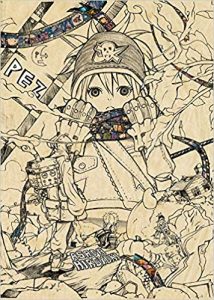
Pez is the young woman on the cover, who we first see wandering around the ruins of a home in the middle of nowhere, scavenging for what she can find. She’s joined by Decosuke, who appears at first to be a young man the same age as her but it quickly becomes apparent is actually the brain that the body is carrying behind it. She’s found a old movie filmstrip, which she proceeds… to wear as a scarf, which tells you right off that this is not going to be all bleak tragedy. That said, it’s not all laughs either – Pez and Deco’s past when they were both normal kids (who appear to be living off the streets) is short but extremely painful (indeed, Pez calls this out in the actual manga). The reason they’re where they are right now is a mad scientist sort by the name of Dr. Thunder Land, who is able to revive/robotize the dead Decosuke, and also (as we find out in the final pages) gives a little something to Pez that makes her able to see a bit more than most people. (This section also involves some shots of Pwz topless, be warned.)

Most of the short volume is Pez and Decosuke walking the Earth, finding bombed-out shelters and discussing things. There’s a sweet bit where they find an old pizzeria whose chef is caught under rubble – they can’t free them from their inevitable death, but they can get instructions on how to make a delicious pizza. Sometimes it’s ridiculous, as with Pez’s imagining what sweets are like. And sometimes it’s inspirational, as the ending involves Pez and Decosuke following the “lights” in the sky and seeing where they lead so they can find out how the world got this way. They will find out, maybe, but we won’t – the book wraps up there. That said, as a one-shot it feels well worth the purchase, being made entirely of mood, and with some Wonderful sketch-like art that you’d normally only see in the likes of Ikki and similar magazines – or in the pages of the Robot anthology. It feels like a boutique manga, the sort you’d leave on your coffee table to impress the guests.

The Saga of Tanya the Evil: Dabit Deus His Quoque Finem

By Carlo Zen and Shinobu Shinotsuki. Released in Japan by Enterbrain. Released in North America by Yen On. Translated by Emily Balistrieri.

I’ve talked before about how Tanya the Evil is at many times written like you’re reading a history book. It’s actually a bit weirder than that, as you’re reading several competing history books, each with its own agenda. This is made obvious in the sections involving the Federation, aka not-USSR, whose style of Communism under “Josef” is mocked mercilessly, even to the point of having one section written as a children’s history book. The Federation in general comes in for a bashing this volume, partly because, well, Communism under Stalin, please look at real history, but also because Tanya is virulently, rabidly anti-Communist and says so most of the time. The book starts with her taking her team to “put a scare” into the Federation capital. She proceeds to overdo it. One of the more interesting bits is when she tells Visha, who escaped the Federation as a child, not to hold back her hatre3d and to go all out. Visha, who honestly doesn’t recall much of her childhood and isn’t really driven by hatred, is rather nonplussed.

It can be difficult at times to remember that Tanya is not the heroine, merely the protagonist. We’re meant to be a bit horrified by her. Quite a bit. The trouble is that most of the book is in her semi-1st person monologue, so sympathy naturally falls with her, especially when the war is not going her war, which is constantly. There’s a glorious bit when she’s on trial for some of her actions when they realize that this little girl is, in fact… acting like a petulant child. Even when she finally gets her wish of a transfer to a non-combat position, it doesn’t even last two weeks. But we’re not really meant to like ANYONE in this “war is hell” series. Not the Empire’s generals. Not the government, who are invisible but making poor decisions behind them. Not the Federation, who I would call a parody of Stalin’s Russia were it not already hard to parody. And not even the Commonwealth or the Unified States, who we see training up their own crack mage unit, complete with blonde Kansas girl Mary Sue, who unfortunately runs into Tanya in her first combat and realizes that Tanya was the one who killed her father. She doesn’t take it well.

These books continue to be bricks, far longer than almost all light novels that aren’t DanMachi. A lot of that is tactics and military discussion, and I say it again: don’t read this unless you’re fascinated by such things, because it will drive you mad. One other downside: we’re introduced in this book to “Josef” and his number two, who is named Loria. Loria is based on Lavrentiy Beria, who was a sexual predator, and it’s this aspect that Carlo Zen mines for “humor” (and also horror, to be fair), as he spots the 12-year-old Tanya (she must be twelve by now, right?) stomping all over Moscow burning everything in sight and decides that he needs to make her his. It’s as disturbing as it sounds, and it gets a color illustration that makes it much worse. Sadly, I expect to see more of him. As well as Mary Sue, who’s a talented newbie this time around but is now driven by hatred and fury, so I expect her next run-in with Tanya will be very different.

Tanya fans who only watched the anime will be happy to know this is where the new stuff begins (well, technically the end of the last book). It’s still a very interesting series to read, but remember that the author is actually a left-wing socialist. Tanya is not here to be admired. No one is, really.

Ao-chan Can’t Study!, Vols. 1-2

By Ren Kawahara. Released in Japan as “Midara na Ao-chan wa Benkyou ga Dekinai” by Kodansha, serialization ongoing in the magazine Shonen Magazine Edge. Released in North America digitally by Kodansha Comics. Translated by Erin Proctor.

Sometimes when reading manga you are looking for a well-characterized, touching work that will heal your heart and make you think. And sometimes you’re looking for silly sex jokes. If it’s the latter you’re after, I am pleased to say that Ao-chan Can’t Study! is here for you. It’s about as subtle as a brick to the head, but why would you want to be subtle in a case like this? It’s a sex comedy. With the emphasis on the comedy, I hasten to add – there’s tons of sex talk, but don’t expect any forward progress, at least not at the start of the series. It sort of feels like Seitokai Yakuindomo to a degree (and I could write an entire POST about why Kodansha Comics never licensed that, complete with them indirectly dissing it when they picked up Aho-Girl). Despite all that, though, things still remain on the innocent side here, adn the kids read like normal romance comedy heroes and heroines and not perverts. Well, mostly.

Ao-chan has had difficulties with her childhood almost from the start, when she introduced herself to the elementary school class as Ao, “A as in apple and O as in orgy”. We find out why fairly quickly – her father is a famous author of erotic novels, and also the equivalent of Happosai from Ranma 1/2 (he even looks like him), and despite her best efforts, Ao is now in high school and has a mind that quickly turns filthy at the slightest provocation. Not that she has any experience or anything, but just being around her father has sort of led her to be a pervert by osmosis. She tries to repress this by being a stoic ice queen, with perfect grades and no interest in men. Sadly, she has piqued the interest of Takumi, the class’ resident hot guy, who doesn’t study very well but finds Ao interesting. She attempts to drive him off, but her dad has decided now is the time to get his daughter laid. What’s more, Takumi’s feelings appear to be genuine. And worst of all, there’s a rumor going around that he is… well, larger than average.

Shonen Magazine Edge tends to push boundaries a bit, and despite being clean at heart, so does this title. There’s Lots of discussion of penis size and how it can actually hurt for a woman when a guy’s too big. In the second volume, when the class goes to summer camp, Ao somehow gets it into her head that she’s going to be invited to a “fuck party”. As I said, things you wouldn’t normally see in Fairy Tail (UQ Holder, maybe), and you can see why it’s a digital-only series. The reason it avoids being pure skeeze is Ao, who is pretty innocent – she has no idea what a dick really looks like, and most everything that she gets in her head is either exaggerated or wrong. Plus she’s falling for Takumi too, and has no idea how to deal with her feelings – and her libido. Add in a rival or two, and you’ve got a fun if ecchi comedy, recommended for those who don’t mind that sort of thing.