Yearly Archives: 2018

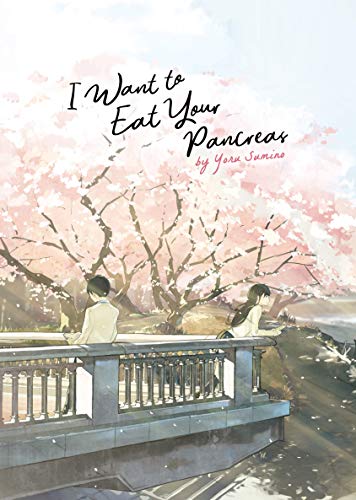
I Want to Eat Your Pancreas

By Yoru Sumino. Released in Japan as “Kimi no Suizō o Tabetai” by Futabasha. Released in North America by Seven Seas. Translated by Nathan Collins.

The book spoils you on page 1, so allow me to do the same: the heroine does not survive the book. That is in fact, the point of the book, which is a novel rather than a light novel, and has its feet planted firmly on the ground. Despite the title, this is not about zombies or anything like that. Sakura, the heroine, has something wrong with her pancreas, to the point that she has a year to live at most. Our hero, whose name remains deliberately obscured for most of the book, accidentally finds out about this (they’re classmates, but she’s only told her family and is hiding it from everyone else) and the bulk of the book is the two of them gradually getting closer and hanging out. They’re not quite falling in love (I suspect were it not for her illness they’d get together much faster, even with the hero’s personality issues), but most of the prose till near the end consists of either school or “dates”.

The handling of the hero’s name is quite interesting, if a bit aggravating at first. He’s defined by how others think of him – for most of the first half Sakura (who he also avoids naming, so her name also rarely comes up) refers to him as “Classmate I Get Along With-kun”. but this changes depending on circumstances, and other people like classmates also address him this way. It ties into the book that Sakura is writing, called Living with Dying, and while the text of this novel isn’t that book, it does sort of follows the rules of said book, which also avoids using him name. Speaking of the hero, he is a loner and something of an outcast – always reading, self-proclaimed with no friends, but very perceptive in a negative sort of way. Of course, he’s not as perceptive when it comes to emotions, and one of the highlights of the book is a fight that he and Sakura have over a misunderstanding.

Again, I will try not to spoil too much, but there is a definite sense that the book is going to end the way you’d expect (I mean, it begins with her funeral, which our hero does not attend), but the book has a few surprises in its last quarter or so. The surprise might upset a few readers – it’s foreshadowed, but not by much. That said, it’s mentioned that “real life doesn’t work like an novel”, and you get the feeling that the way things played out was the author’s way of avoiding things simply being too predictable. I also felt the epilogue, which jumps forward in time and avoids showing us two characters’ growth more than I like, was a bit abrupt, but that’s likely because the payoff of everything right after Sakura’s death was the best part of the book, and very emotionally raw.

This is not, for most of the time, a depressing tragedy of a book. I tweeted that it felt like a darker Teasing Master Takagi-san, and given that Sakura spends most of the time imposing demands on our nameless hero’s time, there’s a lot of Haruhi Suzumiya here as well. It’s a touching story of two people who have a deep and affecting impact on each other’s lives over the course of only a few months. I really, really enjoyed it.
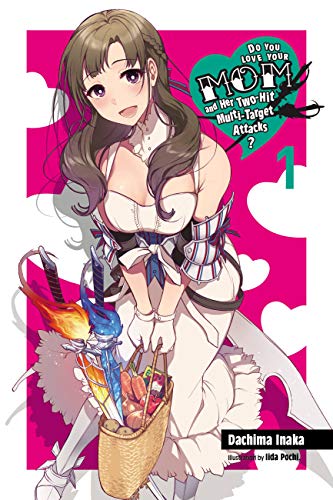
Do You Love Your Mom and Her Two-Hit Multi-Target Attacks?, Vol. 1

By Dachima Inaka and Iida Pochi. Released in Japan as “Tsujo Kogeki ga Zentai Kogeki de Ni-kai Kogeki no Okasan wa Suki desu ka?” by Fujimi Shobo. Released in North America digitally by Yen On. Translated by Andrew Cunningham.

This book is straight up ridiculous. I realize that may be the most obvious thing to say, but I want to say it up front because I went into it thinking that the ridiculous content would take a back seat to sketchy mom-son sex humor. And there is a bit of that, but mostly the comedy is first and foremost the important thing here. This series is not trying to titillate its reader, it’s going for fun. And it pretty much succeeds. We get a lot of amusing riffs on the standard “adventure game” tropes, the characters are all obvious cliches but fairly likeable. Best of all, despite the occasional lewd joke or ogling, there’s absolutely no sense that Mamako (yes, really, that’s her name) and Masato view themselves as anything other than mother and son. This allows the reader to relax and focus on what’s important: Mamako is hilarious.

Masato is our hero, a 15-year-old boy who is dealing with a mom who a) looks about seventeen and is gorgeous; and b) doesn’t seem to realize that he’s not six years old anymore, so is overly doting and smothering. One day he comes home to find a government worker there who tells him that he has been chosen to play in an ‘MMMMMORPG’. He’s not sure why there are so many M’s, but he agrees… and finds himself in a virtual game world. He’s a hero! He gets an awesome sword! He has party members who are an adorable and trusting 12-year-old girl and a tsundere but clearly future love interest mage! There’s just one problem. His mother has come along with him into the game. And she has TWO swords (the two he didn’t pick when given a choice) that do so much damage that he never has a chance to shine. She may not know anything about adventure games, but she certainly knows how to make him feel awkward and embarrassed.

As you can see, we’re not going for subtle here. In fact, the overtness is part of the point – the series works better for it. The game that Masato and company are in is a beta release, and they’re meant to be testing it. This leads to many of the NPCs simply reciting the guidebook, or speaking in actual gamer talk rather than having it filtered through a fantasy world. Wise, the tsundere girl (she spends most of the book in a state of fury, but there are good reasons for it) is amusing, and you get the feeling she’d be nice if she ever calmed down. Porta, the girl, is a parody of the ‘little girl party member’, and this about as deep as a small puddle, but her pureness is almost endearing. As for Masato and Mamako, they start off exaggerated types, and by the end are slightly less so. Believe it or not, there is a bit of plot and character development in this, and by the end of the book Masato has learned not to take his mother’s actions as a personal attack, and Mamako has (possibly) learned to allow her boy to grow up. (I say possibly as, well, there’s more books in the series, and the premise is that Mama is more powerful and steals the spotlight.)

I also need to mention the main reason to read this series, which is Ms. Shirase, the government agent who starts this entire mess. She is amazingly funny in a deadpan sort of way, and I was delighted at her appearances throughout, as well as her constant fourth-wall breaking. I really hope we get more of her. The series reminds me a lot of KonoSuba in terms of its style and laughs, and I think fans will enjoy it. Yes, there’s some incest parody – that’s the premise! – but I feel safe that it won’t go anywhere and isn’t serious. Recommended for fans of comedies and mothers.

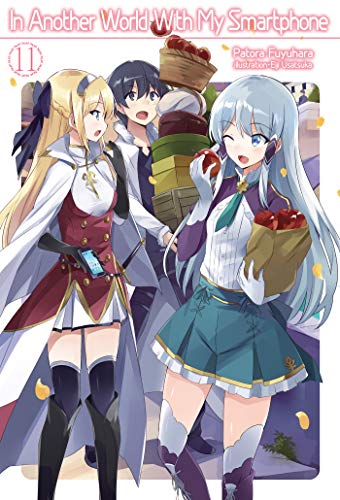
In Another World with My Smartphone, Vol. 11

By Patora Fuyuhara and Eiji Usatsuka. Released in Japan as “Isekai wa Smartphone to Tomo ni” by Hobby Japan. Released in North America digitally by J-Novel Club. Translated by Andrew Hodgson.

I am somewhat tempted to copy/paste much of my review of Vol. 10, which would work just as well here. Most of this is relatively tolerable Smartphone, and there’s even a bit about 3/4 into the book which was reasonably horrific and well-written. But it wouldn’t be Smartphone without its worst trait ether, and given that fantasy China has basically been totally destroyed, it’s time to go after fantasy Arabia. We have more of Touya meeting up with really obvious villains, fat-shaming them, and killing them. Actually, I tell a lie. The villain is killed by a slave girl. He then returns as a zombie JUST so that Touya can humiliate the man himself. Smartphone has always had a bit of a “is this a parody or not?” aspect to it, and I honestly wish it would lean towards parody more. Even though the character introduction describes Touya as impulsive and dangerous, it’s not what I want to see.

As usual, the book is decided into sections that make it seem more like a short-story collection. Touya and company have another big competition to see who is worthy to become a knight in his kingdom. I appreciated that they weren’t just looking for strong fighters – one weak and feeble guy who has good knowledge of plants passes the test. There’s also a rather thuddingly over the top “racists are not welcome in our group here” sequence, but given where the world is in 2018 I’m OK with racism call-outs being obvious and overbearing. There are a few plot strands dangled that will likely be resolved in a book or two – they’ve found a hidden island that seems to be inhabited by people and giant monsters, making me wonder if we’re going to get Mothra showing up. We definitely get Gamera this time around, as the new Phrase monster is a giant turtle, who sadly is not a friend to all children. Oh, and we get four new gods, three of whom are pointless, and one of whom (the underage lush) is seriously annoying, to both me and Touya.

There’s a new Phrase alien who basically drops by to scout out the area and leaves, but he also manages to hook up with the rogue God that Touya and company have been trying to catch. The result is not pretty, as Sandora (the pseudo-Arabia run on slavery) loses an entire city to some sort of negative emotion virus. Worst of all, it eats their souls, so the people there can’t be reincarnated. It’s a chilling sequence, something that’s a rarity in the otherwise relaxed Smartphone, so it’s worth singling out. Unfortunately, we then get the Sandora plot itself, which I’ve gone on about already, but I will also note that the author’s (and Japanese light novel authors in general) casual attitude towards slavery irritates me, particularly the “well, the criminals can continue to be slaves” part, though at least he has Yumina and company sift out those wrongfully convicted.

Basically, a typical Smartphone volume, for good and ill. I wish it had more scenes of Touya and the girls all staying up after drinking too much coffee and less of Touya mocking fat ugly evil people and then killing them.