Yearly Archives: 2018

Ran and the Gray World, Vol. 1

By Aki Irie. Released in Japan as “Ran to Haiiro no Sekai” by Enterbrain, serialized in the magazine Harta. Released in North America by Viz Media. Translated by Emi Louie-Nishikawa.

Sometimes you really do just read a book for the art. Oh, there’s other reasons to read Ran and the Gray World. The lead heroine is cute and rambunctious, and the plot spirals out from her ability to get into trouble and also her ability to transform into an older version of herself. Her family seems to consist of sensible men and eccentric but very powerful women, and her older brother is usually stuck trying to fix Ran’s messes. There’s some great humor, particularly with Ran’s interactions with a rich playboy. But let’s face it: You read this title for the gorgeous art. Every panel seems chock full of stuff, but it draws the eye in and makes you want to take your time reading it. It’s the type of story that you say is ‘crafted’ rather than written. And it makes me want to read more, despite the possibility of a trope from many other ‘young girl magically grows into adult’ stories cropping up.

We are introduced in the first chapter to Ran, a young tomboyish girl who is very interested in finding her shoes. We also meet her brother Jin, who has hidden said shoes for a reason. They’re shoes that help Ran to age about ten years, appearing to be a young woman but still with the mentality of a young child. This is a fairly common theme, especially in magical girl Japanese manga (Tezuka did it at least once, I know), but Ran’s not aging up to help save the world from bad guys – she’s just curious about everything, and wants to have fun. Ran lives at home with her brother and father, and at first I assumed that her mother had passed away, but I’m wrong – her mother is SO powerful she is needed to restrain what appears to be a door to hell, and thus can’t be all that involved with her daughter’s life, though she does write. And so Ran does things like taking a train (and hitchhiking) to try to find her, or attempting to learn to fly, etc.

When I say I read the manga for the art, I don’t mean that it’s filled with detailed backgrounds and the like, although those pop up as well (love the shot of Ran’s messy room). But the art I meant is more composition, the way the creator draws your eye in. The double-page spread of Ran in her adult form, shoes in deep close-up. The expressions on her face, which shows that she’s a clever but naive girl, who one day is likely going to be more powerful than her mother. And the endless grumpiness of her brother Jin, who did not sign up to be a minder but is anyway. I will warn of one ongoing plotline – Ran (in adult form) runs into an eccentric rich guy, who is immediately charmed by bother her looks and her seeming magical abilities. This is also a staple of “age up” titles, but I hope that it remains innocent, as Ran really is a young kid (and also, the guy is sort of a jerk). I am definitely interested in more of this series, and I note the author also has another title out next year from Vertical. One to watch out for.

Apparently It’s My Fault That My Husband Has the Head of a Beast, Vol. 1

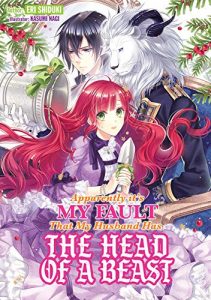
By Eri Shiduki and Kasumi Nagi. Released in Japan by Ichijinsha. Released in North America by J-Novel Club. Translated by David Evelyn.

I worry that the title of this 2-volume series may actually be putting readers off. Let’s face it, it sounds exactly like the sort of oververbose light novel title you’d see written by any other author, and makes people think that it will be of a similar character. It’s not. Technically Bakarina was also a romance novel, but it’s overly dense heroine and otome game mechanics made it appeal to a larger male audience too. This, though, is pure romance novel, written by a woman for other women. This is not to say that I don’t think male readers will like this title – it’s a great read. But it lacks the trappings of light novelness that everyone is used to, and that means it’s a title that can be read by women without having to worry about harems, or wacky chases in the nude, or any number of other anime tropes that you’d commonly see. This has romance novel tropes. A young, terminally shy and introverted princess. A prince with a curse who is blunt and melancholy. And a bucket. Yes, really.

Rosemarie is the second princess of a small agricultural nation, and has spent most of her life either indoors or in her garden due to one simple fact: when anyone shows negative emotions around her, their heads transform into that of beasts. This has led her to be terrified of most human contact, and when she’s incited to a ball in one of the larger, far more prosperous countries to the north, she sees it as something she will have to endure. But then she sees the country’s prince, Claudio, who over the course of the entire party does not have his head transform. Clearly he is the man of her dreams! They marry a few months later, and she learns the truth: everyone ELSE sees Claudio’s head as that of a beast – except her. Moreover, he says this is her fault because he rescued her as a child and she stole his mana (something she does not recall doing at all). And the marriage is a sham, as he regards her more like a thing than a wife. Fortunately, she has her maid. And her large metal bucket, which she wears on her head in times of great stress.

There is a fair bit of magic and fantasy involved in this, but that’s hardly uncommon in today’s romance novels, where the heroes can be vampires or werewolves. The main reason to read it is the growing relationship between Rosemarie and Claudio, who are both terminally bad at communicating with each other. He seems always angry, she seems always terrified, and there’s very little common ground to find. But find it they do, because Rosemarie has a determination to fix whatever she did wrong and make Claudio whole again, and Claudio realizes that he’s being a major jerk and that Rosemarie actually is looking out for his best interests. Which is good, as there’s an evil archbishop who would like Claudio to be out of the succession for the throne. That said, the plot is merely OK, and the humor mostly stems from Rosemarie’s desire to hide (the bucket reminds me a little bit of Akari’s House from Battle Athletes). You should read this for the excellent character work and sweet, if slow-going romance between the two leads. And one bucket.

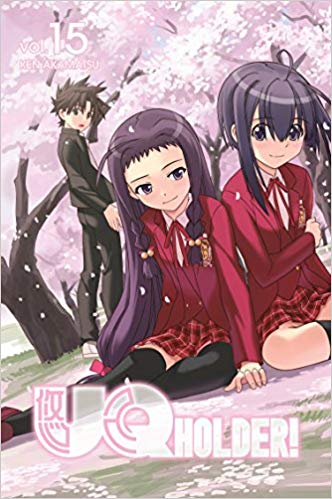
UQ Holder!, Vol. 15

By Ken Akamatsu. Released in Japan by Kodansha, serialization ongoing in the magazine Bessatsu Shonen Magazine. Released in North America by Kodansha Comics. Translated by Alethea and Athena Nibley.

There are spoilers in this review for the entire book, as well as the ending of Mahou Sensei Negima.

I’m actually tagging Negima in this review as well, because after a lot of faffing about, this is, finally, the Negima ending that actually resolves things. The entire volume reads as if Akamatsu is saying “Yeah, sorry about the end of Negima, I was fighting with Kodansha and threw a hissy fit, here’s a much better version of what happened.” The amusing thing, of course, is that UQ Holder doesn’t quite take place in the same universe as Negima – something explicitly spelled out by Tota here. The mysterious stranger from the cliffhanger of the last book (who turns out to be Chamo) is getting ready to show us a movie of what happened to Negi and company in Tota’s home world, through the dead eyes of Chachazero (which is really creepy when you think about it) when Dana bursts in, punches a middle school girl unconscious, and shows them an alternate universe “happy ending” – i.e. what happens in Negima’s home world.

That’s Nodoka and Yue on the cover, but sorry to break it to you, neither one of them wins the Negi sweepstakes. I had talked before about how the ending of Negima had him tell Asuna that he loved one of the girls, but didn’t say who, except Asuna’s surprise made it clear it wasn’t a) her, or b) one of the more obvious candidates. They do get to confess, and Negi turns them down, and it’s well-handled and very sweet. Then there’s Negi’s confession to the girl he actually does like. Given it wasn’t Asuna, the Naru-lookie likee, there’s only one other choice it could be given Akamatsu’s own preferences. It’s the OTHER Naru-lookie likee, Chisame. Again, you can see why Asuna was surprised but not THAT surprised. Chisame filled the role of Negi’s mentor and “common sense” throughout Negima, and he’s also commented on how pretty she is multiple times, much to her annoyance. The main issue is that Negi is far too young. Which is why, when he confesses, she shoots him down.

This leads to the funny parts of the book, as the ENTIRE CLASS was spying on them, and Ayaka in particular seems ready to burn Chisame to death with her mind for rejecting Negi. But Chisame’s right – despite all the many, many, MANY shotacon jokes in Negima, he really is too young to be dating. (She is also too young to be dealing with the fact that she really does like him too.) As such, we can swiftly move forward five years, to when Negi is sixteen, and show the final battle between him and the entity possessing his father. (Negi’s mother’s fate remains unknown – I assume she died at some point after he was born, but it’s never made clear.) The battle allows mostly everyone to take part (though the noncombatants are shown watching from the side in cat-eared spacesuits, and Eva and the three cheerleaders stay home) and lets Akamatsu do the only thing he loves more than nude harem chases – big fights with lots of punching.

After this epic battle, we move forward two more years and get the epilogue. Everyone lives happily ever after. Negi, now an adult, marries a grumpy, blushing Chisame (which makes Kyrie very happy – she’s likely noticed that she and Chisame are the same, and thus this increases her chances) and his recovered father marries Evangeline (I assume that he freed her from her curse at some point, though honestly she still looks about ten years old in the wedding photo.). I was amused at Tota pointing out the flaws inherent in Akamatsu’s own plotting – the entire happy ending depends on Asuna getting rescued via time travel, which many readers at the time called a giant cheat, and so does Tota, saying they have to get their own happy ending without cheating. (I didn’t have issues with the time travel in the original ending, as I felt it had been foreshadowed quite well.) Perhaps now Akamatsu can get on with moving forward with his new cast and dealing with the plot in their own universe… though given all the villains are essentially dark variations on the cast of Negima, this seems unlikely.

If you liked Negima but have not read UQ Holder, you should pick up this volume anyway – you really don’t need to know much about the latter to understand this, and it gives much better closure to the series. Just… five and a half years later.