Yearly Archives: 2018

True Tenchi Muyo!: Yosho

By Yousuke Kuroda and Masaki Kajishima. Released in Japan as “Shin Tenchi Muyo! Ryo-o-ki” by Kadokawa Shoten. Released in North America by Seven Seas. Translated by Lillian Olsen. Adapted by AstroNerdBoy.

The three novels in this series came out around 1997-99 or so in Japan, which was between the 2nd OAV series (the one that came out here when Tenchi was still huge) and the 3rd OAV series (which came out here when Tenchi’s popularity was waning). As such, they serve as both a ‘filling in the blanks’ backstory for what we’ve already seen and a ‘taste of what’s to come’ teaser for future episodes. The first book was something that I enjoyed but it didn’t reach out and say “that was great”, partly as I don’t find Azusa all that likeable. The second volume is a much better book, partly as Yosho may be staid but he’s also a lot of fun, and partly as this volume features Ryoko’s attack on Jurai and everything that comes along with it, so the book ends with an epic battle sequence before it settles down on Earth. We’re also introduced to Airi, who is Yosho’s first love… well, OK, second love, but first consummated love.

Yosho is the 12-year-old crown prince of Jurai, and is being sent off to Galactic Boarding School, essentially, mostly as he’s developing a crush on his stepmother, who has no sense of personal space. (If this surprises you, you’ve never seen Tenchi, which uses incest as a spice – liberally). While there he meets Airi, an older student who’s there to show him around and also comes from a planet of religious zealots. The book balances its time between Yosho coming out of his shell and he and Airi falling in love and the political machinations of Jurai, which is still dealing with the shock and horror of having Funaho as the First Empress. Their relationship is a bad idea politically, at least for now, and what’s more Ryoko attacks Jurai at the behest of Kagato, so Yosho rapidly vanishes to that he can bring her down – and also, it has to be said, to get away from the repressive heritage that he really doesn’t want to deal with.

Lest you think the book is all romantic drama and action movie sequences, there’s also a great deal of humor here as well. Airi is a loud, blunt girl who tells you that she likes you by putting you in a wrestling lock, and she pairs very well with Yosho, who even at his most emotional exhibits a certain Mr. Spock quality. There is a repeated sequence with puppies that is both adorable and hilarious. And I can’t not mention Funaho’s drunken duel with someone who insulted her son, which shows off why you should never, ever get Funaho drunk. In other words, it’s very much still a Tenchi book. It also shows off Ayeka’s massive crush on her brother, and why he finds it uncomfortable (because it reminds him of his crush on Misaki). I haven’t seen the 3rd OAV series, which I understand has Airi in it, but for those who only recall 90s Tenchi, this is also a great read, with a good look at Ryoko’s personality pre-Tenchi.

There’s one last book in the series, which will focus on Washuu. I’m looking forward to it. These books have been a real treat for Tenchi Muyo fans, especially because it reminds them of the time when the series walked the anime fandom like a colossus.

Sword Art Online: Hollow Realization, Vol. 1

By Tomo Hirokawa, based on the series created by Reki Kawahara. Released in Japan by ASCII Mediaworks, serialization ongoing in the magazine Dengeki Maoh. Released in North America by Yen Press. Translated by Stephen Paul.

Fair warning, this review contains spoilers for the video game Sword Art Online: Hollow Realization. And while the average reader may be staring at their screen now and saying “DUR!”, believe me, they came as a surprise to me. I have not played any of the SAO games, but assumed that this adaptation would not really have a lot of barriers to me picking it up and just reading it. And that’s… somewhat true? The main issue being when all the other girls in Kirito’s life start showing up. There’s our usual main harem, but then I ran into a girl who I was pretty sure died tragically in one of the prior books, and Yui’s little sister, and a sysadmin helping the group, and… I had to run crying to the Sword Art Online wiki. Not a pretty sight. So yes, for readers of the manga who have NOT played the game (and its prequels)? You will be confused.

The premise is that Kirito and company are beta testing a new version of SAO based off the original game… but without the ‘trapped and dying’ parts. They immediately run into a few NPCs, including one who appears to be more of a blank slate than you’d expect, particularly as the NPCs here are more lifelike and real than had been seen in SAO previously (let’s leave Kizmel to the side for the moment). Asuna names the NPC Premiere, and we begin to watch her slowly develop wants and needs, such as the desire to protect herself. And she certainly needs to protect herself too, as players are going around killing NPCs for their stuff… and the NPCs don’t return afterwards. Can our heroes help Premiere achieve sentience while also stopping the ‘it’s just a game’ PCs and a creepy swordsman named Genesis?

The concept of NPCs being more than what they seem is something SAO (and indeed many other ‘trapped in a game world’ series) has come back to many times, especially since Kawahara began the “Progressive” series. In fact, one of the very first SAO doujinshi the author wrote, back when it was still a webnovel, featured Kirito and Asuna arguing over whether it was OK to sacrifice NPCs in order to clear a level. Clearly the story is meant to have us rooting for Premiere and her fellow non-players, and I’m fine with that – she’s cute and likeable without being overly cloying. As for the rest of the cast, they all show up, but mostly it’s the Kirito and Asuna show, which is fine by me – there’s lots of “they’re so in love with each other” interaction that makes Lisbeth and company a bit ill. (Quiet, Liz, the artist was very kind to you.) And as I indicated there’s a few extra girls who also show up here, and if Mother’s Rosario left you wishing that it could have gone differently… you might want to check this out, though you’ll be whistling for explanations – “buy Lost Song” is apparently the answer.

Overall, this is a fun tie-in manga that I suspect will appeal more to those familiar with the game, though (as I’ve shown) you can read it without any game knowledge and just be slightly confused.

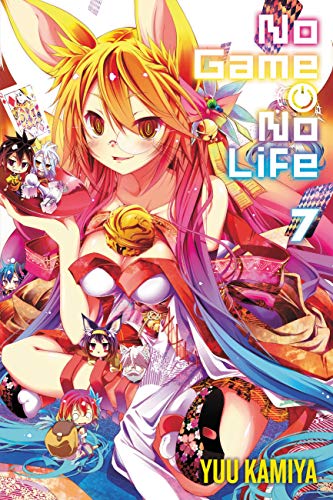
No Game No Life, Vol. 7

By Yuu Kamiya. Released in Japan by Media Factory. Released in North America by Yen On. Translated by Daniel Komen.

Until I read the afterword of this volume, I was going to comment a lot on how this volume’s release was delayed, I believe, four times, to the point where I’ve forgotten almost everything that came before it. But the afterword indicates that it was delayed in Japan the exact same number of months, which made me suspicious and wonder if it was delayed here deliberately. Probably not, but given the nature of this series, you can never be too paranoid. Things are not helped on the “remember what happened previously” end by the fact that Volume 6 was a flashback, and also the best volume in the series, which Kamiya sheepishly agrees with – he had writer’s block trying to top it. Sadly, I don’t think he did here, as this 7th volume of NGNL is bout 3/4 irritating and wordy faffing about, and it only really picks up towards the end. That said, if the ending is doing what I think it’s doing, the 8th volume may be much better. It’s out in February. Theoretically.

We start off in media res, which is a difficult thing to pull off for a normal writer, and even more difficult when you’re this writer, who tends to expound about eight times more than is necessary. Sora, Shiro and the rest of the cast have apparently agreed to play a game against an Old Deus, with the shrine Maiden’s life at stake. This surprises them, as they have no memory of having agreed to the game. It’s a dice game with complicated rules, which Sora says is based on a game from Earth but which I was mostly blank on. Much of the volume is spent with our heroes (and Steph, who sadly is reduced to a cliche here) whining and being creepily fetishistic as the dice board is the same size as the world, which is to say it takes days to travel across spaces. And they also gain or lose age depending on the dice they have, meaning a lot of 2-year-old Steph here. And when you arrive at a space, you have to do a task that another player has assigned, which can be very difficult and dangerous.

I’ve talked a bit about the translation before. I don’t think it’s the worst thing ever, like some NGNL fans do, but it’s not doing the prose any favors either. Kamiya, as I said earlier, tends to expound a lot, and Sora and Shiro also speak in a jaded gamer sort of way. Add to that the fact that, unlike a lot of other translations, there’s very little “Sora said” or “Steph replied” added to the text to help the reader, and you get a book that feels like a slog much of the time. Thankfully, this changes towards the end, when we see a) Plum trying to become a full-time villain in the real world, and b) Jibril challenging [ ] to a game where SOMEONE is going to have to die. Actually, the nature of the game she’s challenging them to intrigues me quite a bit, and I’m interested in seeing how it’s handled.

Unfortunately, looking forward to Vol. 8 does not make Vol. 7 better. Kamiya was right in his afterword, this is a step down from the previous book. Still, if you enjoye NGNL, you’ll need to read it anyway.