Yearly Archives: 2018

Onimonogatari: Demon Tale

By NISIOISIN and VOFAN. Released in Japan by Kodansha. Released in North America by Vertical, Inc. Translated by Ko Ransom.

Every once in a while there comes along a volume where NISIOISIN shows off exactly why people are turned off by his writing so much, and I think that Onimonogatari may set a record there, as it’s extraordinarily difficult to get through. While Araragi is the narrator again, a large chunk of the book is told by Shinobu explaining past events to him, and helps to show off (as she herself admits!) why she’s a bad storyteller and why the rule that “aberrations shouldn’t narrate the series” is a good one. Moreover, given that the main interactions Araragi has in this book are with Shinobu (who looks eight), Hachikuji (who looks ten), and Ononoki (who looks twelve), we really get far, far too many pedophilia jokes, and having the other girls be really pissed off at him for them really doesn’t help, no. That said, the book isn’t a total writeoff, and you get the sense that a lot of this book is the author realizing they need to have a genuine backstory and goal for the series, and creating one on the spot.

We’re back in August again in the Monogatari timeline, and the events of Kabukimonogatari have just finished. But Araragi still can’t go back to school and actually start classes, as he and Hachikuji are being pursued by a mysterious darkness that consumes all in its path (well, seemingly all in its path). After being rescued by Ononoki, they end up holing up in the abandoned cram school, where Shinobu tells Araragi and the reader about her first visit to Japan four hundred years ago, which led to her first encounter with “the Darkness” and also the backstory with her first thrall, Araragi’s predecessor. Unfortunately, the Darkness is really good at coming after them – or more accurate, after Hachikuji, who seems to be its goal. Can Araragi figure out what’s going on and save her? If only there was someone who knew everything to offer even MORE explanations…

NISIOISIN has often taken the advice “show, don’t tell” and stomped all over it in hobnail boots, but this book may take the cake in that regard, as there ends up being very little action and a whole lot of talking about the problem, both from Shinobu (who, as I said, is not a good storyteller) or by Izuko Gaen (who is deliberately written to be arrogant and uncaring). “The Darkness” may tie into the ongoing plot – is it related to Ogi, who it turns out Araragi has been narrating the entire book to? We also get discussion of MORE events on that busy August weekend that haven’t happened yet, which I assume will be in a future book. Where this book does succeed is a) it’s meta-humor, particularly Shinobu shilling for the Kizumonogatari movie, which is especially hilarious as it ended up coming out five years after the book did – and b) the ending, which I won’t spoil but is touching and a bit heartbreaking.

A necessary read if you’re interested in the world of Araragi and company, in the end I found Onimonogatari to be a bit of a slog. The book teases that Senjogahara will be narrating the next book in the series, but let me spoil this and say: no she doesn’t. As for who does? Well, it’s not Araragi either. We’ll find out.

Is It Wrong To Try To Pick Up Girls In A Dungeon? On The Side: Sword Oratoria, Vol. 7

By Fujino Omori and Kiyotaka Haimura. Released in Japan as “Dungeon ni Deai o Motomeru no wa Machigatte Iru Darou ka? Gaiden – Sword Oratoria” by Softbank Creative. Released in North America by Yen On. Translated by Liv Sommerlot.

First of all, I apologize, as it turns out I’ve been crediting the wrong illustrator for this series all along. The main series does indeed have illustrations by Suzuhito Yasuda, but this side story uses Kiyotaka Haimura, the illustrator of the A Certain Magical Index series, instead. Honestly, it’s pretty obvious if you just look at the style – it feels very Index-ey. As for the content, this takes place just before the events in the 7th book of the main series, and involves the Loki Familia hunting down more evidence on the Evils and the other things they’ve spent the last six books trying to deal with. Unfortunately, though most of the book is a dungeon crawl, it’s not the main dungeon they have to deal with here, but one created by Daedalus, and it proves to be far more deadly for the familia than the lower levels of the main dungeon.

Ironically, though Aiz is alone on the cover, this isn’t really her turn to shine – she actually gets beaten up worse than ever here. In fact, that sets the tone for the book itself, which is separated into halves. The first half shows our heroes getting into big big trouble and dealing with seemingly insurmountable odds. The threat is made significant by taking out Finn early on, meaning everyone is having to rely on their wits rather than do what they’re much better at doing, which is following orders. That said, the second half shows our heroes regrouping and kicking much ass, though they don’t so much win as survive. Several of the more minor characters show off their strength – though Raul showing off his strength just leads everyone to laugh at him, alas. But it gets the point across. Unfortunately, not everyone is so fortunate – a few minor characters who’ve been around since the start are killed off in a brutal last-minute downer ending. This is not Loki Familia’s finest hour.

Loki Familia is joined in their quest by Filvis, and in case it wasn’t really obvious beforehand, Filvis has a massive crush on Lefiya that everyone but Lefiya can see. Honestly, I think that Lefiya would be much better off with Filvis, but a key running theme in the Danmachi books is that the most obvious pairing isn’t going to happen because we cannot control who we love. Lefiya loves Aiz. Likewise, as much as Finn is correct that he and Lilly would be a really awesome pairing, she loves Bell, so oh well. Much of DanMachi’s harem elements run on frustrated unrequited love, and the author is good at simply letting it speak for itself without belaboring the point.

The next volume is supposed to focus on Bete, which I’m not all that wild about, but he’s much more tolerable in this side story. I also hope that it’s just a bit lighter in tone. The last two volumes have been pretty damn bleak. For those who enjoyed DanMachi, this is a very good side story, even if you didn’t like its adaptation.

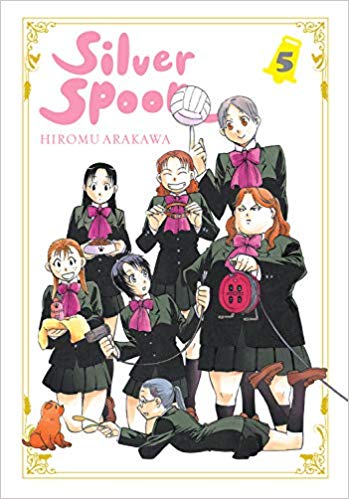
Silver Spoon, Vol. 5

By Hiromu Arakawa. Released in Japan as “Gin no Saji” by Shogakukan, serialization ongoing in the magazine Weekly Shonen Sunday. Released in North America by Yen Press. Translated by Amanda Haley.

I am fortunate enough to say that I am not one of those people who is naturally good at organization and so ends up completely buried when everyone comes to them and asks them to help/supervise/do everything. However, I am the son of such a person, so I am very familiar with how it works. It seems like it will be OK to take on something, and then one thing leads to another, and you find yourself taking on five other things. This is the dilemma that Hachiken is dealing with here. He’s nice, and competent, and doesn’t know how to say no, and everyone is independently asking him for help and now realizing that he’s getting piled on. So far everything seems to be holding up, but judging by the narrative, we’re headed for a nasty fall soon. But we’re not there yet, so we can all also revel in the joys of preparing for a cultural festival, ag school style.

There’s a big highlight in this book, as Hachiken is still learning how to ride that horse that seems to have it in for him. He’s not used to animals, and doesn’t understand how to interact with them or see that they’re even more important than the rider is. He thinks of horses like you would a car. As such, there’s a number of great scenes in this volume showing how much love and trust Mikage and the other riders give to their animals, and it helps him to see what’s missing from how he treats Chestnut. This also ties in with his self-esteem, as we see him freaking otu as everyone but him is able to manage the jumps – he’s seeing this as falling behind in class, and it’s VERY UPSETTING. Fortunately, Mikage and the others are able to show him what he’s missing. (There’s some romantic tease, but at this point Silver spoon isn’t really about that.)

Mikage and Komaba are still dealing with their own issues, though fortunately things seem to be OK betwen them and Hachiken again. (That said, no one has figured out why it happened – lack of communication is still a major obstacle among the main cast. Komaba is pouring his struggles into baseball, which is terrific… provided the team continues to win. Mikage seems to simply be giving up and accepting she won’t achieve her dream, which is even ore depressing. Dreams are important, even for a group of kids whose goals – take over the family farm – seem to be set in stone from the moment they’re born. This is why Hachiken arriving at school is great for both him and the other kids, as it leads to new perspectives. And also pet dogs. Because, as you’d expect from the running theme of this volume, Hachiken can’t say no to ANYONE.

Will we get a successful festival next time? Will Hachiken end up stressing out about everything? Will he and Mikage ever really talk to each other and not at each other? Not sure, but I can’t wait to find out.