Yearly Archives: 2018

Durarara!!, Vol. 9

By Ryohgo Narita and Suzuhito Yasuda. Released in Japan by ASCII Mediaworks. Released in North America by Yen On. Translated by Stephen Paul.

I may have mentioned in previous books that I don’t like Orihara Izaya, who is as close as DRRR!! gets to a main antagonist. At this point, I should be writing “Admittedly, he’s not meant to be likeable”, but this is the 9th DRRR!! novel, the first anime had already aired, and Narita is well aware that his fanbase consists of a whooooooooole lot of Shizaya fans. As such, this book is an attempt to give Izaya the closest thing he can get to a sympathetic backstory, as well as flesh out his relationship with Shinra. It’s more successful in the second than the first, in my opinion. Izaya at one point thinks of himself as Shinra as complete opposites, and I can see why. Izaya proclaims he loves all humanity (except Shizuo), but this all-encompassing love does not extend itself to individual humans per se. As for Shinra, he only loves one non-human, and has no use for anyone else. If you like deeply broken twisted viewpoints, Narita is here for you.

The cover features a heaping help of Oriharas, as we also see Izaya’s twin sisters, who provide fanservice for the cover (well, Kururi does), and also have the largest role they’ve had in the books since their debut. We get their origin, so to speak, which (unsurprisingly) turns out to be related to Izaya making a cruel and nasty comment. That said, I was far more amused seeing the two of them flirt with Aoba. Aoba’s function in the story so far has been to sort of be an Izaya-lite, leading Mikado into a path towards darkness. But, as he finds, he’s rather crap at being Izaya (who he dislikes anyway), and Mikado is able to walk the dark path without any help from him. As such, it’s much more fun seeing him as an average high school freshman dealing with two girls coming on far too strong for him. He’s living every teenage boy’s dream, but somehow is more unnerved than anything else.

Mikado is actually absent from this book for the most part, though the ending suggests that this will change for Book 10. The main plot is Izaya supposedly getting kidnapped and worked over by an underground gambling ring led by a sadistic woman named Earthworm. If you read that sentence and thought “yeah right, like Izaya would be kidnapped and worked over”, you’re wrong and yet correct, in that he proves to be in total control the entire time. His hot pot partygoers have also turned into his own personal goon squad, either beating people with martial arts, breaking their digits with hammers, or just using Saika to take possession of them – no, not Anri, but another Saika user we’ve seen before. Add in a group fronting illegal drugs, and you’ve got the usual recipe for DRRR!! chaos.

That said, for all that Izaya fans will love this, this volume felt like one of those that is marking time. This is not at all uncommon with DRRR!!, and frustrated anime fans as well, as it can sometimes take a while for all the plot hammers to fire. Still, I’m sure we’re introduced to some nice payoffs down the road here. As for me? It was a good book, but needed less Izaya being Izaya.

Perfect World, Vol. 1

By Rie Aruga. Released in Japan by Kodansha, serialization ongoing in the magazine Kiss. Released in North America digitally by Kodansha Comics. Translated by Rachel Murakawa.

We’ve been getting a giant pile of digital-only titles for the last several months, and it can be very difficult to keep up. But the benefit is that we’re getting titles that would not normally get the time of day over here. A good example is this manga which runs in Kodansha’s josei magazine Kiss, involving a young woman who runs into her old high school crush, who’s now in a wheelchair after an accident. Five years ago this is probably the sort of title that I would be tweeting about and saying “see, this sort of thing is what they should be putting out!”. And now they are. And for the most part it’s a good decision, as this is an excellent, thoughtful and romantic manga. The female lead is perhaps a bit too idealized, but when you’re writing a josei romance for young woman about the same age as the heroine, you’re going to accept that.

Kawana is an aspiring interior decorator. One day at a business lunch she runs into Ayukawa, who is an architect from the firm they’re doing business with. He was her old high school crush, and a fantastic basketball player. Much to her surprise, he’s now in a wheelchair. As they begin to work together on projects and reconnect, she starts to realize the problems that need to be overcome for Ayukawa in day-to-day life, as well as the casual denial of ease of access that a lot of other folks who use wheelchairs have. The other problem is that she’s falling for him all over again, and while he’s nice and pleasant enough he’s putting up quite a wall preventing things from going any further, telling her one or two things about his life now (such as incontinence) that might make her pull back. I’m not even sure he does this consciously. But, of course, she is made of sterner stuff.

As I noted above, Kawana is a sweet and likeable heroine, but I sometimes found her going a bit above and beyond – after seeing Ayukawa and his ex-girlfriend have a bittersweet discussion about her upcoming wedding to someone else, she immediately whisks him off to the wedding anyway, because he needs closure. I don’t doubt he does, but this felt a bit rude. For the most part, though, the manga does an excellent job of balancing out the cute romance between the two leads and showing the daily life of a paraplegic, with all the difficulty that this entails, including a higher risk of kidney issues, and bedsores that you don’t notice until they get infected. We also see them interacting with a teenager, who was also a basketball player who now has to be in a wheelchair (and who also has a nice, patient girlfriend) so that Ayukawa can show off a wheelchair basketball league and tell the teen (and the reader) that there is still fun to be had.

The book had a larger number of endnotes to it, with more explanation of things that “manga fans” would already know. I suspect Kodansha knows this might sell well to an outside audience who doesn’t normally read manga. I agree. It’s not perfect, but I am absolutely ready to read more about this world.

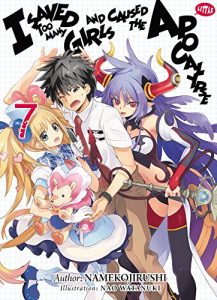
I Saved Too Many Girls and Caused the Apocalypse, Vol. 7

By Namekojirushi and Nao Watanuki. Released in Japan as “Ore ga Heroine o Tasukesugite Sekai ga Little Mokushiroku!?” by Hobby Japan. Released in North America digitally by J-Novel Club. Translated by Adam Lensenmayer.

I was somewhat taken by surprise by the ending to this volume, as I kept reading and thinking “shouldn’t things be wrapping up soon?” It wasn’t until I got right near the end that I realized this would be Little Apocalypse’s first two-parter, something that should have been mnre obvious given this book features four heroines but only two of them are on the cover. It might be frustrating to wait till the 8th book too, as this volume actually ended up being one of the strongest in the series to date. The author has realized there’s only so far he can go with parody, and has moved on to deconstruction, which is a far richer vein. He’s also gotten better at juggling the heroines – sure, some are still missing or deliberately left out, but the balance we get here shows he’s thinking “who needs more attention?”, so Harissa gets a larger role here, as does Tsumiki. The series is beginning to mature… as much as a series like this can.

As I said, we stack up four different heroines in this book, and they are of a wide variety: an idol singer who’s getting tired of the grind; a psychic (which is a much broader term in Japan than it is here) on the run from a yakuza-like psychic gang; a (seeming) former hero sealed in the depths of an alien dungeon; and a sylpheed (wind fairy) dealing with a zombie infestation. It’s a tall order even for someone like Rekka. Fortunately, his current harem is not at war with each other (that’s supposedly in the future), and he is thus able to use them as sort of a mobile army. Thus, he and a team of girls go off to try to solve one issue, and Hibiki and another group try to work on the psychic problem. I really liked this, and enjoy that (for the most part) there’s not really much rivalry between the girls when serious events are happening. We also get lampshaded how weird everyone is when Rekka explains who he is to the idol and is surprised she DOESN’T know about magic.

The other highlight of the book is a bit of a spoiler, but I want to discuss it anyway: what happens when Rekka fails? And how do we define failure? The sylpheed rejects Rekka because her sister (who we saw in the prologue) is already dead – she died before Rekka even arrived in her world. As R points out, that doesn’t mean that the story is over, and Rekka is working on another aspect of it by trying to fix the zombie thing. But Rekka fixing the stories usually ends with everyone happy (and happily in love with Rekka), and that doesn’t seem like it’s going to work out this time around. Now yes, I am very familiar with the genre, and would not be too surprised if a magical sister-saving solution popped up in Book 8. But it’s still a good question to ask: what if Rekka fails? Can he deal with the aftermath of NOT saving someone’s story?

The book ends with everyone in trouble, and we’ve got to wait a bit till the next one. But Little Apocalypse in general has been qa quick, light, fluffy read. It’s nice to see it gain a bit of added depth.