Yearly Archives: 2018

New Game!, Vol. 1

By Shotaro Tokuno. Released in Japan by Houbunsha, serialization ongoing in the magazine Manga Time Kirara Carat. Released in North America by Seven Seas. Translated by Jenny McKeon. Adapted by Jamal Joseph, Jr.

I have joked before about the tendency of trends in the Japanese manga and light novel industry, and over here in North America as well. The piles of vampire manga, the buttloads of zombie manga, the oddly weird Alice in Wonderland deconstruction mangas, etc. But one that has been around forever, and likely will be long into the future, is “a group of cute girls do cute and funny stuff in a 4-koma”, aka the Azumanga Daioh clone. The series are of various types – mostly in school, but some (like this one) in a workplace, and sometimes there may be a token man. But for the most part, that describes an endless number of series that have essentially the same premise and audience, and generally also succeed about the same way – “that was cute”. They also sometimes have yuri subtext, though that isn’t a requirement. It even has its own magazine devoted to the genre, Manga Time Kirara Carat. And now we have New Game!.

New Game! stars Chiyo-chan… sorry, Aoba, who looks like she’s a 7th grader but has actually graduated high school and headed into the workforce – in this case, a game company, where she’s starting off designing characters. The rest of the team consists of Kou, the “ladette” sort of woman who’s the main character designer; Rin, the art director and team mom who seems to have an unrequited crush on Kou; Hifumi (character design), who is painfully shy but also rather cute (and apparently a heavy drinker); Yun (also character design), who I didn’t get much of an impression of except she has a heavy accent; and Hajime (motion), who seems overearnest and a bit hyperactive. The bulk of the first volume shows us Aoba fitting into the team, learning how they do things, and designing background NPCs for the fantasy RPG they’re working on.

New Game! is cute. I enjoyed it as I read it. That said, a lot of the actual humor has difficulty sticking in your head after you move on. The one joke I recall is also, oddly, the most out of character, when Kou amuses herself by having Aoba finish the design of a character that’s clearly based on herself (which Aoba doesn’t realize), who is an NPC who’s there to start the plot and then get killed, much to Aoba’s horror. Apart from that, there’s a few workplace gags that touch on the insane hours these jobs entail, and some character development showing Aoba settling in but still being somewhat hapless. As I noted above, Rin seems to have a crush on Kou, and this occasionally comes up, mostly when she’s frustrated that Kou isn’t picking up on it. It’s all standard stuff, but I did find it quite enjoyable. I will note that, once again, the decision to translate a heavy Kansai (I’m assuming) accent as something out of the ordinary doesn’t always work well. Yun saying “Wot’s all this, then?” and calling someone a “tosser” took me right out of the manga and made me notice the effort, which it shouldn’t.

Despite having forgotten much of the manga a few minutes after reading it, I was pleasantly amused enough that I’ll get the next book. If you enjoy cute girls doing cute things with no plot to speak of, New Game! is an easy buy.
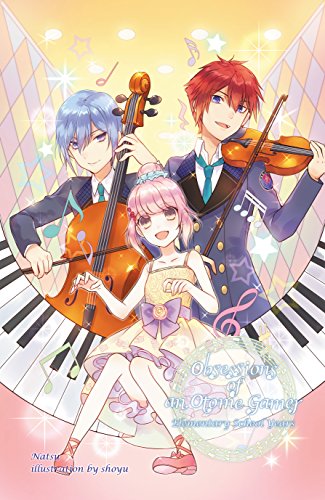
Obsessions of an Otome Gamer: Elementary School Years

By Natsu and Shoyu. Released in Japan as “Ongaku de Otome wa Sukuenai” by the author on the Syosetu website. Released in North America digitally by Cross Infinite World. Translated by Charis Messier.

I’d never really read a Cross Infinite World novel before now. They specialize in both novels geared towards young women and also going directly through the author, i.e. most of the books published were published on the Syosetsu original fiction website, or various equivalents, rather than going through a publisher. (That said, the author has had published work as well.) But nothing had really caught my attention until the announcement of this series. I love visual novel-style storytelling, and I love classical music, so I was delighted to see the two combined. As I started to read the book, I was expecting things to be very light and fluffy, with the occasional warped sense of humor. I was surprised at several plot and character choices the book made, though. I was even more surprised by a plot twist that I will do my best not to spoil (yes, really) about one-third in. And I was not surprised but a bit taken aback by the length. This book is HUGE.

One thing that surprised me was the decision to have the entire book take place when our reincarnated heroine, Mashiro, is between the ages of seven and twelve, something that I blame on the light and hard to read font on the front cover, which meant I missed the subtitle. She’s the reincarnation of Rika, a young woman who was obsessed with an insanely difficult otome game called Hear My Heart, where you not only had to make the right romantic choices with regards to the two guys (one outgoing and arrogant, one sullen and introverted), but you also had to compose music – and if the music wasn’t good enough, you failed. That’s a high bar to clear. She then sees a poster advertising a remake of the game… and falls into an open manhole and dies. (This would be the warped sense of humor I mentioned above.) As Mashiro, she recalls her previous life when she’s seven years old and just your average elementary school girl who folds origami of Angkor Wat in her spare time. Now she’s in the game world, and has met Kou and Sou, the two heroes, as young boys. But is the game world what she really wants from life?

While Mashiro is eighteen years old in her head (at times – it’s lampshaded that this isn’t consistent, and is actually an important plot point), she and the two boys are young kids, and despite the occasional schoolkid flirtation, the book maintains those boundaries. Of course, this doesn’t mean we don’t get a heartfelt confession or two, but you may relax and not have to worry about kiddie makeouts. There’s also a heavy emphasis on classical music and piano, as Mashiro burns with a sudden desire to learn the piano, at first because she wants to meet the guy she liked from the game, but her love rapidly becomes genuine and all-consuming. The book helpfully tells us the names of the pieces she’s working on, and you could make an excellent Spotify playlist if you liked. Mashiro is a prodigy, though she may not be aware of it. And there’s also that spoiler, which revolves around her best friend Kon, who is Kou’s sister – and also reincarnated into this world from a previous one. Mashiro only has memories of the first version of the game. Kon played the remake, but not all of it. Is she really what she seems? And can Mashiro really avoid being a heroine?

The writing and plotting can get immensely wordy at times – I understand this was actually edited down from the original text, but it’s still super long, about twice the size of your average light novel. That said, I never found myself counting pages till it was over. Mashiro is a fun heroine, savvy when needed, clueless also when needed. There’s also a surprisingly deep look at how reincarnation into another world would work when you retain some of your own memories. The book ends with Mashiro graduating and moving on to Middle School, which I imagine will take up Book 2 of the series. If you’re looking for a nice romantic book with hidden depths, or love shoujo and visual novels, this is a fantastic read.

Dragon Half, Vol. 1

By Ryusuke Mita. Released in Japan as two separate volumes by Fujimi Shobo, serialized in the magazine Dragon Magazine. Released in North America by Seven Seas. Translated by Andrew Cunningham. Adapted by David Lumsdom.

In another world, this sort of title would have been licensed around the time it came out, back in the late 1980s/mid-1990s, when its art style and sort of humor were far more common and appreciated, and the anime had become a cult classic due to its over the top humor and pacing. Of course, back in 1994 or so when the Dragon Half OAVs came out, and the manga had just finished its run, the “manga scene” did not really exist as such – we’re talking a time when Mai the Psychic Girl was the hot thing, and Ranma 1/2 was still in 32-page pamphlet form. Still, what goes around comes around, and a lot of the cliches that were ripe for mocking in the late 80s RPG/fantasy scene are still ripe for mocking. And thus, despite artstyle and personalities that remind me a bit of Urusei Yatsura, Dragon Half manages to be a heck of a lot of fun, which is surprising given that humor titles tend to wear out faster in omnibus format.

I must say, the cover does the title no favors – Mink is a lot more dynamic than the passive little girl figure we see there. She’s the daughter of a human adventurer and a dragon, who can helpfully turn human when she wants to. As such, Mink has certain advantages like super strength and flight, but also has teenage girl obsessions, such as the teen idol (and also adventurer) Dick Saucer. (Yes, he’s named Dick Saucer in Japanese.) Unfortunately, Mink is half-dragon, and Dick is dedicated to killing dragons. Poor Mink! Can her feelings ever get through to him? Well, no, but nobody really cares, because the plot is just an excuse for Mink and her two friends (the airhead “bi-curious” Lufa and the childish always-armored Pia) to go around having adventures and making fun of everything that 80s RPGs and bad fantasy novels had to offer.

Everything in Dragon Half is subservient to the humor – and there are a lot of laughs, all of the “broad comedy” variety. If you’re looking for subtlety, look elsewhere, but if people getting hit with rocks is your thing, you’re in the right place. Surprisingly, Mink ends up being the “straight man” for much of the volume, using her semi-superpowers to bail her foolish friend out of trouble (yes, friend – Pia usually just goes along with things, but Rufa is actively harmful most of the time). She’s be in danger if the villains were any threat at all, but from the evil princess who’s really a slime in disguise to the soldier who brags that the tiny size of his brain is an advantage, Mink can usually do pretty well for herself. Towards the end of the volume (as the author notes) there are one or two stories that actually have a semi-serious tone, but fortunately they fit in pretty well, and more jokes are just around the corner.

This is the first of three omnibuses schedules, and is filled to the brim with extras such as color pages, promotional artwork, and author commentary. It’s a good title if you like humor, a great title if you enjoy mocking old-school games, and essential if you’re nostalgic for the late 80s-early 90s style of manga art and characterization.