Yearly Archives: 2018

Strike the Blood, Vol. 8

By Gakuto Mikumo and Manyako. Released in Japan by ASCII Mediaworks. Released in North America by Yen On. Translated by Jeremiah Bourque.

This does not quite hit the highs (relatively speaking) of the previous volume, mostly as the entire volume is “let’s reveal the backstory the reader has been in the dark about for so long” and not much else, but it’s still a pretty solid volume of Strike the Blood. While we’re technically carrying on from the end of the last book, most of this is Kojou (and Asagi, along for the ride for some reason) remembering the events that led to him becoming the Fourth Primogenitor, which took place just before the start of the series. There’s a lot of attempts at worldbuiding and introducing potential new antagonists, which doesn’t work quite as well as the author likes. The good news is that there were a couple of genuine surprises in this volume, which is especially impressive given that Strike the Blood is one of the most by-the-numbers light novels out there.
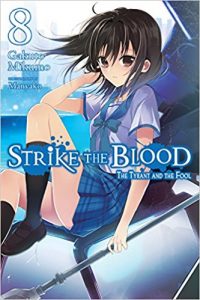
Despite being on the cover as always, there’s very little Yukina in this book, which makes sense given it’s predominately a flashback. (This, by the way, means we have now gone TWO WHOLE BOOKS without her catchphrase of “No, sempai, this is OUR fight!”. I feel like I’m going through withdrawal.) She and Natsuki have removed Kojou and Asagi to her dream prison space so that Kojou can recover the memories of what really happened and be controlled if that happens to drive him insane (spoiler: it doesn’t.) What we see is not particularly surprising: Kojou is a natural at empathizing with others, which is why all the girls fall for him, and that also works here for Avrova. I hate to break it to people who may roll their eyes at the appearance of another one, but Avrova is, in fact, a blond vampire girl with the body of a child. That said, while she occasionally tries to be haughty in a Shinobu Oshino sort of way, she’s really more introverted and scared. Her bonding with Kojou was the best part of this book.

I’d mentioned surprises, and it comes in the form of Veldiana, who we’d met in the prior volume as a somewhat harried colleague of Kojou’s father. (Speaking of which, both Kojou’s parents appear quite a bit in this book, and while they are admittedly trying their best to save Nagisa’s life, it doesn’t change the fact that they are terrible, terrible parents.) Veldiana is played, in the first half of the book, as something of a comic relief character, and we assume that this is going to be her role in the book. But no, she’s here to teach a darker lesson about what happens when you let revenge consume you, and (leaving the epilogue aside, which I wasn’t too fond of) it works very well. There are also one or two scenes that are not surprises, but the way that they work out with precision timing is also well handled – watch for Kojou bribing the enemy with ice cream.

Strike the Blood is never going to rise to the level of the top light novels being released over here. But it has at least risen to the level where I don’t feel the need to make fun of it or wonder if it’s written by a Light Novel artificial intelligence. As always, the fights are well written and make you want to see them animated. It’s a decent volume in what has become a decent series.

Juana and the Dragonewts’ Seven Kingdoms, Vol. 1

By Kiyohisa Tanaka. Released in Japan as “Ryuu no Nanakuni to Minashigo no Juana” by Mag Garden, serialized in the online magazine Alterna pixiv. Released in North America by Seven Seas. Translated by Adrienne Beck. Adapted by Ysabet Reinhardt MacFarlane.

The immediate gimmick of this series, one that’s not uncommon in fantasy but which I haven’t seen too much in manga, is that of a foundling story. The world we’re in is populated mostly by dragonewts, including the hero on the cover, who seems to spend his days scavenging the immediate area for old relics of the previous long-dead civilization, the Muernandes (or “humans”, as we would call them). He finds an egg, and inside is Juana, which is very odd. She comes out of the egg looking about six years old and speaking Spanish, which is even odder. Nid, the dragonewt who found her, is determined to see if there are others like her, so sets off on a journey to the northern lands where they might find a bit more evidence. That is, of course, if they can get past Nid’s naivete, Juana’s tendency to run off when she’s curious, and very dapper villains.

While Nid is not much of a mentor, being the equivalent of a young adult himself, this series feels very much in the mold of other gentle Seven Seas fantasies like The Ancient Magus’ Bride and The Girl from the Other Side. The worldbuilding is done by showing, not telling, which I always approve of, and while Nid has a tendency to be ostracized (again for the meat-eating thing, which I found quite fascinating – a reminder that this is indeed a dragonewt world with dragonewt prejudices) he does have one or two allies… \or at least boisterous loudmouths. As for Juana, she spends the entire book speaking untranslated Spanish, which means (unless you also speak Spanish, which I admittedly do not) that the reader is as much at a loss as Nid as to what she’s saying. That said, she’s pretty good at making her needs known anyway. And at least even I know what “Me gusta!” means.

There are, honestly, a LOT of mysteries still to discover here. We need to know more about this world, which is so different from ours and yet has many similarities i9n terms of the types of people in it. The cliffhanger reminds us that there are still bad guys floating around, though with a top hat and cane it has to be said that the bad guys look fabulous. And of course, everything about Juana is simply odd, though she’s fairly unconcerned herself. In addition to the mysteries, though, I’d argue the main reason to read this is it’s simply pretty well written. There’s elements of comedy, involving the large and boisterous dragonewt who makes Juana her clothing for their long journey (a spacesuit – it’s much hotter on the planet now). There’s elements of sadness, such as running across a dying old dragonewt in the middle of the forest, and realizing that there’s not much they can do except listen to his story. And there’s honest to god terror at the end, as Mr. Smith shows his true intentions and Nid appears to be headed towards a rapid death.

Juana is only two volumes and counting in Japan, so we’ll catch up pretty quickly, but I’m definitely on board. Another well-crafted and likeable fantasy manga is always welcome.

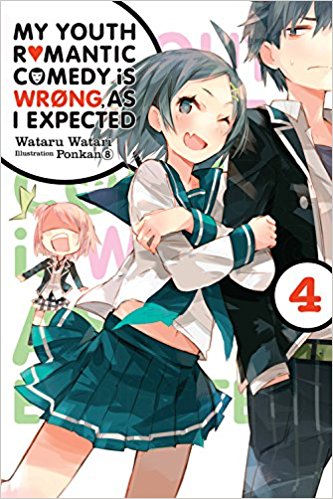
My Youth Romantic Comedy Is Wrong As I Expected, Vol. 4

By Wataru Watari and Ponkan 8. Released in Japan as “Yahari Ore no Seishun Rabukome wa Machigatte Iru” by Shogakukan. Released in North America by Yen On. Translated by Jennifer Ward.

I think I have to come to terms with the fact that the pacing of this series is going to be glacial at best. Much as I have been clamoring for a bit less isekai and a bit more real world in my light novels, I’m pretty sure that other slice of life books must have plots that move faster than the main one in OreGairu. That said, the author is clearly settling in for the long haul, and I’m not sure if I’m just used to him or if he was less appalling, but Hachiman was not nearly as punchable this time around. He’s still a cynic and misanthrope of the worst order, but his analysis of group dynamics, once unpacked from his own mindset, is very clever and not entirely wrong. He works best when paired off with Yukino, who is very similar to him though I think they’d both rather not admit that. As for Yui… I want to give her a hug and send her to a different series.

Despite Komachi starring on the cover, she’s more of a supporting character this time around. The premise, which is actually quite a good one, is that over summer break the teacher gets the Service Club and its auxiliaries, as well as the Cool Kids group, to help supervise an elementary school camping trip. While they’re there, they notice, as often happens with a class of students, that one girl is being shunned by all the others. Hachiman sees her attempts to power through it and be cool and uncaring as Yukino; Yukino sees her desire to be one of the gang but awkward failures as Yui; Yui just sees a sad young girl she wants to help. That said, the attempts to try to fix the group dynamics are somewhat terrible, and it’s only after Hachiman comes up with a clever but incredibly cruel plan that things are even vaguely helped. And even then you aren’t sure if it did any good.

We get a bit more development of Hayama and his group here, and see he has a past with Yukino that I think makes him a bit jealous of Hachiman. And yes, Saika is here as well and we get endless accounts of how attracted to him Hachiman is, which I’ve come to accept is simply never going to go away. But as always, the best reasons to read the book are the prose, particularly Hachiman’s twisted narration, which can be utterly hilarious, brutally on point, or just plain pathetic – sometimes all three at once. In particular, his strange desire to tell stories of his incredibly pathetic childhood, with only the occasional “this happened to someone else” attempt at a cover up, borders on the needy. But it’s what makes this series compulsively readable, and it’s another good, solid volume for this series. That said, the only major plot development happens on the last two pages. Perhaps that bodes well for the next book.