Yearly Archives: 2018

Made in Abyss, Vol. 1

By Akihito Tsukushi. Released in Japan by Takeshobo, serialized in the online magazine Manga Life Win +. Released in North America by Seven Seas. Translated by Beni Axia Conrad. Adapted by Jake Jung.

The idea of doing serious and sometimes dark and deadly plotlines with adorably cute characters is not new to manga – in fact, one might argue it’s been around since manga first began. The last few years, though, particularly since the advent of Puella Magi Madoka Magica, we’ve seen a number of series that deliberately want the dissonance to be part of the point, showing us young happy people and then having very bad things happen to them. In general in some prior reviews I’ve tended to be more annoyed at the plotline than the art style; I tend to like happy endings, as people know, and don’t like characters put through the ringer just for the sake of being mean. Fortunately, Made in Abyss is not that series. You can tell there’s a lot of care put into the basic concept of the world, and the darkness of the first volume is balanced out by the cheerfulness of the heroine.
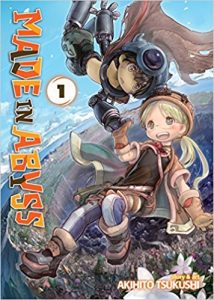
We are in a fantasy world that exists on the edge of a giant pit, wherein are treasures beyond compare but which is also super lethal, especially as you get further down. Our heroine is Riko, who delves to the shallowest depths of the pit with her fellow orphan children in order to be trained to be an actual adventurer and go deeper. She’s an orphan as both of her parents went into the pit and haven’t returned… that is, until the city gets a message from Riko’s mother. Most of the city chooses to treat this as confirmation of her death, since she was clearly in the “if you go to this level you will die” area. Riko, though, takes it as a sign that she needs to disregard the slow, filled-with-rules training and go down the pit to find her mother, accompanied by Reg, an amnesiac robot boy who wants to find out who he really is. The volume ends with their illegal descent.

Riko and Reg are the best reason to read the series. Riko is a great heroine, being impulsive and bratty but without tipping over into obnoxious, and she’s balanced well by the thoughtful, withdrawn Reg. You sense that her descent is clearly a bad idea and I have no doubt things will get much worse, but she’s the heroine and I want to root for her anyway. Also, the concept of the pit and the levels therein is quite well drawn, being overly complex without requiring the reader to actually remember all of it. If there’s one big drawback, it’s that this time around I *am* more annoyed at the art style than the plotline. I think the series might have worked better for me if the cast looked a bit more realistic and a bit less, well, Madoka Magica. It does not help that the artist at one point as a gag shows us Riko naked and strung up as “punishment” for rule breaking; it’s not as explicit as I feared, but please, do not show naked children in your fantasy adventures, PLEASE. Especially for the lulz.

Despite that, I will be trying another volume of this, mostly as I am very curious to see what happens next, and I hope Riko succeeds.

RWBY

By Shirow Miwa, based on the series created by Monty Oum. Released in Japan by Shueisha, serialized in the magazine Ultra Jump. Released in North America by Viz Media. Translated by Joe Yamazaki. Adapted by Jeremy Haun and Jason A. Hurley.

I have never actually seen the RWBY series, though I know of it via Tumblr osmosis. What I know can be summed up as a) there’s a team of fighting girls; b) two of them are super gay; c) OK probably not canonically but fandom thinks they’re super gay. That’s about it. So I was looking forward to seeing this series. It’s always interesting when Japan does a manga of a Western property, though in this case obviously RWBY has a certain anime style to begin with. The manga serves as a prequel to the series, showing off the four main characters, as well as another team that also works with them, as they protect the world from enemies while also attending what seems to be superhero school. I enjoyed it quite a bit, but I suspect that this may be more a book for newbies than the hardcore RWBY fan.

The girl on the cover is Ruby Rose, the R of the group, and she gets the first of what turns out to be an introductory story for each of the team. She’s essentially the standard Shonen Jump hero, only female. I like her, she’s very straightforward. Less straightforward are Weiss, who is fighting with the team despite the objections of her rich, upper-class family, who have other plans for her; Blake, who is a faunus, aka a catgirl, and who has a dark past and seems to have once been a terrorist; and Yang, Ruby’s sister, who likes to be a big sister type, punching things, and Blake, not necessarily in that order. The stories are not particularly deep – Weiss and Blake’s, being more serious, had greater impact for me – but they sketch out the personalities of the team pretty well.

The ending story tries to focus on one of the other teams in the series, Team JNPR, whose leader seems to have a crush on Weiss, and also an extreme case of self-doubt. Unfortunately, this is a one-volume title, so we don’t really get to know the rest of his team that well, but that’s what the series is for. Again, there’s nothing particularly surprising here – Jaune’s team leaves early to battle a monster so that he can prove how awesome he is, only to run into trouble and need to get bailed out by our heroines. We get a few cameos from people who are clearly also regular cast members (I liked the flying robot girl), as well as a hint of GREAT EVIL afoot that no doubt also will appear in the show rather than this manga.

As I said, this seems to serve more as an introduction to RWBY for those who haven’t seen it – fans may want to wait for the anthology series that Viz just licensed. It’s not great, but I felt it had a lot of style, just like the team it’s trying to show us. It made me curious about the series, which is probably all it was designed to do. Definitely worth a shot.

Paying to Win in a VRMMO, Vol. 6

By Blitz Kiva and Kuwashima Rein. Released in Japan as “VRMMO wo Kane no Chikara de Musou suru” by Hobby Japan. Released in North America digitally by J-Novel Club. Translated by Elizabeth Ellis.

One benefit of reading light novels on my phone rather than in print is that there’s less tendency for me to look back at the color pages. These pages, seen in most light novels, are basically a preview of the book, showing various exciting scenes in color to whet the appetite. When done well, they do just that, and show off the drama, excitement, or humor within. Sometimes, though, they can actually be major spoilers, revealing the surprise climax before you’ve even started the book. Fortunately, by the time I got to said climax, I’d forgotten that I’d already read it in the color page the day before. Which is good, as the climax is brilliant, showing off the protagonist at their best, in a magnificent display of everything we love about her. Yes, that’s right, her. Ichiro may be the one Paying to Win, but in the end Iris gets the cover of this final volume, and rightly so.

This volume picks up right where the last one left off, and certainly has a nice little starting point: Ichiro is arrested. Of course he’s not guilty, but the problem is that announcing the guilty party would be problematic for many different reasons. As such, after posting bail, he and Airi (who has rushed to see him at the station due to, well, sheer outrage, I think) set about trying to figure out a way to fix this. It gradually becomes clear that there’s no quick and easy way to do that, and that it looks as if Ichiro is going to have to break his own “rules” he’s set for himself in order to do so. But fortunately, the people he has met in the game over the past few months are here to help him, as are a few of his friends outside the game. And there’s always Airi/Iris and her use of her sharp tongue, though for once it’s not the words that are as effective as simply, wonderful violence.

Not to spoil but there was a scene in this volume that had me cheering out loud. I’ve made no bones in prior reviews about how much I did NOT want to see Ichiro and Iris as a romantic pairing, and I got my wish. Rosemary, the AI from the prior volumes, is asking various “rivals” how they feel about Ichiro, and Iris comments that she sees him as “an enemy”, someone to show up and surpass. She also notes she’s not attracted to him. I love this because I feel Iris’ character is so much better when she has this goal in mind. She’s never been a tsundere, much as the narrative might have occasionally tries to shoehorn it in. She’s just determination in one small package. (Actually, there may be more rivals out to defeat Ichiro than there are rivals for his love – Megumi may have lucked out there.) Pay2Win ended up with precisely zero romantic pairings over the course of the book, and that was very refreshing, especially for this genre.

Aside form Iris’ violence at the finale, I must admit my favorite moment in the book was the use of a popular meme. It was first seen as part of a montage of players discussing Ichiro and how they felt about him, and was a very amusing gag – there’s always that one player who wants to speak in meme. Then it shows up again later, and I felt “Oh, no, he ruined it by trying to use it again. Minus five points.” But its use as the big villain reveal at the end of the book left me with my jaw dropped, as suddenly I went “Oh my goooooood, of COURSE.” Honestly, I’ve felt that way throughout the last couple volumes of this series. It started off unevenly, and got better as it went along. J-Novel Club has better written light novels, but there are few that have genuinely entertained me as much as Paying to Win in a VRMMO. Can we get that “Irish Sniper” web-only side-story as an extra?