Monthly Archives: January 2019

I Saved Too Many Girls and Caused the Apocalypse, Vol. 11

By Namekojirushi and Nao Watanuki. Released in Japan as “Ore ga Heroine o Tasukesugite Sekai ga Little Mokushiroku!?” by Hobby Japan. Released in North America digitally by J-Novel Club. Translated by Mana Z.

By the end of this volume, we have five left to go before the series ends. It’s started to make me wonder what the endgame is actually going to be. Oh, I’m still convinced it will end with him not choosing anyone. But it has to be said, if he is going to choose one of the girls, it has to be someone the reader has a strong attachment to as well. And, well, First Girl Wins is not just a trope for nothing. Satsuki has an advantage that the other girls do not. She’s a childhood friend, she has magical wikipedia powers and is therefore involved in Rekka’s life rather than being kept in the dark. And she gets a big focus in this volume as well, as she and Rekka are accidentally sent to a deserted island for a while, where they can wax nostalgic, almost get eaten by a leopard, and come close (but not close enough) to a confession.
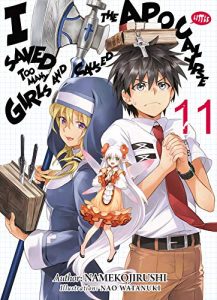
Satsuki is not on the cover, of course. The interesting thing, though, is that both girls on the cover, while heroines that Rekka “solves”, are not romantic heroines that we can see. Yulia is a nun who, like many Japanese nuns in fiction, is also an exorcist and a bit of a fanatic. Given she’s ended up in Rekka’s hometown, which is teeming with otherworldly inhabitants, particularly the vampire Rosalind, you can see why Yulia is flipping out a bit. In fact, dialing back her fanaticism is the point – she’s mistaking the Church’s vendetta for her own, and Rekka has an actual Angel to tell her “no, God says the Church is wrong”. (A very common thing in light novels lately.) As for Poppy the fairy, “staying hidden” and avoiding a group of kids trying to capture her is the sole goal she has. Compared to prior volumes, the stakes are very low key here.

Back to Satsuki, a surprise in this volume was that we not only see her parents, but get art showing what they look like. (In fact, the author wondered if there were enough interesting scenes for the artist, which may be why we see her parents as well as the kids harassing the fairy.) The other plot-heavy part of the book involves L, who has been abandoned by her villain friends and is on her own in the past, and essentially homeless till she gets picked up and adopted, for the moment, by Satsuki’s family. She’s still trying to kill Rekka technically, but it is interesting that whereas R is going for “hammer Rekka with as many heroines as possible to create a crisis point”, L is more “I am in one heroine’s corner”. And that heroine is Satsuki.

Will she win? Likely we won’t know till Book 16. Will R ever be seen? And of course the one question that absolutely has to wait for the last book: will Rekka get a clue that everyone is in love with him and do something about it other than change the subject? We do apparently get a girl in a top hat, though, so that’s nice. If you’ve been reading this, keep reading it. It’s fun froth.

Silver Spoon, Vol. 6

By Hiromu Arakawa. Released in Japan as “Gin no Saji” by Shogakukan, serialization ongoing in the magazine Weekly Shonen Sunday. Released in North America by Yen Press. Translated by Amanda Haley.

It’s going to be very hard to discuss this volume without talking about the final chapter that overshadows the rest of it, but I will do my best to save that for later. In the meantime, there is still festival prep, and horse races! The racing is a highlight of the book, mostly as, despite getting distracted by family, studies, and Mikage, Hachiken is finally learning how to ride. This is despite the fact that he almost falls off Chestnut 3/4 of the way through, creating a dramatic moment when everyone panics he’s going to fall and get trampled. But he survives, and ends up in fourth place! Which is interesting, because it’s really good for a newbie, but it still irritates him. He wants more. He’s getting competitive spirit. This is especially good news given that he’s fallen for Mikage, who gets third in her own race and actually agrees to go on a date with him during the festival (though she may not have realized that’s what it was).

It would be remiss of me not to mention Ayame, who is introduced in this volume and is FABULOUS, in all senses of the word. Trying her hardest to have wandered in from a Rose of Versailles manga, and consumed with an intense rivalry with Mikage (who merely sees her as a good childhood friend), Ayame is pure hilarity the moment she steps onto the page. She’s basically the “ohohohohohoho” laugh given human form. She rides slowly and perfectly through her race, not understanding or even really caring that she’d doing it wrong. And when Hachiken manages to get fourth in a race (and thus finish ahead of her), Ayame admits that she’s rivals with him as well. For all that I praise Silver Spoon for its depiction of agriculture and compelling characters, there’s also no doubt that Arakawa can make things incredibly funny.

…and then Hachiken collapses and is taken to hospital, right before the festival begins. Frankly, the astute reader should have guessed this was going to happen. He hasn’t been brought up on a farm, and he got goaded into taking charge of eighty different things. He was ridiculously exhausted, and now he’s paying. That doesn’t make this any less depressing, though. His look as he wakes up in the hospital is almost heartbreaking. And that cliffhanger, showing the arrival of his dad, promises that the next volume is not going to be starting with laughs either. Still, I like that we are shown the start of the festival anyway – the manga is not just Hachiken, and I’ll lay you even money that his incredibly detailed and easy to understand festival plan is going to be noticed by someone at some point (there’s even a shot of the notebook sitting there like Chekhov’s gun.)

So the festival looks to be a success, but will Hachiken get to see any of it? And will his dad demand he pull out of the school? Can his dad, in fact, find it in him to not be a complete dick this time? I cannot wait to find out, because Silver Spoon is still amazingly addicting.

The Asterisk War: Idol Showdown

By Yuu Miyazaki and okiura. Released in Japan by Media Factory. Released in North America by Yen On. Translated by Haydn Trowell.

I must admit, of all the minor characters introduced in the last book when Ayato toured the festivals, I was not expecting the comic relief idol band to be the most important. Yet here we are, with said band trying to shame Ayato for being a clueless harem protagonist, getting into fights with other, more delinquent contestants, discovering secret underground battle rings, and taking on our heroes in the final part of the book. Actually, possibly the most interesting part of their story is the fact that their weapon is so powerful, even divided into five bits, that it literally makes them more eccentric and difficult. They have weaponized being cloud cuckoolanders! They also put up a damn good fight, forcing Claudia to use a lot more of her precognitive powers than I think she wanted, which will no doubt come to haunt her in the end. That said, this is really Saya’s book. So I will save her for later.

But first, let’s stay with Claudia, who stuns everyone by announcing her goal in front of the press. This certainly unnerves many people in power, especially her mother, who it turns out if in charge of most everything. As you can imagine, Claudia and her mother do not get along, and yet their confrontation is a highlight of the book. It also seems to tie into what Sylvie is searching for – as does the aforementioned underground battle ring, which is shut down for now but I’ll bet you even money will be started up again in a few books so that Ayato and Julis can fight forbidden illegal battles. Much of the rest of the book is the start of this tournament, with various groups fighting and showing off their dangerous points. This includes Claudia’s team as well, usually with her as the ‘team captain’, though that changes for the final match of the book.

Which brings us to Saya, who gets a lot of focus here. She’s both the childhood friend love interest and the ‘stoic’ one, so brings a lot of popular cards to the table. Her stoicness masks a lot of emotion, though, both in her desire to be able to bring everything she can to the battles with her weapons (which works out wonderfully in the last battle with her homing bazooka thing), and in her desire to be closer to Ayato. She spends a lot of the middle of the book convincing the idol group girls that Ayato is not, in fact, a playboy (well, not deliberately) and explaining all the times he’s been there for her. Which seems to lead her to the big cliffhanger, where she confesses to him. Now, I have a feeling that Saya is aware of the cliches of harem novels like this, and knows that by both being a childhood friend *and* confessing first, she’s out of luck. Still, it’s super impressive, and I hope that Ayato is able to give her a response that’s not just hemming and hawing.

Asterisk War is still very light and fluffy, but this was a particularly strong volume of the series. If you only watched the anime to make fun of it, you might be surprised by this book.