Monthly Archives: January 2019

Kimagure Orange Road, Vol. 1

By Izumi Matsumoto. Released in Japan in three separate volumes by Shueisha, serialized in the magazine Weekly Shonen Jump. Released in North America by Digital Manga Publishing. Translated by Steven LeCroy.

It’s been an awfully long journey from “the anime is a big hit, the manga is sure to be licensed” to “why didn’t Viz license this back in the day?” to “yay, DMP is Kickstartering the entire series!” to “will this be released before DMP dies?”. But here we are at last, and all six omnibuses of the legendary Kimagure Orange Road are now in my hot little hands. They look nice – good paper stock, solid covers. You can tell the KS money went into printing them. The question is who the audience is. Chances are that anyone who ponied up the considerable cash to get six print omnibuses of the entire series is already going to be a KOR fan. You aren’t getting casual readers. If a casual reader did get the series (there are PDF copies of the omnibuses on sale at emanga), they might be startled by how ordinary it all seems. But that’s typical with manga that sets the trend and then is quickly surpassed by those who come after it.
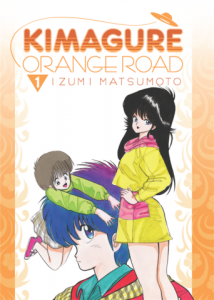
For those unfamiliar (and given that the heyday of North American fandom was around twenty-five years ago, I think that’s most of you), the premise of Kimagure Orange Road has a family moving to a new neighborhood. The father is fairly normal. But his children, Kyosuke, Manami, and Kurumi… are psychics! Just like their late mother. (Yes, sorry, Hard-KOR fans, esper is not used here.) They move a lot because the kids, being young and impetuous, abuse their powers and are caught. Kyosuke is really trying to not do that and fit in at his new school. Then he sees two girls smoking behind the school… cool, aloof Madoka and outgoing, impetuous Hikaru. He’s met Madoka before, running up a stairway with either 99 or 100 steps, depending on who you agree with. But she seems totally different now, and doesn’t want to give him the time of day! Kyosuke promptly falls for her… and Hikaru falls for him. But what of Madoka, this whimsical girl?

“Kimagure” can be translated as “whimsical”, and it certainly applies to Madoka, who runs hot or cold depending on the situation. She clearly likes Kyosuke immediately but she also sees Hikaru likes him too, and that he’s not doing a good job of telling Hikaru he’s not interested. Plus he tends to be a jerk some of the time, saying things like “if you smoke, you won’t have healthy babies”. (Note the two reactions: Madoka blushes at the thought of doing things that make you have babies, Hikaru gets mad and says “I’ll show you! Imma have ALL the babies!”) The series plays out like a classic shonen romantic comedy – in fact, it is *the* classic shonen romantic comedy. That said, it’s also steeped in what was big in 80s manga, as Kyosuke does use his powers quite a bit – if you’re wondering what specific powers, well, it tends to vary depending on the need of the plot, but includes teleportation, telekenesis and mind reading. You can see why their dad is worried about his kids.

I mentioned that North America had a big KOR fandom back in the day, but that’s not quite true. The fandom was for Madoka. The rest of the anime and cast was secondary. Most modern manga tries to keep the love triangle at least a little balanced, but Matsumoto is not really interested in that. We *know* Kyosuke and Madoka are the couple, the question is how long it will take. The answer is there’s five more of these 600-page omnibuses to go. As for Hikaru, fans these days are more sympathetic to her than they were back in the 1990s, where she was the very first “bashed” anime character – even before Akane in Ranma 1/2! Given that, in the manga at least (the anime is another story) she is unaware of Kyosuke and Madoka’s feelings for each other, her forwardness is a lot more understandable. Still, looking back on the series now, I must admit: things would be solved a lot faster if Kyosuke mustered a backbone.

If you want to see shonen romance as your parents read it, you really can’t get a more perfect choice than KOR, which is pure 1980s Japan, even down to the discos – and the amusement park called Cougar Town. Recommended.
The Devil Is a Part-Timer!, Vol. 12

By Satoshi Wagahara and 029. Released in Japan by ASCII Mediaworks. Released in North America by Yen Press. Translated by Kevin Gifford.

This is a stronger volume of Devil Is a Part-Timer! than the previous one, probably because the previous one got all the exposition out of its system in one gulp. Actually, the theme of this new volume could be avoiding exposition, as both Emilia and Maou do their absolute best to not talk to Laila and avoiding knowing why it is they’re the only ones who can save the world this time. In practice, this means this is a “downtime’ volume, though there is an exciting battle in a subway tunnel in the middle of the book. For the most part, though, Emi is still shattered by the last book, to the point where she runs away to a minor character’s home for college advice. Maou is just trying to get the new delivery program at MgRonald’s in gear. And Chiho should be pleased that Emi and Maou are finally acting closer, but this is offset by her realizing that she’s in a shonen love triangle where she’s the sweet girl who doesn’t get the guy but finds new confidence so that’s OK. Which does not sit well with her.

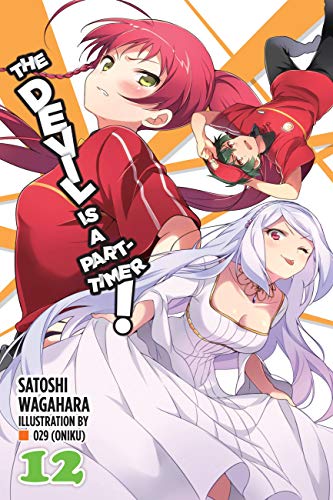
That’s Laila on the cover, but I get the feeling it’s meant to be what Emi and Maou think she’s doing in this book, rather than her real personality. Laila is genuinely trying to save the world, but seems to be making a lot of incorrect assumptions as well, not least of which is “this is for a good cause so my daughter who I have been manipulating her entire life and the boy I helped before he was a demon king will totally be into it”. But sometimes world-saving is goddamn exhausting, and after getting kidnapped/rescued and learning some nasty truths about heaven and Enta Isla, neither Emi or Maou really wants to deal with it right now. Probably the best scene in the book (and the author knows it, as the other characters praise him for it as well) is Maou talking about assuming that the strongest person will always be there to protect and save. If you have something made of steel, does that mean it’s OK to beat the crap out of it?

There’s also the romantic dynamics here. This series has been pretty good at keeping the romance there but on a low boil. Chiho has confessed to Maou (though he’s pretty much ignored that) and everyone can see how she feels. Suzuno is starting to realize that she may have feelings for Maou, though is very reluctant to admit it. And Emi, while not quite admitting that she’s in love with Maou yet, is willing to admit that she sometimes wants to be protected, and is OK if the person doing it is him. She even hugs him! (He does not hug her back. Maou still seems to be baffled by the concept of loving and being attracted to someone.) Unfortunately, both this and the main plot collide at the end, as due to a deal made between Maou and Laila, Emi is now refusing to leave his side, much to everyone’s horror.

That said, she can’t keep running from her problems forever. I suspect the next volume will have more details on how we’re going to save the world next. But for now, enjoy Maou reminding folks that heroes and villains need downtime too.

The Quintessential Quintuplets, Vol. 1

By Negi Haruba. Released in Japan by Kodansha, serialization ongoing in the magazine Weekly Shonen Magazine. Released in North America by Kodansha Comics. Translated by Steven LeCroy.

Deserved or not, it has to be said that sometimes Kodansha in Japan has a certain reputation for making series that are very similar to series published by other publishers. The most obvious example is Fairy Tail, which is “Kodansha’s One Piece”, but there are a few others. So when Shueisha started releasing a series in Weekly Shonen Jump about a poor high school student who is blackmailed into tutoring a bunch of eccentric, mistrusting but gorgeous young women (We Never Learn), I raised an eyebrow when I saw that Shonen Magazine, precisely six months later, has debuted this title, in which a poor high school student who is blackmailed into tutoring a bunch of eccentric, mistrusting but gorgeous young women. (It’s also not hard to think of Araragi from the Monogatari series when looking at Futaro, and I think the author was on the short list of manga artists considered for that adaptation.) That said, unoriginal does not equal bad, and I found the first volume of this series enjoyable enough, though these girls are VERY mistrusting.

Futaro is our hero, a somewhat misanthropic young man who gets excellent grades but has a “loner” personality. His family is in debt, which may explain why he’s so gloomy, though his bubbly younger sister seems fine with it. He’s told that he can get his family out of debt by tutoring some girls, all of whom with grade issues, from his school. Imagine his surprise when he finds that one of them is the new transfer student he met the previous day. In fact, all these girls seem familiar… that’s right, they’re quintuplets, all in the same school, having left their previous school for low grades. And they are all pretty low. How he has to figure out a way to teach them so they retain it, while also dealing with the fact that they’re either unmotivated, airheaded, stubborn, or just plain malicious. Is there any way he can do this?

Well, we know the answer to that one right away – the manga debuts with a flashforward to the wedding of Futaro and…. one of the quintuplets. They look very alike, and sometimes try to “switch” to another sibling to fool Futaro, so there’s no guarantee that it’s Itsuki he’s marrying simply because she’s the first one that he meets. (That said, this is a shonen romantic comedy, where “first girl wins” holds quite a lot of weight.) Actually, the bulk of the character development in this first book goes to Miku, the middle sister, who’s the “quiet one” of the siblings and also has an obsession with the Warring States period. This allows Futaro to figure out a way to tutor her, and they bond a bit. Others may prove harder. Futaro getting literally drugged into unconsciousness by Nino, the angriest of the five sisters, was going a bit too far for me.

If you like reading shonen romantic comedies and arguing about who is “best girl”, well, we have five siblings who look a lot alike but have differing personalities, so you should have a lot of fun here. That said, this seems like the sort of series that gets better in future volumes. This was an okay start, but only okay. It has several more volumes out digitally, though, and is getting an anime soon.