Monthly Archives: March 2019

In Another World with My Smartphone, Vol. 13

By Patora Fuyuhara and Eiji Usatsuka. Released in Japan as “Isekai wa Smartphone to Tomo ni” by Hobby Japan. Released in North America digitally by J-Novel Club. Translated by Andrew Hodgson.

Smartphone continues to be a series with two very different types of interlocking plots. The first is the “main” plot, showing Touya battling the Phrase, deducing what’s actually going on in this world, and traveling to other worlds and having adventures. The second is Touya basically wandering around, goofing off, and leisurely talking with everyone in his kingdom. The problem is that the author is very good at the second thing but consistently falls down on the first. Oh, the Phrase battle was pretty good, except for one consequence which I’ll get to later. But when Touya comes back to the Reverse World, he promptly runs into a villain. Stop me if this surprises you… the villain is insane to the point of mad laughter, gleefully kills tons of innocents, and is also a bit of a sexual deviant. Touya learns that her personality might be degraded due to the golem she’s contracted with… but then undercuts it by saying “no, I think she’s like that anyway” so as not to upset readers with that fetish. Guh.

Sorry to say that despite the cover we do not get to see Touya and his fiancees racing early 20th century cars around the kingdom here. The majority of the book is supposed to be the Festival that Touya set up last time, and we do get to see the front end. It’s pretty fun, with baseball tournaments, shogi tournaments, lots of shops, lots of food. Touya gets to walk around with a fiancee or two, chat, and just be his usual bland self. It’s refreshing, and it makes it more entertaining when he has to actually try hard NOT to be his bland self. The best joke in the book has him walking with Hilde, one of his more insecure fiancees, and having to reassure her that he loves her by saying it out loud. This gets back to the others… and he now has to say it to all of them, something which causes him to nearly break down in embarrassment. It’s really cute.

Unfortunately, despite setting up for an entire festival (and even bringing God down from Heaven), the Phrase show up somewhere in the smoking remains of not-China and Touya and his mecha army have to go take them out. The plot here is actually interesting. The Phrase seem to be having a civil war, with Phrase that have been infected by the evil God killing the non-infected Phrases in a way that reminds me of the old Dalek civil war in Doctor Who. We also see the return of Gila, the arrogant Phrase construct who looked to be a reoccurring villain… till Touya killed him here, cutting that off pretty rapidly. Touya also has to use God powers to do it, meaning afterwards he falls unconscious… and we miss the entire rest of the festival as a result. This really irritated me, especially as Touya rattled off all the stuff that happened in a couple of paragraphs.

So, cute but also frustrating, bad villains but good fiancees and a bland hero who is at his best (and worst) when he tries not to be bland. In other words, typical Smartphone.
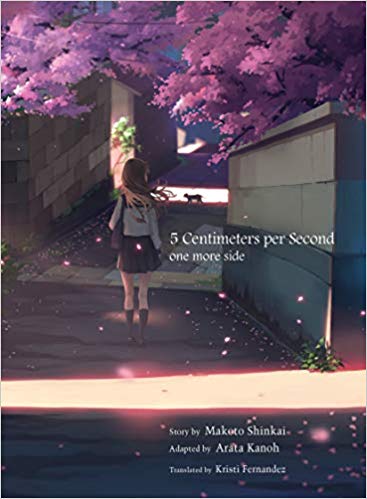
5 Centimeters per Second: one more side

By Makoto Shinkai and Arata Kanoh. Released in Japan by Enterbrain. Released in North America by Vertical, Inc. Translated by Kristi Fernandez.

(This review is based on a review copy provided by the publisher)

I hadn’t initially planned to review this, mostly as I’ve never seen the 5 Centimeters per Second movie, and if I read the manga it was so long ago I’ve forgotten it. But I’m familiar with the author from the your name spinoff he wrote, which I enjoyed, and he also has a Voices of a Distant Star novel coming out over here this summer. So I gave it a try, and I’m glad I did. I knew going in from the start that the overall mood of the book would be ‘wistful verging on bleak’, of course. This is Makoto Shinkai we’re talking about, the creator who surprised everyone by NOT giving your name a bittersweet ending. 5 Centimeters per Second tells the story of a boy, Takaki, and a girl, Akari, who meet as kids, fall in love, separate, try to stay in touch, meet one more time in an ultra romantic scene… and then never meet again. This book tells the story from different perspectives.

I’ll be honest here, I liked Akari a lot more than I liked Takaki. This is deliberate, I suspect. It’s one reason why I think my favorite part of the book was the start, showing us Akari’s perspective of life as a shy, introverted child who had to transfer schools. Her emotions are raw, and mention is made of wanting to “disappear” but not actually having the wherewithal to kill herself, which is really bleak given she’s about nine. Transferring schools is a lot more common in Japan than it is in the West, and the lessons given here on how to fit in – and how hard it is – read very true. Takaki is at his best here, helping Akari with some sound advice and an ear to lend, but even at this age we can see how he tends to withdraw from her when things get too close.

The second part of the book is Takaki’s, showing his middle school life after he moves down South to Tanegashima. He meets a nice girl who falls for him hard, and he clearly likes her, but is also deliberately not doing anything. This compares nicely to the third part of the book, which has interlocking POVs, where he meets a nice woman as an adult who falls for him hard and he clearly likes her but is also deliberately not doing anything. Takaki seems trapped in that one moment he had with Akari at the station when they were thirteen (twelve? Around there), and it’s only at the very, very end of the book that he seems to grow past it. Akari, on the other hand, blossoms into a confident, happy young woman, marries a nice guy, and has a wonderful life. Seeing this made the ending less bittersweet than I’d expected. Sure, young love didn’t work out. That happens all the time. But, helped by Takaki’s advice as a child, Akari has become a wonderful young woman.

I’m not sure how this complements the movie, but I’m pretty sure fans of it will want to pick this up. The prose is gorgeous and evocative, worth the price of the book alone. I’ll definitely want to get more of this author’s take on Shinkai’s works.

Captain Harlock: The Classic Collection, Vol. 3

By Leiji Matsumoto. Released in Japan as “Uchuu Kaizoku Captain Harlock” by Akita Shoten, serialized in the magazine Play Comic. Released in North America by Seven Seas. Translated by Zack Davisson. Adapted by Snati Whitesides.

In many respects this is Daiba’s story more than Harlock’s, and we’ve been following his journey and not really going back to show how Harlock got started, got the crew together, etc. That said, just because we started with Daiba doesn’t mean we get a satisfying ending for him – or anyone. A lot of Matsumoto series, I’ve found, tend to best be described as “a cutout of a larger, more epic tale”, even when they’re being epic tales themselves. And so this volume wraps up with not much having changed, except that we’ve possibly found the Mazon are more similar to humanity than anyone expected – except, of course, the reader. The Arcadia, with its main cast all intact, set sail to further adventures and battles, which we, as a reader will not see, because Matsumoto wrapped up the manga at this point, probably so he could concentrate more on Galaxy Express 999.

A lot of the back half of this volume is concerned with the life and death of Tochiro, who frequently appears posthumously in the Harlockverse (he was in Queen Emeraldas as well) but rarely shows up in the flesh. His death looms over everyone, and is handled with such reverence and dignity that when a rogue Mazon tries to attack Arcadia while they’re at his gravesite, the Queen literally throws her off the ship, where she falls to her death, because let’s face it, these are pirate ships more than spaceships. It’s a bit ridiculous, but fits with the overall mood of the book, which is brooding, somber, and oh so serious. Aside from the occasional stab at humor, such as everyone’s collections falling over in a battle, or Kei getting fall down drunk at one point, the laughs of the last two books are mostly gone. (There is a short Harlock/Emeraldas story added after the main events here, which is meant to show them as almost Rule 63 versions of each other. I didn’t enjoy it much, but it DOES have humor.)

As for Daiba, well, he’s trying hard to grow and learn everything as fast as possible, and that’s not going very well, though he is rather clever. Harlock seems to be grooming him as a sort of heir at times. He also helps to discover the Mazon’s involvement with the Ancient Pyramids, as the Wagnerian myth takes a slight detour and also shows off the Mazon as sort of dandelion spores that will gradually infect everything in the galaxy. Not the world’s most original plot, but that’s fine, as you’re reading a story about space pirates, so originality is not why you’re here. The dialogue continues to be ripe, even with the seriousness, and I think it may actually work even better if you read it aloud in a stentorian voice, sort of like William Daniels as Captain Harlock.

The modern-day reboot of the series, Dimensional Voyage, is still going strong, and adding a bit more depth and characterization that isn’t in this original. But if you want the definitive mood for Harlock, it’s hard to beat this three-volume set, which is dramatic and stentorian to the last. A classic slice of manga history.